


10 Landing Page Builders Purpose-Built for Marketers Who Buy Traffic
10 landing page builders for marketers in 2026, ranked by A/B testing, DTR, CRM integration, and page speed. Includes comparison table and buyer's guide.
Updated 17 min read


10 landing page builders for marketers in 2026, ranked by A/B testing, DTR, CRM integration, and page speed. Includes comparison table and buyer's guide.
Unbounce, Instapage, and Leadpages lead the category for marketers running paid campaigns. Unbounce wins on Smart Traffic AI routing and Dynamic Text Replacement. Instapage wins for enterprise teams needing AdMap and real-time collaboration.
Leadpages wins for SMBs with no visitor caps and accessible A/B testing. Below, 10 builders ranked by the criteria that matter for paid traffic: conversion optimization, not template count.
Ordered by overall fit for conversion-focused marketing, with conversion-specialist tools first, then niche alternatives for specific use cases.
Generic landing page roundups miss the marketer-specific criteria. Here is what separates a real marketer's tool from a general website builder:
Builder | Best For | Key Features | Pricing | Free Plan | Platforms |
|---|---|---|---|---|---|
Paid traffic teams | Smart Traffic AI, DTR, popups | No | Web | ||
Enterprise ad campaigns | AdMap, AI Collections, collaboration | $79/mo (annual) | No | Web | |
SMBs, solopreneurs | No visitor caps, Optimization Score, Lead Meter | No | Web | ||
Mobile-first campaigns | AMP, Smart Pages, unlimited pages | No | Web | ||
Agencies, high volume | Lunar AI, 400+ templates, subaccounts | No | Web | ||
HubSpot ecosystem | Native CRM sync, A/B testing at $15/mo | Free | Yes | Web | |
Email-first marketers | A/B testing at $10/mo, AI generator | Free | Yes | Web | |
Design-led teams | Full CSS control, AI, AEO tools | Yes | Web | ||
Brand campaigns | AI design, A/B add-on, stunning output | Yes | Web | ||
WordPress agencies | 200+ widgets, shared templates, native WP | No | WordPress |
10 landing page builders for marketers compared at a glance
Best for paid traffic teams and PPC agencies with serious A/B testing volume
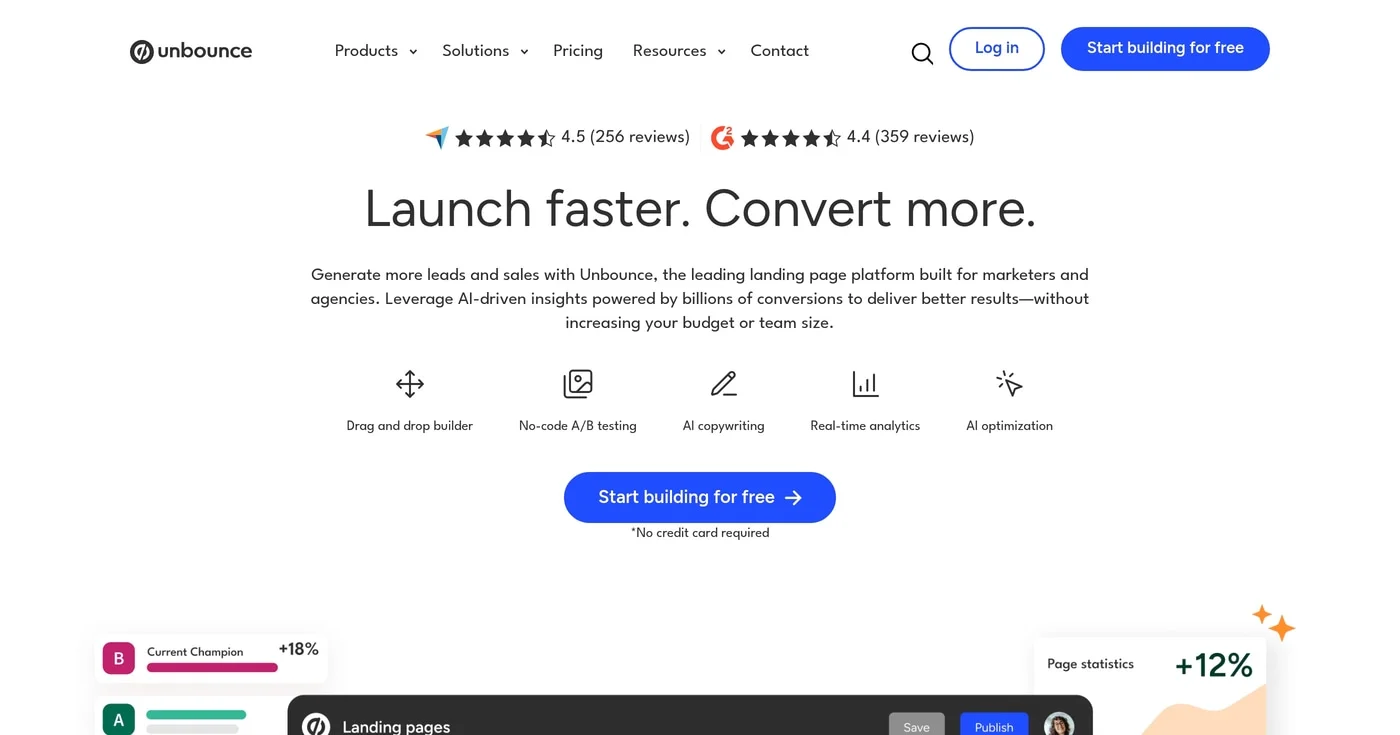
Unbounce is the conversion-specialist that r/PPC keeps coming back to, specifically because of two features no competitor matches: Dynamic Text Replacement and Smart Traffic. DTR automatically inserts the visitor's search keyword into your landing page headline, boosting Google Ads Quality Score. Smart Traffic routes each individual visitor to their highest-converting page variant using visitor attributes like device, location, and referral source, and it starts working from just 50 visits.
That second feature solves the A/B testing problem most SMBs face: statistical significance requires 50+ conversions per variant per month, and most accounts never get there. Smart Traffic bypasses that threshold entirely. Unbounce is the only tool in the category with multi-variant optimization for accounts running under 50 monthly conversions per variant.
On the downside, Unbounce's GTM and GA4 integration is non-trivial. Multiple r/PPC practitioners warn that its subdomain setup creates cross-domain attribution gaps, and combining it with GA4 tracking can produce duplicate conversion events without an intentional fix. As u/QuantumWolf99 in r/PPC puts it: "At £500-1k/month ad spend for a plumber, you won't hit statistical significance on A/B tests anyway." Unbounce's setup complexity is worthwhile only when monthly spend justifies the volume.
All plans include unlimited landing pages. Smart Traffic is exclusively on the Optimize plan. Dynamic Text Replacement requires the Experiment plan or higher.
Best for enterprise teams running 1:1 ad-to-page personalization at scale
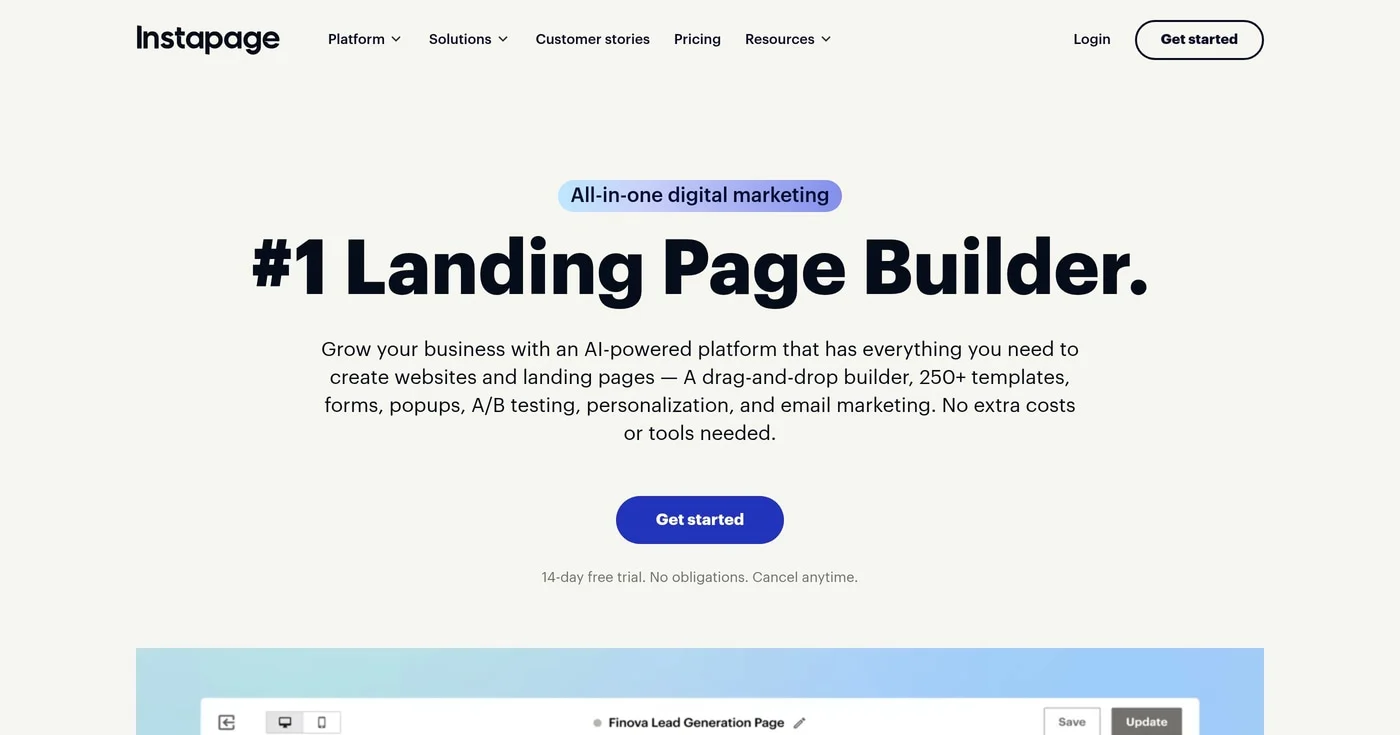
Instapage's AdMap is the feature that sets it apart at the enterprise level. You visually map individual ads to dedicated landing pages, so every ad group in a large PPC campaign connects to a page with precisely matched copy. For teams running hundreds of ad variations, this is the difference between message match and message chaos.
In February 2026, Instapage launched AI Collections, which generates hundreds of personalized page variants from a single template and a content spreadsheet. In March 2026, it added AI schema markup, automatically generating structured data to improve discoverability in ChatGPT, Perplexity, and Google SGE: the first landing page builder to address answer-engine optimization directly.
Real-time visual collaboration (on-page commenting, approval workflows, simultaneous editing) makes Instapage the only tool in the category built for team-based campaign production. Its Thor Render Engine delivers sub-200ms page loads; its heatmaps show exactly where users drop off per variant.
The entry price is the main constraint: the Create plan starts at $79/mo annual with a 15,000 visitor/mo cap. Every CRO feature you actually want (A/B testing and heatmaps) requires the Optimize plan at $159/mo annual.
Best for SMBs and solopreneurs who need accessible A/B testing with no visitor caps
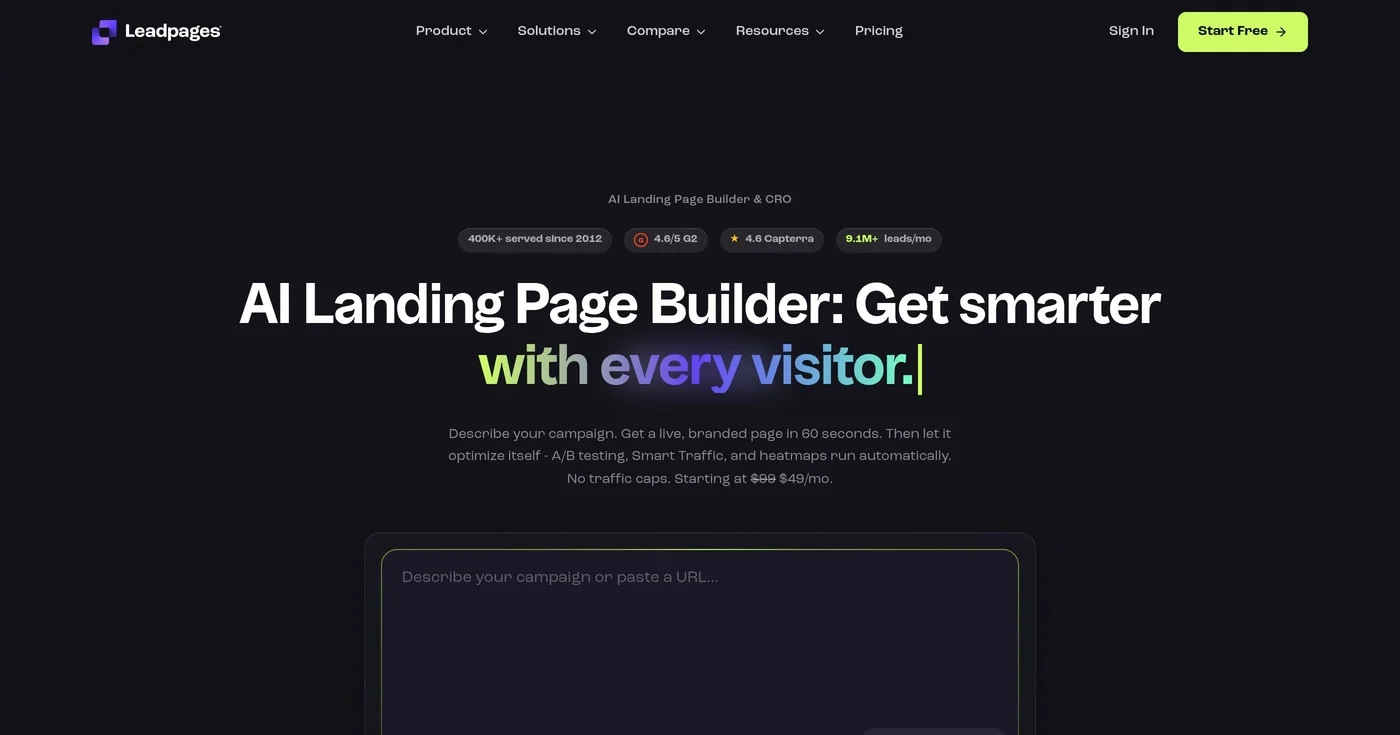
Leadpages is the SMB default in this category because it removes the two biggest growth constraints: visitor caps and a high A/B testing entry price. 400K+ businesses have used it since 2012, generating more than 9.1M leads per month. You get unlimited traffic on the Grow plan and above, and A/B testing starts at $99/mo on the Grow plan.
The Optimization Score, launched in June 2026, is the feature that genuinely differentiates it. Before running an ad, Leadpages grades your page from A to F across seven criteria: CTA clarity, form friction, value proposition, mobile speed, social proof, message match, and answer-engine readiness.
As Leadpages noted on LinkedIn: "Most marketers spend money on traffic before fixing the page." The Optimization Score is a pre-ad-launch gate that catches fixable conversion killers before you pay for clicks.
AdBuilder, also launched in 2026, reads your page URL and generates consistent ad sets for Facebook, Instagram, Google Display, and LinkedIn: the reverse direction from the usual workflow. The Lead Meter predicts conversion potential before you publish.
The MCP connector (2026) lets AI agents like Claude or ChatGPT publish Leadpages directly, a meaningful workflow accelerator for teams that build pages from AI-generated briefs.
A/B testing and unlimited traffic start with the Grow plan.
Best for mobile-first paid social campaigns where page speed directly impacts cost per click
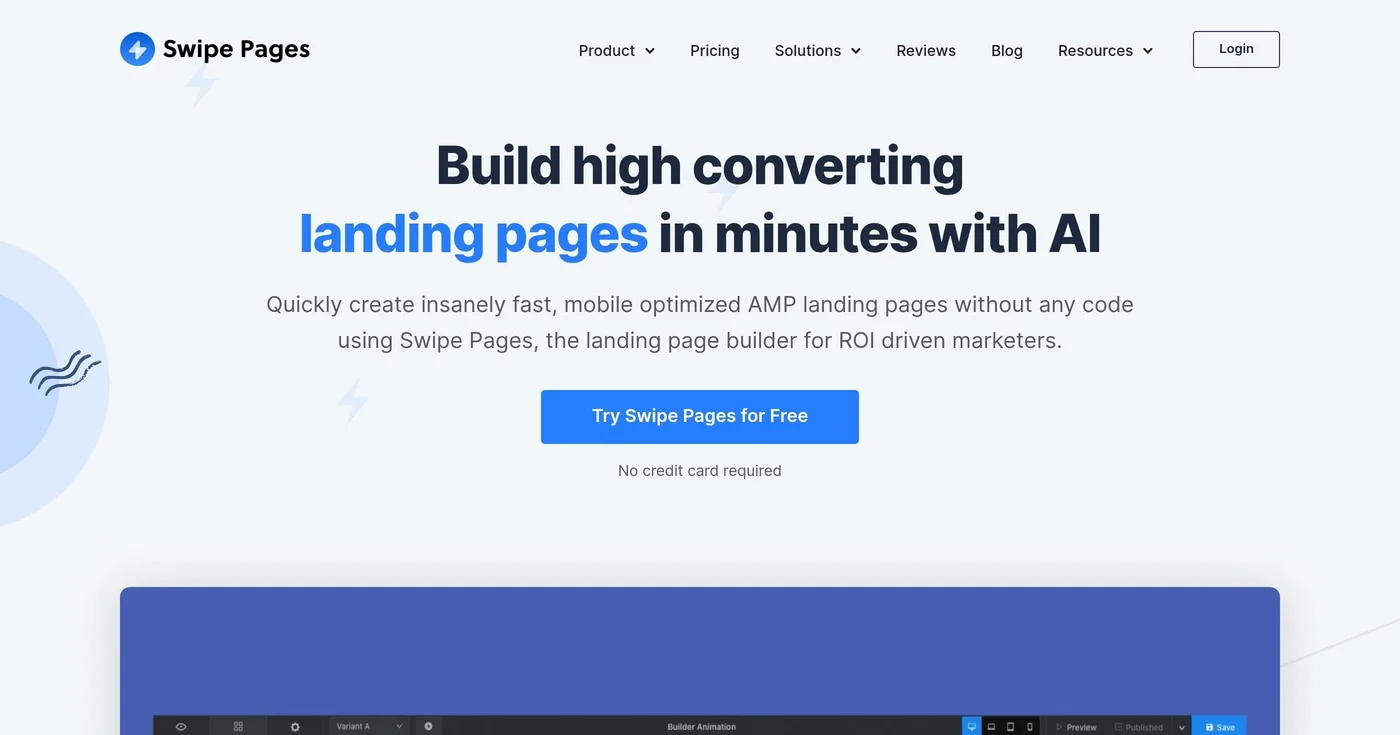
53% of mobile visitors leave a page that takes more than 3 seconds to load, and Google Ads charges you for every one of them. Slow pages don't just hurt conversions: they depress your Quality Score and raise your cost per click. Swipe Pages is the only dedicated landing page builder that addresses this with AMP (Accelerated Mobile Pages), delivering sub-second mobile loads via Google's own certified technology.
Smart Pages takes this further: when a mobile visitor arrives from a paid social campaign, they see a swipe-based, app-like experience rather than a scrolling page. For traffic from Meta or TikTok, where users expect mobile-native interactions, this measurably increases engagement.
Swipe Pages also removes the per-conversion pricing that makes most tools expensive at scale: unlimited landing pages and unlimited conversions on every plan. Its 30-speed-optimization stack includes image compression, code minification, CDN hosting, and render-blocking elimination.
Matt from Tradesman Digital Marketing benchmarks this directly: "Websites normally convert anywhere from 0 to 10%. Landing pages convert anywhere from 20 to 40%" and that gap only materializes if the page actually loads.
Best for agencies building high volumes of pages across multiple clients
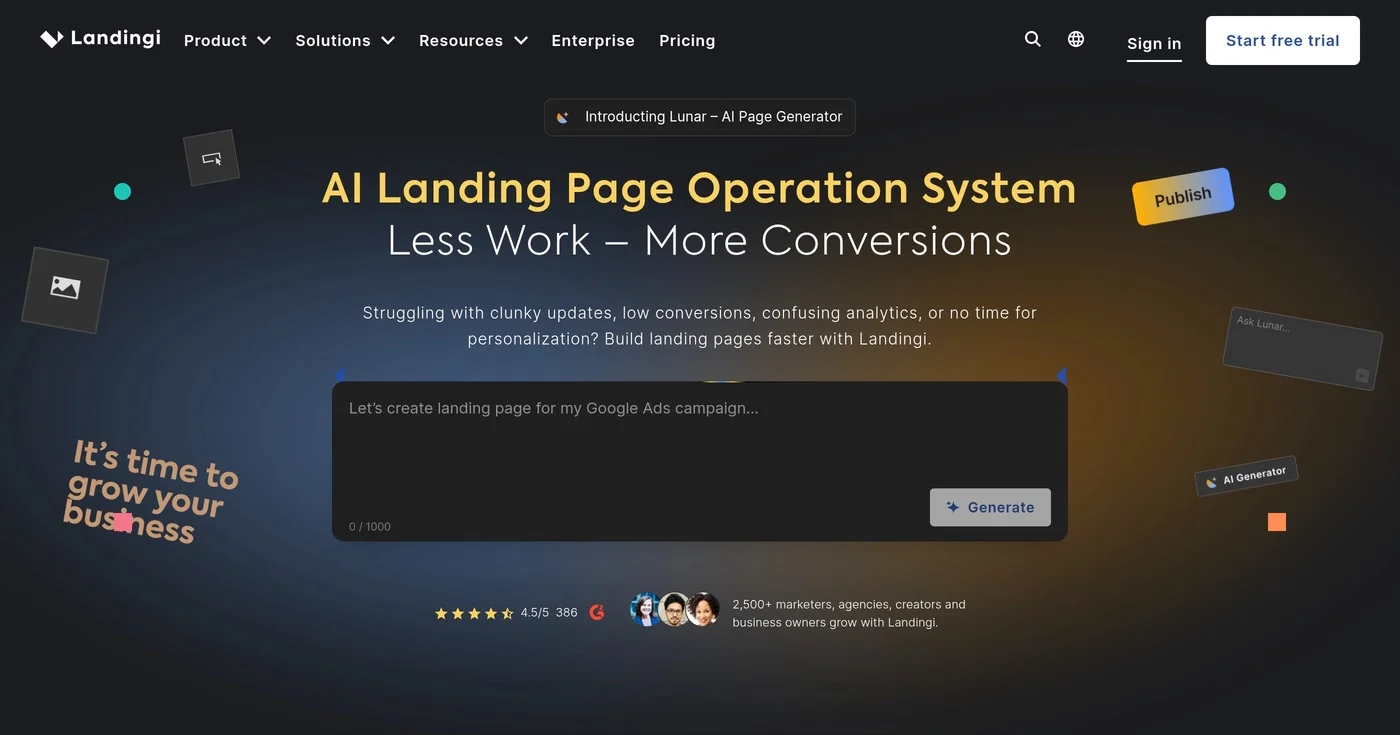
Landingi offers 400+ templates, more than any other tool in this roundup. The Lunar AI page generator builds pages from chat prompts, and Solis AI provides automated conversion recommendations based on page performance data.
For agencies managing multiple clients, Landingi supports client subaccounts and shared template libraries, keeping deliverables consistent without redundant work. Its template depth and AI-assisted generation make rapid page production practical at scale.
The entry plan is its main limitation: the Build plan at $24/mo allows only 2,000 visits/mo: not enough for any active paid campaign. A/B testing and meaningful visitor volume require the Optimize plan at $119/mo.
Best for B2B teams already running on the HubSpot CRM
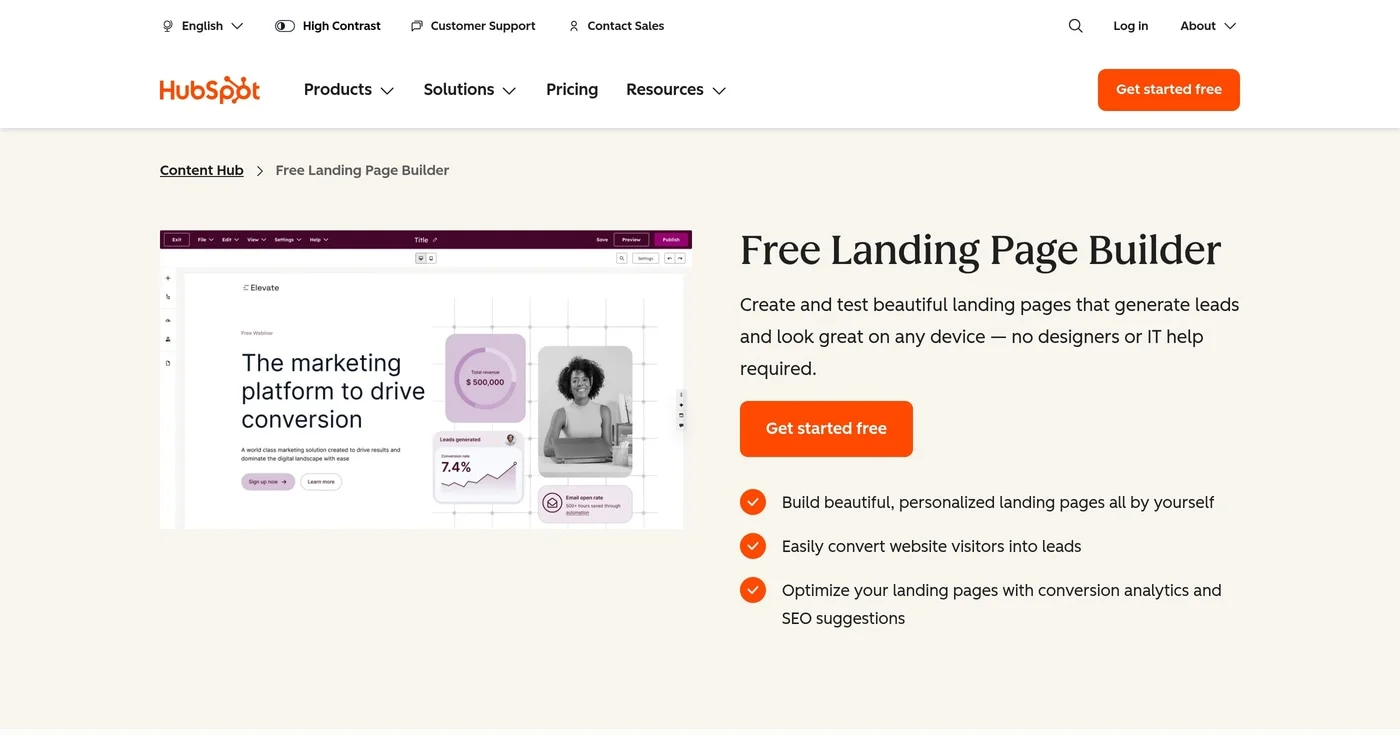
HubSpot Landing Pages earns its place by removing every integration headache between landing page form fills and your CRM. Every lead captured goes directly into HubSpot's CRM, with full contact history, campaign attribution, and lead scoring applied automatically. No webhook to configure, no Zapier zap to maintain.
At the free tier, you get landing pages with HubSpot branding. At $15/mo Starter, branding is removed and A/B testing unlocks, giving you the lowest A/B testing price in this category (tied with MailerLite). HubSpot's 2026 AEO add-on ($50/mo) also shows how your brand appears in ChatGPT, Gemini, and Perplexity, and provides recommendations for improving that visibility.
The price jump is steep: personalization and advanced reporting require the Professional plan at $800/mo. As a standalone landing page tool, HubSpot is not competitive. As the landing-page layer inside a full HubSpot marketing stack, it is the simplest option by a wide margin.
Best for email marketers who want landing pages and email automation in one platform
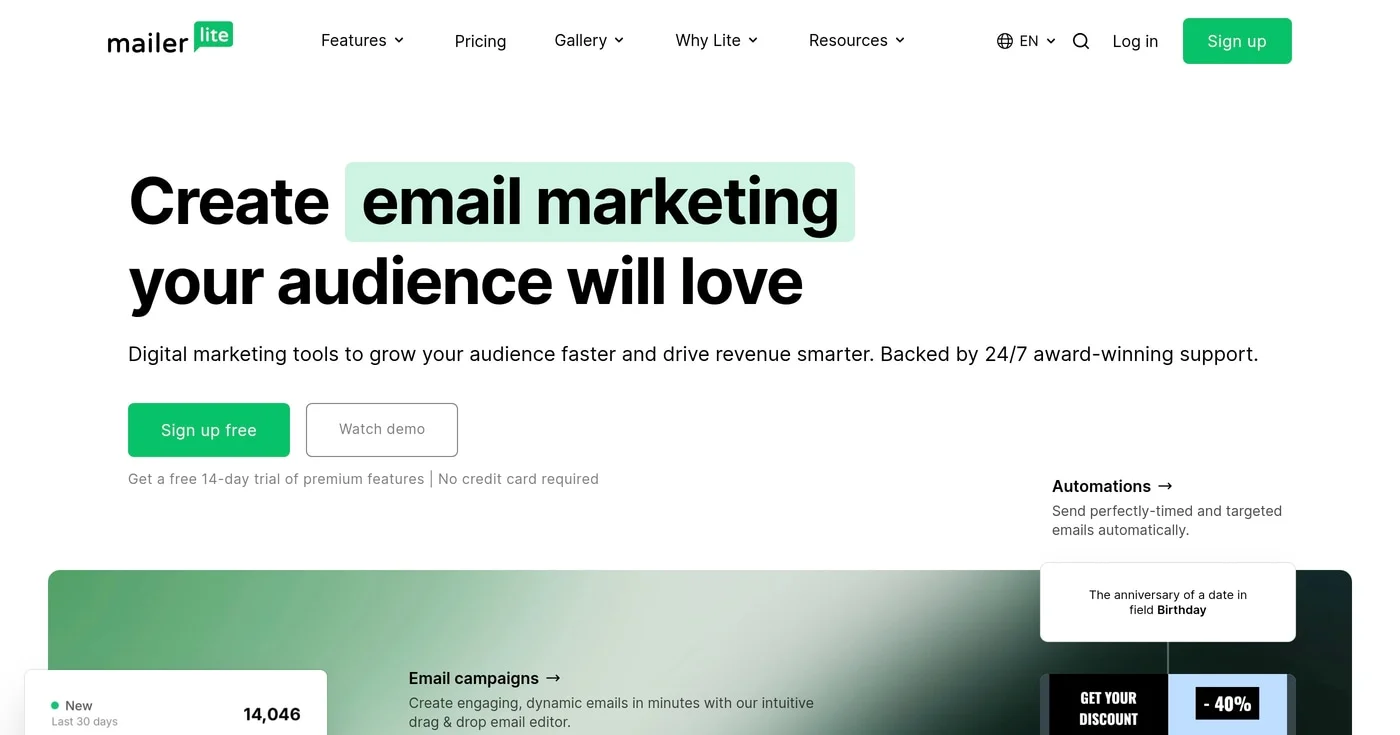
MailerLite's best argument is price. Its landing page product includes A/B testing at $10/mo, the cheapest in the category.
The AI landing page generator accepts a goal description and returns three layout options in brand colors. Landing pages connect directly to email automation without a third-party sync.
It is not a paid traffic specialist. You won't find Dynamic Text Replacement, visitor-routing AI, or heatmaps. For marketers whose primary channel is email and who want a simple, branded destination page for their list-building campaigns, MailerLite is the clearest choice on price and simplicity.
For anyone running Google Ads or paid social at volume, Unbounce, Instapage, or Swipe Pages give you the conversion tooling this platform doesn't.
Best for design-led marketing teams who need full control over layout and code
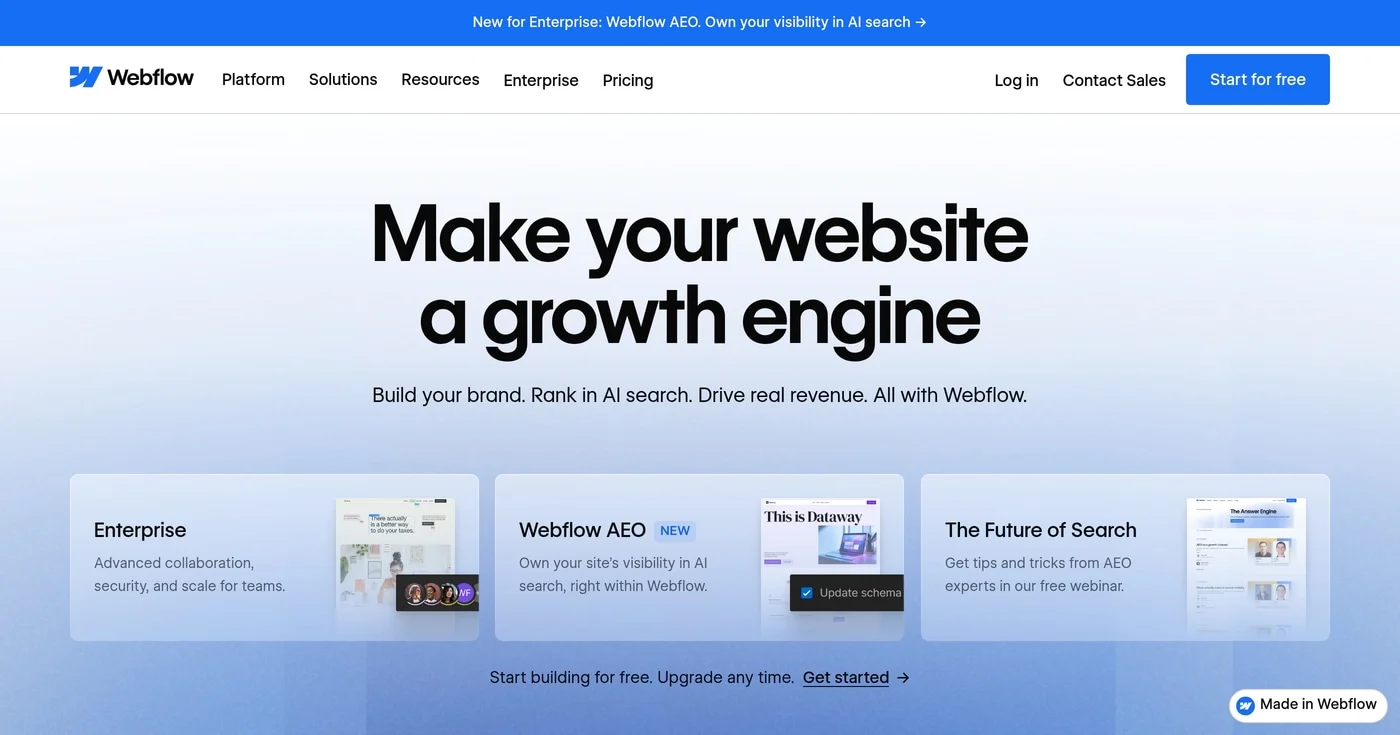
Webflow gives you the highest design ceiling in this category. Full CSS and HTML access, responsive layout controls, and Webflow's 2026 MCP server connector (which lets AI agents publish directly to Webflow) come standard. Its AEO optimization tools (Team plan) help you structure content for AI search discoverability.
The conversion trade-off is real. Webflow has no native A/B testing (you need a third-party tool like Optimizely or VWO) and no native CRM integration (forms route via Zapier or Make). It's not built for quick lead-capture pages where iteration speed and conversion analytics are the priority.
Webflow makes sense when your campaign's landing page is also your brand impression. For SaaS product launches, investor pages, or brand campaigns where design quality directly signals credibility, Webflow's output quality justifies the learning investment.
Best for design-literate marketers running high-aesthetics brand campaigns
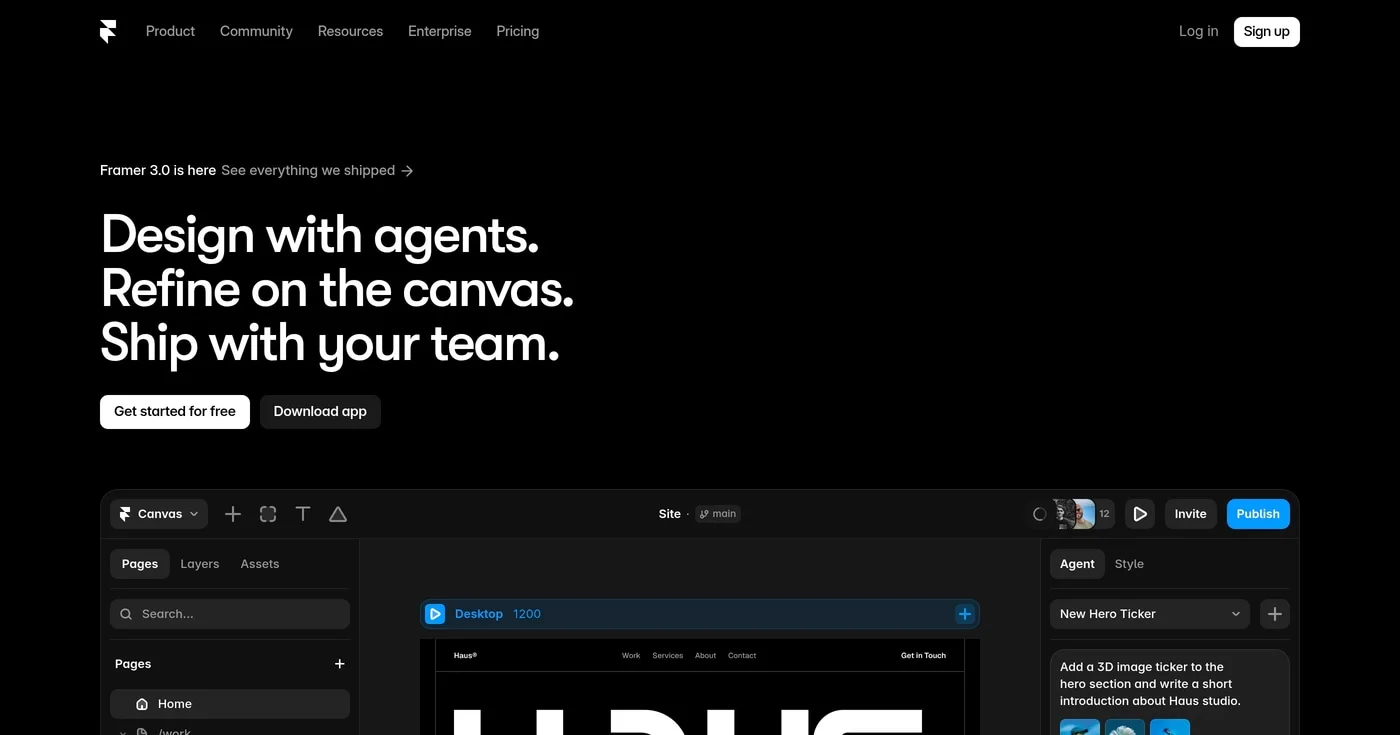
Framer produces the visually strongest output in this roundup. Its AI design generation creates polished, animation-ready layouts from prompts, suitable for SaaS product launches or brand-forward campaigns where visual quality is a trust signal. A/B testing is available as an add-on on the Pro plan.
Like Webflow, Framer is not a conversion optimization tool. No native CRM, no DTR, no Smart Traffic. It competes on aesthetics and speed-to-beautiful-page, not on the marketing analytics stack.
The free tier works for solo projects. At $10/mo Basic (custom domain) and $30/mo Pro (adds a staging environment), the price-to-quality ratio for design-led teams is hard to beat.
Best for agencies running PPC campaigns across multiple clients on a shared infrastructure
For agencies managing 10+ clients on £500–£1K/mo budgets, Elementor on WordPress solves the Unbounce problem. You own the infrastructure, share templates across clients, clients keep their assets, and GTM setup is clean from day one.
u/BbAaCcEeFf in r/PPC describes the practical case. Elementor with WP Engine or Kinsta at $30–35/mo per client site gives you clean conversion tracking, shared templates, and full client ownership of their WordPress instance: no vendor lock-in, no per-account SaaS costs.
At $60/yr for Elementor Pro plus $60–$120/yr for managed hosting, the annual cost per client site is a fraction of any SaaS landing page builder for accounts that don't need Smart Traffic or AI insights. SeedProd ($39.50/yr on Elementor Pro equivalent) is an alternative that adds WooCommerce-native landing pages for ecommerce clients.
It takes more setup than a SaaS builder. Tracking, caching, security, and updates are all yours to manage.
For high-spend accounts where Unbounce's conversion tooling pays for itself, switch. For the long tail of smaller clients, WordPress wins on total cost and flexibility.
AI has split into two distinct categories. Visitor-routing AI (Unbounce Smart Traffic) routes each individual visitor to their optimal variant, bypassing the statistical significance problem. Content-generation AI (Leadpages AI builder, Instapage AI Collections, Landingi Lunar) creates page drafts and variants from prompts.
Visitor-routing AI and content-generation AI solve different problems. Map your need before choosing based on "has AI" alone.
Answer-engine optimization (AEO) is the 2026 differentiator. Instapage's March 2026 AI schema markup launch and Leadpages' Optimization Score AEO criterion signal that landing page builders are expanding into ChatGPT, Gemini, and Perplexity discoverability. The tools that help you appear in AI search results will have a structural advantage as AI-driven traffic grows.
Mobile page speed is a paid advertising cost lever. Swipe Pages AMP and the growing emphasis on Core Web Vitals across all major builders reflect a clear category consensus: slow pages are not just a UX problem for paid traffic. They raise your cost per click by depressing Google Ads Quality Scores.
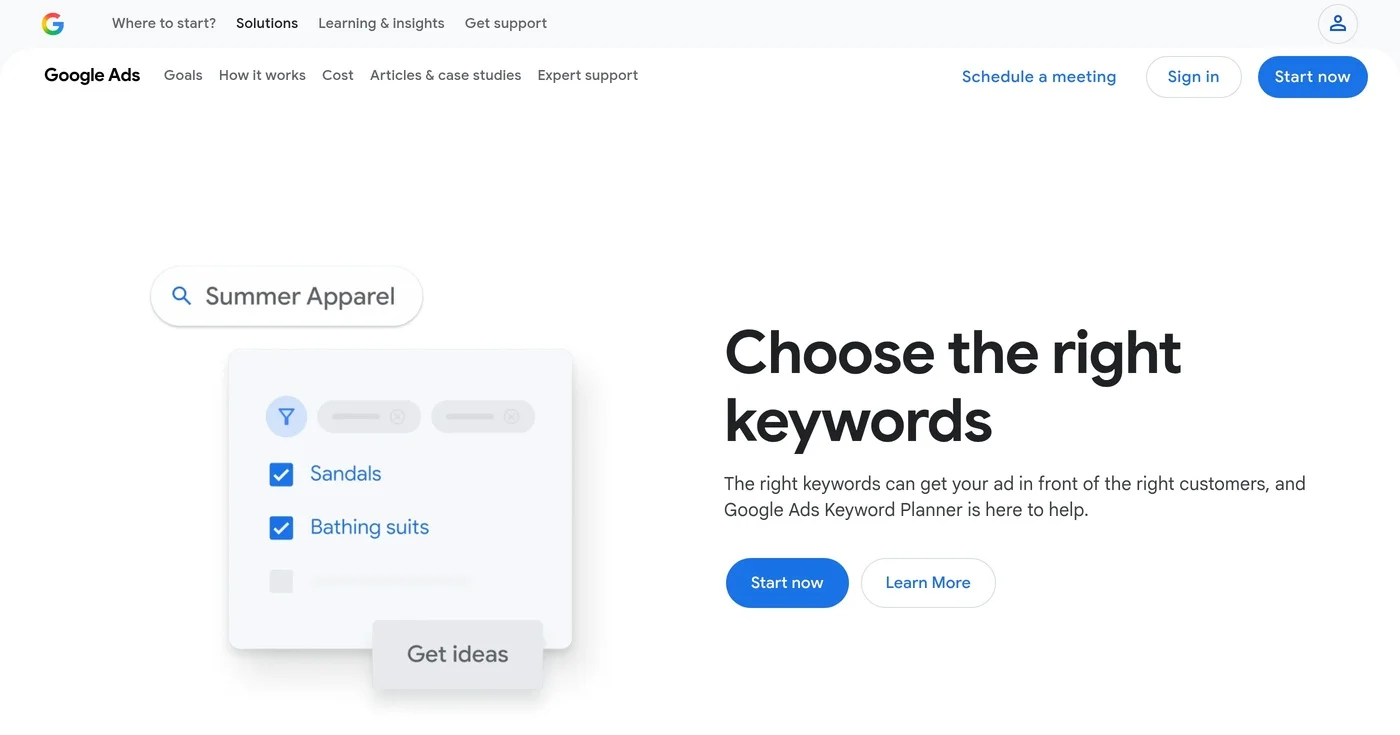
Open Google Keyword Planner without treating setup as running ads, then read volume, competition, and the two bid columns for what those numbers are not.
ZoomInfo alternatives have no public platform list price. Apollo publishes a seat price, Cognism covers EU phones, and Lusha starts at $49.90 a month.

HubSpot's pricing jumps from $0 to $890/month with no mid-tier. These 10 HubSpot alternatives are segmented by sales CRM, email automation, and agency use case
