


Content Creation: Workflow, Tools, and the Distribution Problem
The complete content creation process for marketers: 6-stage workflow, AI integration at each step, core tool stack, and a full ROI attribution model.
Updated 15 min read
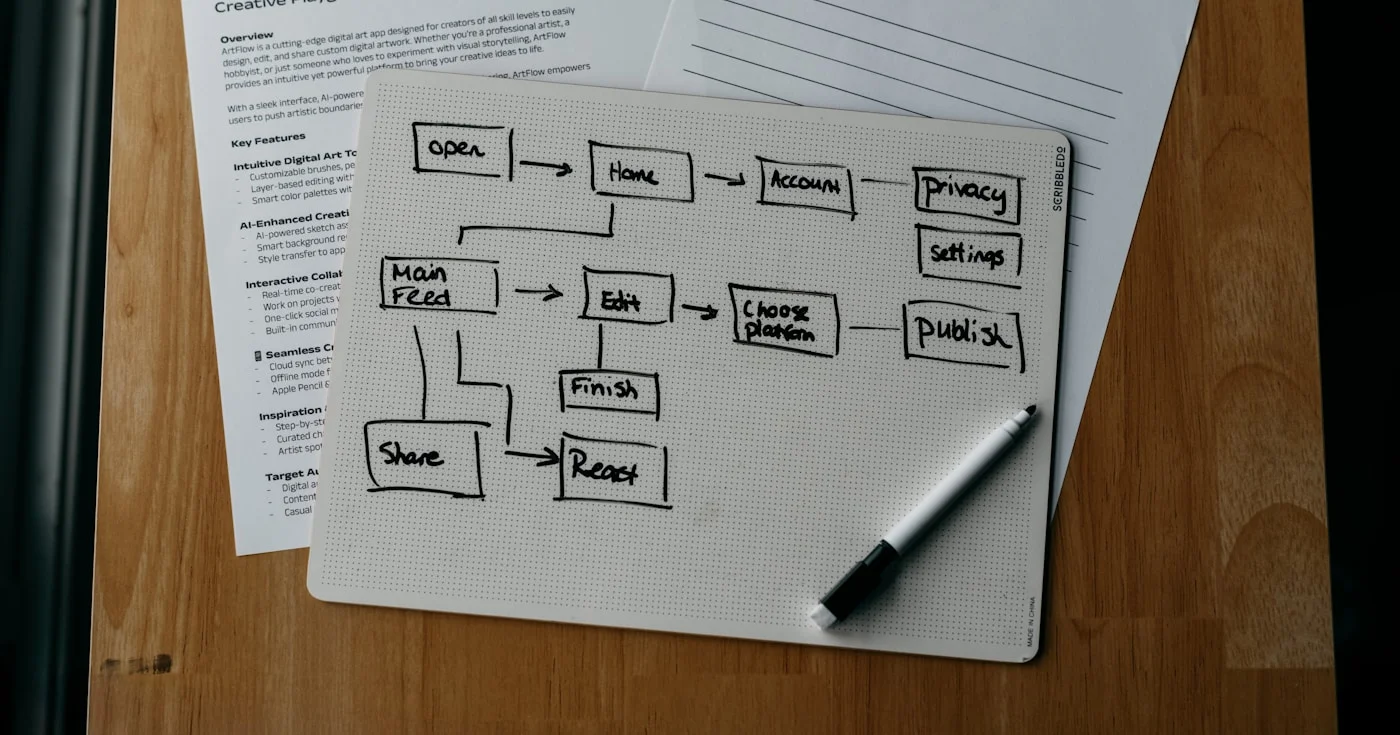

The complete content creation process for marketers: 6-stage workflow, AI integration at each step, core tool stack, and a full ROI attribution model.
Content creation is the end-to-end process of planning, producing, publishing, and distributing valuable content across digital platforms to attract and retain a target audience. 207 million people worldwide identify as content creators in 2026, and the global creator economy has surpassed $250 billion. This guide walks through the full workflow, how AI fits into each stage, the tool stack B2B marketing teams actually use, and the attribution model that connects content output to pipeline.
Most guides treat content creation as a craft problem: writing, filming, designing. The bigger problem is systems: who the audience is, what they need at each funnel stage, how one idea fans out across formats, and how you prove the operation earns its budget. This guide covers both.
Content creation is the process of researching, planning, producing, and distributing digital content across marketing channels to attract and engage a defined audience. Content Marketing Institute defines it as "creating and distributing valuable, relevant, and consistent content to attract and retain a clearly defined audience, and, ultimately, to drive profitable customer action."
HubSpot describes it as generating topic ideas that appeal to your buyer persona, creating content around those ideas, and making it accessible in the right format. Ahrefs frames it as finding topics to attract your target audience, then planning, creating, and publishing. Every credible definition converges on the same core: strategic content that serves a specific reader and a defined business goal.
The scope of "content creation" has expanded. It now encompasses written posts, long-form video, short-form clips, podcasts, infographics, interactive tools, and AI-generated visuals, each with its own production workflow, distribution channel, and measurement framework.
The scale of published content has changed what it takes to stand out. 74.2% of new webpages published in 2025 contain AI-generated content. Volume is the baseline now; originality and distribution are the differentiators.
Two structural shifts compound the challenge. AI Overviews now appear on approximately 60% of Google searches, pulling clicks away from standard organic results. Platforms that once rewarded link-out posts now algorithmically downrank them.
As Wes Kao put it: "Nobody owes you their attention." Getting and keeping that attention is the job.
The upside is concrete. Educational content makes customers 131% more likely to buy. 74% of marketers say content marketing generated demand or leads.
The returns compound when the workflow is structured and erode when it is not.
No format works everywhere. Choosing the right content type for your audience's stage in the buying journey is where content strategy starts, not where it ends.
Blog posts remain the SEO and authority-building backbone for most B2B programs. 56% of marketers call blogging their most effective strategy for organic traffic. White papers (5,000+ words, research-backed) and case studies are the B2B conversion formats: they address "will this work for us?" at the moment a prospect is evaluating options.
Email newsletters own the nurture track for opted-in audiences and drive the highest ROI per send for most B2B teams.
Short-form video (under 60 seconds) leads ROI for 49% of marketers and is the most-used format for 60%. It leads on reach and top-of-funnel awareness. Long-form YouTube content drives deeper engagement and compound audience growth over time.
Webinars and live streams convert warm leads at the bottom of the funnel. Each format has a specific job; treating them as interchangeable produces below-average results on every channel.
Podcasts reach 158 million+ active US listeners and build audience intimacy at a depth social posts don't match. Infographics attract backlinks and social shares. AI-generated images via Midjourney, Canva AI, and Adobe Firefly have reduced visual production time enough that high-quality visual content has become realistic for one-person marketing teams.
Funnel Stage | Goal | Content Types |
|---|---|---|
Awareness (TOFU) | Attract new audiences | Blog posts, social content, infographics, short-form video, podcasts |
Consideration (MOFU) | Nurture interest | Guides, webinars, case studies, email sequences, comparison content |
Decision (BOFU) | Convert | Case studies, demo videos, ROI calculators, testimonials |
Retention | Retain and upsell | Newsletters, tutorials, community content, product updates |
No consensus exists on step count (production frameworks run from 4 to 17 stages), but every credible model converges on the same six core activities. What most guides leave out is the AI layer at each stage and what it actually changes.
Keyword research, audience pain-point mapping, and competitive analysis feed the content brief. In 2026, ideation has to account for conversational search intent. Semrush on LinkedIn (May 2026) captures the shift:
"Users no longer search in shorthand like 'running shoes flat feet.' Today they ask: 'What are the best running shoes for a woman training for a marathon with flat feet and arch issues?' Your job as a marketer is to extract the topics and intent hiding inside conversational searches, not match them word-for-word."
AI contribution at this stage: generate topic clusters from a seed keyword, surface PAA-equivalent questions automatically, and flag semantic gaps competitors haven't addressed.
Set a measurable goal for each piece before any writing starts. 58% of B2B marketers rate their content strategy as only "moderately effective"; nearly half report no clear goals. Bynder's framework begins with goal-setting per content piece before production: "30% increase in webinar registrants in Q3" is a goal; "more content" is a schedule.
A complete content brief includes: target keyword, audience persona and funnel stage, content goal, format and channel, tone and voice guidance, internal subject matter expert, word count, required data points, and conversion CTA. Missing any of these creates rework after the draft is written.
AI contribution: populate outlines, identify internal linking targets, suggest title tag and meta description variants.
A structured outline before drafting cuts revision cycles. For B2B content, pull in subject matter experts early. Robert Rose of CMI has made this point consistently: it is often more effective to train SMEs to write than to teach writers to become SMEs.
87% of content teams already use AI to help create content. Teams using AI produce a median of 17 articles/month versus 12 for non-AI teams: a 42% output lift. That advantage disappears when AI replaces editorial judgment rather than supporting it.
Ali Abdaal names the failure mode directly: "When you suck at doing content... the temptation is there to just put stuff into ChatGPT and get ChatGPT to generate your content. You haven't yet developed the skill of actually doing the content or the taste for what makes good content." (Ali Abdaal in "How I'd Create Content in 2026")
AI contribution: first draft generation. Human contribution: editing for voice, accuracy, original examples, and the kind of specificity that makes content worth reading.
On-page SEO (title tags, meta descriptions, internal links, heading structure), brand voice alignment, fact-checking, and approval cycles all happen before publish. B2B content programs require at least one SME review round. Build buffer time for this in your editorial calendar.
This is where most production schedules slip.
AI contribution: semantic gap analysis against the top-10 SERP results, SEO title and meta description variants, readability scoring.
Owned channels ship first: website, email newsletter, podcast, YouTube. Social amplification follows with platform-native copy adapted for each channel. Then paid amplification, syndication, and community seeding via Reddit, Slack groups, and Discord, still underused by most B2B teams and high-value for early organic reach.
AI contribution: recommend optimal publishing windows by platform, auto-adapt copy tone and format per channel.
Measure against the goal defined in Stage 2. Weekly for social metrics, monthly for organic and email, quarterly for the content audit. The content audit (keep, improve, repurpose, or delete against current performance data) is the most consistently skipped step in beginner-facing guides and one of the highest-leverage activities in a content calendar.
AI contribution: automated performance summaries, content decay alerts, anomaly detection.
A content creation workflow without a documented strategy is a production schedule. The strategy layer defines who you are creating for, why, across which channels, and how you measure return.
The pillar-cluster model structures content around one broad pillar page (e.g., content marketing) linked to and from a set of cluster articles on related subtopics. Ranking for a broad term requires demonstrated topical authority across the full cluster. A single well-optimized article rarely beats a cluster of 10 interlinked pieces on the same theme.
Most B2B marketing teams optimize for content operations: scheduling, approvals, asset management. That is necessary but not sufficient. Content Marketing Institute on LinkedIn (May 2026) draws the distinction:
"What most marketing teams THINK they need: content operations. What most marketing teams ACTUALLY need: content orchestration. Design the integrated systems that enable orchestration, transform your operating model to support it, and deliver right-time relevance at scale."
Operations keeps the machine running. Orchestration makes the machine produce the right content for the right audience at the right moment. Teams that conflate the two report efficiency gains that don't translate to audience impact.
Five team models work in practice: solo creator, small team, enterprise, hybrid, and SME. Solo creators handle all roles with maximum tool leverage. Small teams pair a strategist with specialist writers; enterprise programs staff full production and distribution.
The hybrid (one internal strategist plus freelancers for writing, design, and video) is the most cost-effective option for mid-market B2B. In the SME model, internal experts own topic authority while the content team manages production.
u/Simple__Marketing in r/content_marketing (April 2026) describes the B2B challenge directly:
"We've been doing this for 30 years, and I used to think the tech was the hard part. It's not. We need a clear message... We can't do that. We're too close to the product. And we're all engineers. All we know are the features and nobody cares about those."
The B2B proximity blindness problem (knowing features but not benefits) is a structural challenge that content strategy has to solve before production starts.
CMI founder Joe Pulizzi coined the term "content tilt" for finding a unique angle rather than chasing what everyone else covers. Pulizzi's framing has held: the publications and B2B content programs that compound in value over time are those that carve a specific niche, own it deeply, and build a recognizable editorial voice. Trying to rank for the same angles as a team 10× your size is a resource allocation problem, not an execution problem.
This is the section most content creation guides leave out entirely. Writing is roughly 20% of the modern content workflow.
u/ReachInteresting8861 in r/content_marketing (June 2026) puts it plainly:
"The biggest shift for me was realizing content creation is now mostly a distribution and systems problem... the actual 'writing' is maybe 20% of the workflow: research, SEO, AI visibility, thumbnails/hooks, repurposing, short-form adaptation, newsletters, analytics, distribution, formatting for different platforms. That's the real workload now."
The volume pressure amplifies this. u/FrancisMulatya in r/content_marketing (May 2026) saw the same pattern:
"Everyone is producing more because of AI, so the advantage isn't in creating 'better' content, it's in getting it in front of the right people consistently."
Amanda Natividad named the structural shift: over half of Google searches end without a click, and platforms algorithmically downrank link-out posts. The response is designing content for on-platform value.
It's a tough world out there for creators... Over half of Google searches end without a click. And social media platforms ding you for linking out. What to do? Beat the platforms at their own game. Make Zero-Click Content. Here's how:
A LinkedIn carousel that delivers the full framework in 10 slides outperforms a post linking to the blog article, because the platform rewards it and the audience gets the value without navigating away. Designing for the platform's distribution mechanics means meeting the audience where they already are.
Alex Hormozi's company published 35,000 pieces of content in one year from a much smaller set of live events and long-form source videos.
"We had 35,000 pieces of content. They put out one piece of content a day, that's 365 pieces a year. We're just quite literally doing a hundred times more. And as a result of that 100 times the volume, what do you think's happening? We get a 100 times the prospect." (Alex Hormozi in "My Actual Social Media Strategy For 2026")
That volume is built on systematic repurposing infrastructure, not proportionally more creative effort. One source event generates dozens of derivative pieces without proportionally more creative input.
Original Asset | Derivative Content |
|---|---|
Long-form blog post | Social posts, email newsletter excerpt, infographic, podcast script, short video script |
Webinar / livestream | Blog recap, highlight clips, podcast episode, slide deck, quote cards |
Research report | Infographic, press release, listicle, email series, data visualizations |
Podcast episode | Transcript blog post, audiogram clips, key-quote social cards |
Video series | YouTube playlist, blog embeds, email nurture sequence |
Content repurposing matrix
See content promotion for the full channel-by-channel playbook.
A lean stack of 6 to 10 tools with minimal overlap outperforms a 25-tool setup. Every additional tool adds coordination overhead and context switching. 74% of improved B2B content strategies credited strategy refinement; only 51% credited new technology.
Category | Tool | Pricing | Best For |
|---|---|---|---|
AI writing | From $49/mo | Enterprise brand-consistent content at scale | |
AI assistant | Free–$20/mo | Outlines, first drafts, ideation brainstorming | |
AI editing | Free–$12/mo | Grammar, tone, and readability improvements | |
Design | Free–$12/mo (Pro) | Non-designers; 250K+ templates; social visuals | |
Video (short-form) | Free–$7.99/mo | TikTok/Reels; auto-captions; trending templates | |
Video (long-form) | Free–$24/mo | Podcast and YouTube; text-based editing | |
SEO | Paid | Keyword research, content gap analysis | |
Social scheduling | Free tier available | Multi-channel; API-first workflow automation | |
Content planning | From $10/mo | Editorial calendars, briefs, knowledge management | |
Full platform | From $20/mo | Mid-market B2B: content + CRM fully integrated |
Content creation tool stack by category
Canva (170 million+ users worldwide) remains the default for teams that need fast visual production without design expertise. Descript has become the default for podcast and YouTube producers who want to edit audio and video by editing the transcript text. Both have strong free tiers.
Before committing to paid tools: Ahrefs Webmaster Tools, Google Trends, Adobe Express free tier, and Google Analytics 4 carry a solo creator or early-stage team effectively. Paid seats earn their place when a specific workflow bottleneck shows up in your analytics, not before.
See content marketing tools for a deeper comparison across 30+ tools with use-case matching by team size and content type.
Most content creation guides end at "publish and promote." None provide a full attribution model. That gap is where most B2B content programs stall: strong output, unclear return.
The formula: Content ROI = (Revenue from content - Cost of content) / Cost of content × 100.
Getting to that calculation requires four measurement layers working in sequence.
Sessions, unique visitors, organic traffic growth, and time on page tell you whether content is reaching people and holding attention. These are your leading indicators. A piece ranking for 200 keywords with a 3-minute average session time is working.
A piece with 100 monthly sessions and a 15-second average is not.
Scroll depth, video completion rate, social shares and saves, and email open and click-through rates measure whether readers are acting on what they see. These middle-funnel metrics are the signal between traffic and leads. 62% of marketers say content marketing nurtured leads; engagement is the mechanism.
Form completions, gated content downloads, Marketing Qualified Leads, and Sales Qualified Leads connect content to pipeline. Track lead-to-conversion rate per content piece to identify which formats and topics are attracting your highest-quality prospects, not just the highest volume.
Marketing-attributed revenue, customer lifetime value influence, and cost per acquired customer. Reaching this layer requires agreed attribution logic between marketing and sales before the campaign runs. Attribution set up retroactively produces arguments, not data.
Weekly: social analytics and email performance. Monthly: SMART goal reporting against the brief's stated objective; quarterly: content audit (keep, improve, repurpose, or delete) based on current traffic, engagement, and lead data. See content marketing metrics for the full KPI framework.
No measurement baseline means no feedback loop. Bynder's framework begins with goal-setting per content piece before any production starts. "Increase organic blog traffic by 20% in Q2" is a goal; "create more content" is a schedule with no accountability.
Publishing AI-written bulk content at scale without quality control or repurposing systems produces short-term ranking gains and then traffic erosion. On r/content_marketing, the pattern recurs: companies that pushed bulk AI content for 12 to 18 months now demand "engaging, personalized articles with expert citations" after watching earlier gains disappear.
The Hormozi volume model works because it starts with source events and converts them systematically. Outsourcing drafts to a generic prompt with no editorial oversight is not the model.
Platform-specific optimization is not optional. LinkedIn rewards carousels and practitioner-voice prose. TikTok rewards trend-native short-form.
X rewards threaded conversation. A blog post copy-pasted to all channels underperforms across every channel. Write the format, then adapt the presentation for each surface.
Writers without a defined goal, audience persona, and conversion CTA produce content that reads well but does not convert. Content production specialists consistently identify the brief as the single highest-impact change for teams transitioning from ad hoc publishing to systematic content production.
Writing 10 articles and then figuring out promotion is the operational equivalent of building a product and thinking about go-to-market after launch. Distribution belongs in the brief, not the post-publish checklist. Build the distribution plan before you assign the writer.
Improving an article that already ranks for 50 related keywords outperforms creating a new article targeting the same cluster. Bynder and CMI both emphasize the content audit as the first step before any new production cycle begins. Content refresh is one of the highest-leverage activities in any content calendar.

Paid search wins when you need a visit this week and you do not already rank. SEO wins when you can wait months for a click you stop paying for.
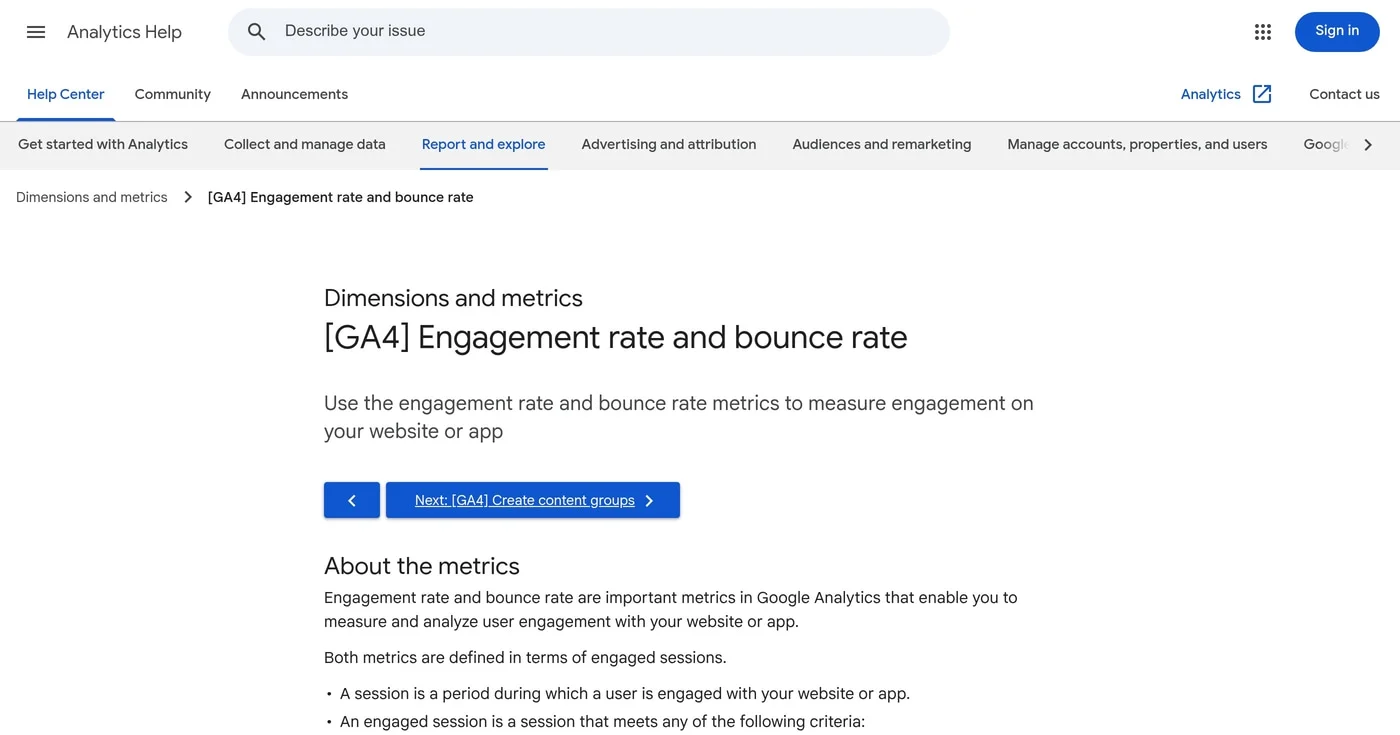
Bounce rate in GA4 is the share of sessions that were not engaged. See how that differs from Universal Analytics, why samples disagree, and what to check first.
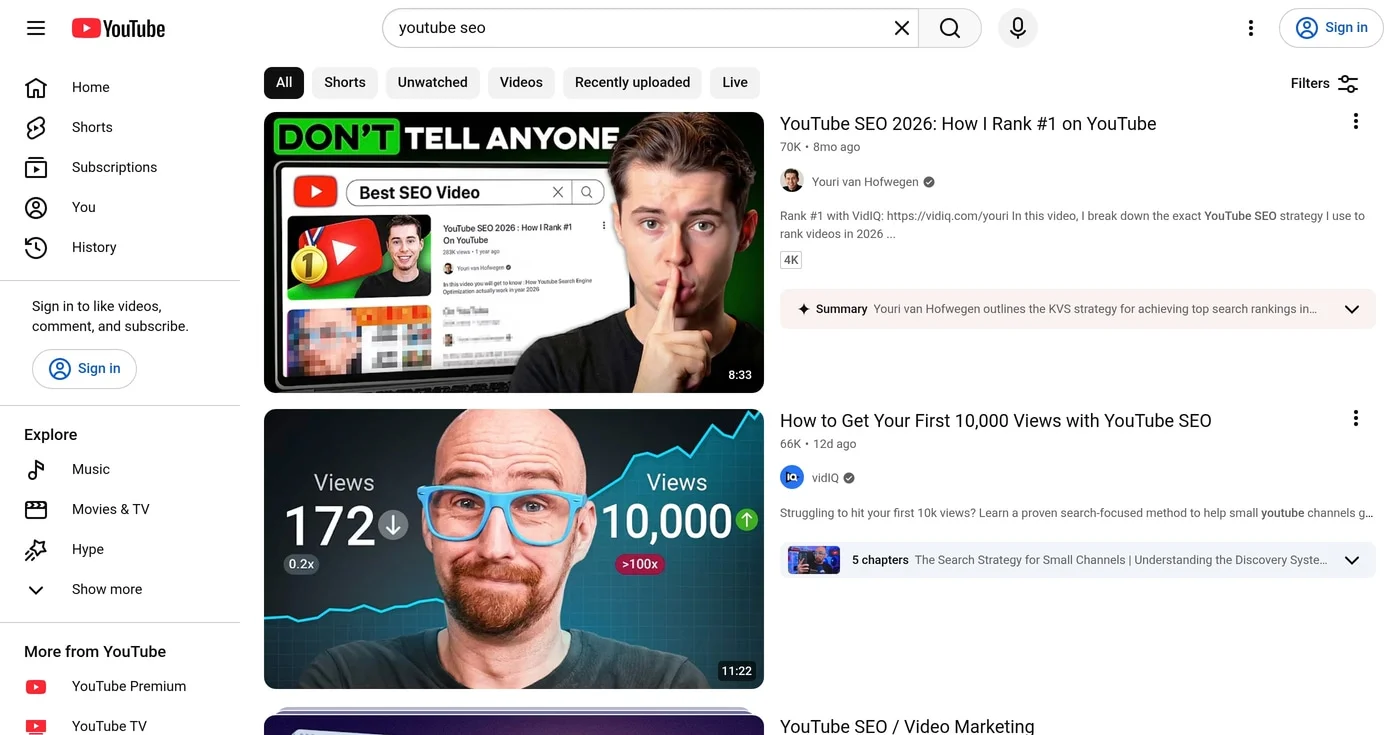
YouTube SEO matches a video to a query. See the ranking factors YouTube names, the official metadata limits, and why retention has no published cutoff.
