


Content Development in 2024 (Full Guide, Resources + Templates)
Content development involves a lot of people, tasks, and processes. Here’s a complete step-by-step guide.
Updated 16 min read


Content development involves a lot of people, tasks, and processes. Here’s a complete step-by-step guide.
Having a repeatable structure for content development is crucial in achieving optimal results while minimizing wasted time, money, and effort.
In this comprehensive guide, you’ll find a wealth of resources and templates to assist you in creating an effective content development process.
Whether you are a seasoned professional or new to the field, this resource will help you understand and implement strategies that drive successful content creation in 2024.
Content development is the process of turning a creative idea into a published content marketing asset. Be it a blog post, eBook, landing page, or news article.
It’s a repeatable checklist of steps and content development teams religiously.
Content development is the key element of a wider content marketing strategy – a documented overview of your content marketing plans pegged to specific business goals.
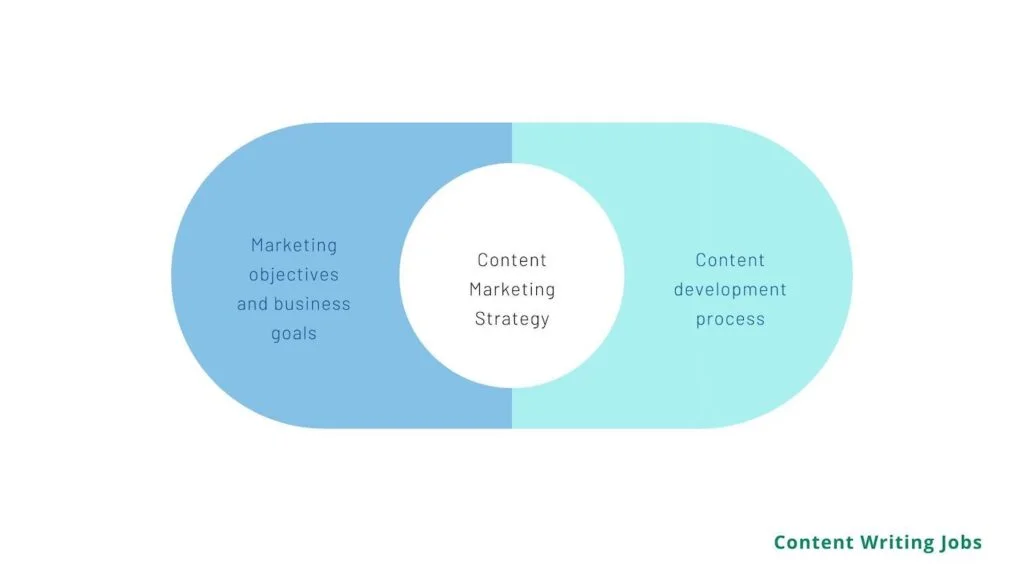
A standard content development process includes ideation, topic research, content writing, editing, optimization, and publishing, among other steps.
That’s a lot of work. Yet, 58% of marketers have a small (or one-person) content team to serve the entire organization. Most create content for different stakeholders — and need to do it fast.
Without a strong content development process, this goal is impossible to achieve.
Content development is a system. As such, it must be repeatable and easy to scale. If this doesn’t sound like your existing content development process, time to change that.
Here are the six main steps of the content development process high-performing content teams use:
This step-by-step guide breaks down each.
76% of B2B marketers use blogs to distribute new content.
Then, there are media organizations churning industry content at break-neck speed. And professional bloggers running their own (micro)media empires.
What does it mean?
There’s a ton of content on the Internet. Some is good, and some is bad.
As part of your content strategy, you need to figure out which:
In the words of Joe Lazauskas of Contently, you need to identify your content pillars:
“Pillars are the big, overarching topics you want to own.”
Content pillars emerge at the intersection of your audience’s interests and pain points – things they feel strongly about – and your company’s value proposition.
For example, for Best Writing, our pillar topics are high-quality content, search engine optimization, content development, and content marketing.
For your business, it could be financial literacy, Android app development, or adventurous travel.
📒 Grab a free content pillar template from the Contently team.
Once you’ve identified your main content pillars (content verticals), break these into specific topic clusters.
Classify all content ideas as TOFU-MOFU-BOFU.
Top-of-the-funnel (TOFU) content ideas and formats lift brand/solution awareness and introduce different solutions to readers. These include SEO-friendly blog posts, brand-building social media marketing assets, educational video content, etc.
Middle-of-the-funnel (MOFU) assets help move buyers at the consideration stage by addressing their concerns and pain points. MOFU content includes webinars, eBooks, interviews with industry experts, comparison tools, etc.
Bottom-of-the-funnel (BOFU) content helps seal the deal at the decision-making stages. BOFU content includes case studies, product demos, calculators, personalized sales presentations, etc.
Concentrate most of your content development efforts on TOFU content, which drives organic traffic you can convert into leads. The average conversion rates for blogs in B2B industries stand at 0.5%-1.5%. In B2C, they are marginally higher.
To meet your content marketing goals, you need to harness every organic search traffic opportunity out there, plus supplement it with paid advertising strategies (especially for content promotion).
To find those sweet traffic-generating opportunities, do extensive keyword research.
On-page search engine optimization (SEO) is a key part of successful content development.
You need to find relevant keywords for your content pillars. Then augment them with related keywords to increase organic search traffic for your website.
To get started, select a general “parent” keyword.
For example: “content development.” Then use a keyword research tool like Ahrefs to get more keyword suggestions:
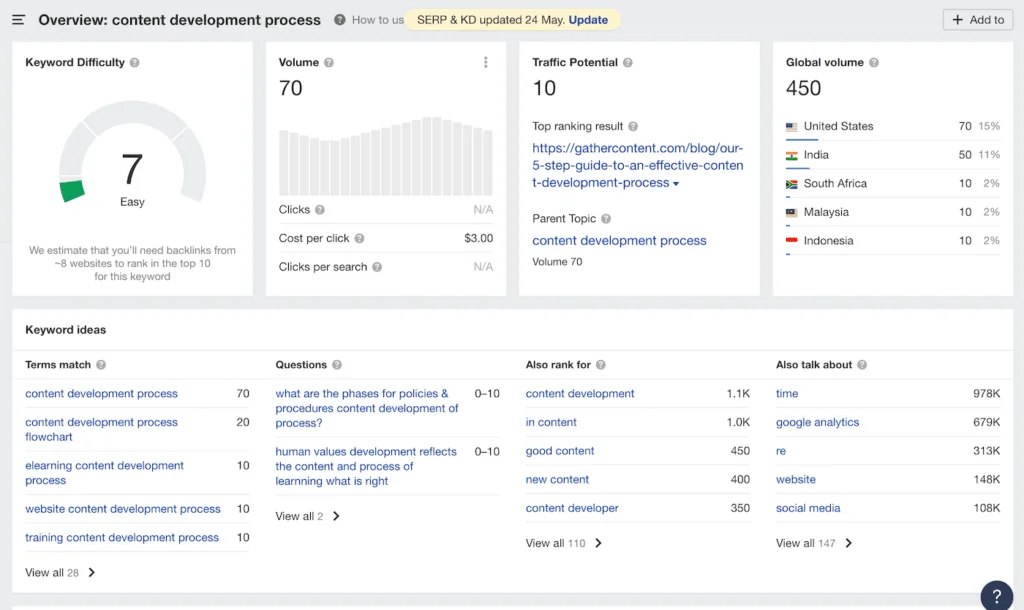
Understand the search intent of users by analyzing different keyword ideas, questions, related keywords, and competing articles.
In our case, most people want to get educated on the topic and receive some instructions (so this guide provides just that!).
Some topics might be broader and more ambiguous.
For example, if you want to talk about “third-party cookies,” you can select different editorial angles:
The editorial angle you select should match your target audience’s interests. And it should drive your choice of related keywords to use in the copy.
For example, if your product is ad-blocking software, you’ll want to make long-form content talk more about blocking third-party cookie tracking and privacy protection.
But if you are content marketing to AdTech businesses, create content about the future of cookieless ad targeting.
Recommended tools for keyword and topic research:
📝 Check our list of the best content optimization tools (with keyword research features!).
Editorial planning is the process of prioritizing different content ideas and formats and assigning them to content developers (your writers!).
A high-performing editorial plan covers:
It provides a visual snapshot of your content strategy.
On a lower level, you have a content calendar. A calendar you use to track daily/weekly progress on content creation.
Both help maintain a consistent publishing schedule and hit tracked marketing goals.
📒 Free resources for editorial planning:
One of the key elements of editorial planning is content brief development.
A content brief is a set of instructions, guidelines, and intake information you provide to an assigned content writer.
A good content brief includes:
✍️ Learn how to create detailed content briefs for your team.
With all the strategic planning done, you are (almost) ready to write.
The content creation process involves:
To start outlining, your content developer needs a complete brief, internal data + reference materials (if any), and tips on search engine optimization.
New writers will need additional instructions and feedback between content creation stages.
Ask them to send you an outline first. Then a draft for detailed editorial review — and a final copy, you’ll then copy edit.
For a multi-channel content development strategy spanning multiple blog articles, social media platforms, and content distribution channels.
That means having:
Here’s how we structured our content creation process at Best Writing, the all-in-one writing marketplace.
Under the hood, we have:
This content development process helps us produce 30+ optimized content assets per month.
High-quality content is 80% writer’s talent and 20% editorial work.
A good editor doesn’t just fix grammar or does light proofreading. They:
Erica Schneider, Head of Content Grizzle, well articulates different “flavors of editing” you should do:
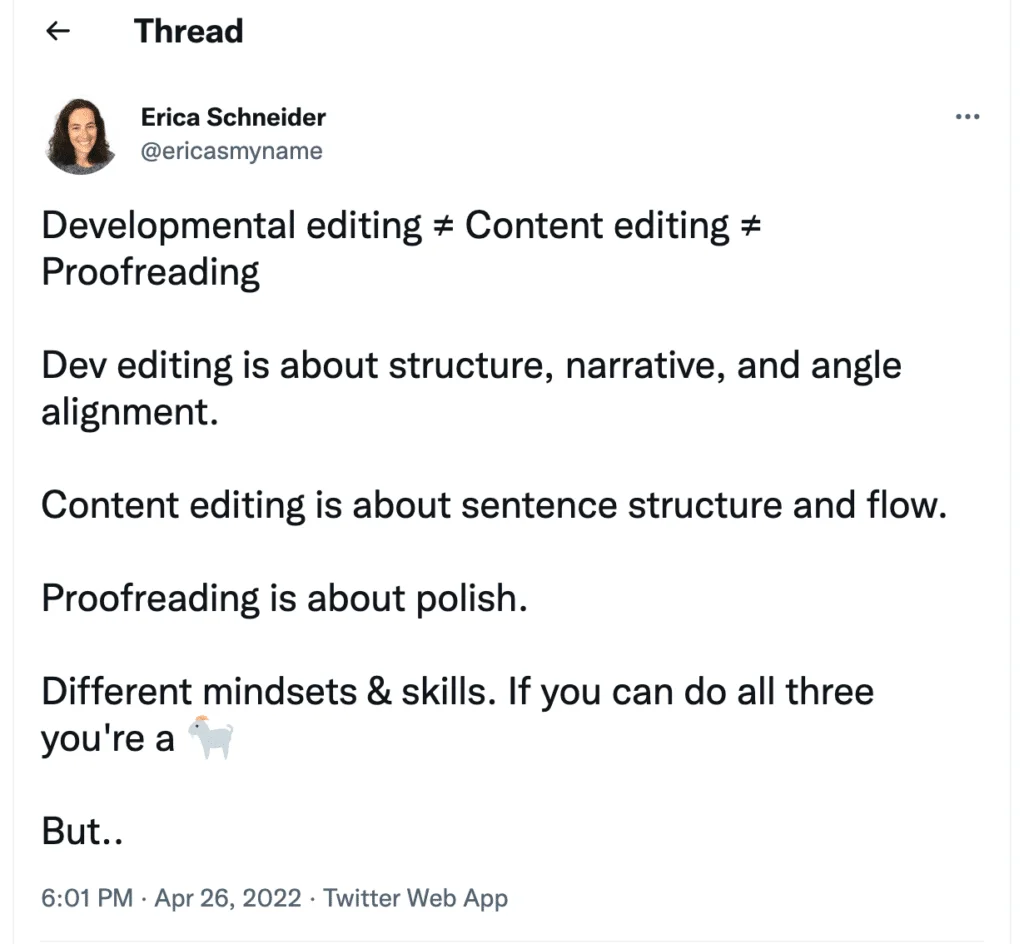
Finally, many editors also stage content for publishing.
They upload finished blog posts to your content management system (CMS), request graphic assets from design teams, prepare texts for social media conversations, and verify that the published content looks equally appealing to potential customers and search engines.
✍️ Need an editor? Get your job offer in front of 100K+ monthly website visitors.
Content development doesn’t end with publishing content.
You need to get your quality content in front of potential customers.
Search engine optimization (SEO) will help you harness organic search traffic over time. But for faster results, you should also promote new content using other strategies.
An effective content distribution process maximizes your content marketing ROI.
40% of content teams plan to invest more in content distribution this year to reach their marketing goals faster.
📒 Free resources for systemizing content distribution:
Creating content takes a lot of time and resources. So you should maximize every asset’s “shelf-life.”
Content repurposing is the process of adapting existing content to other channels. For example, turning a podcast episode into a blog post.
That’s an easy way to keep your editorial calendar full without stretching your marketing budgets.
65% of marketers agree that content repurposing is more cost-effective and drives excellent results.
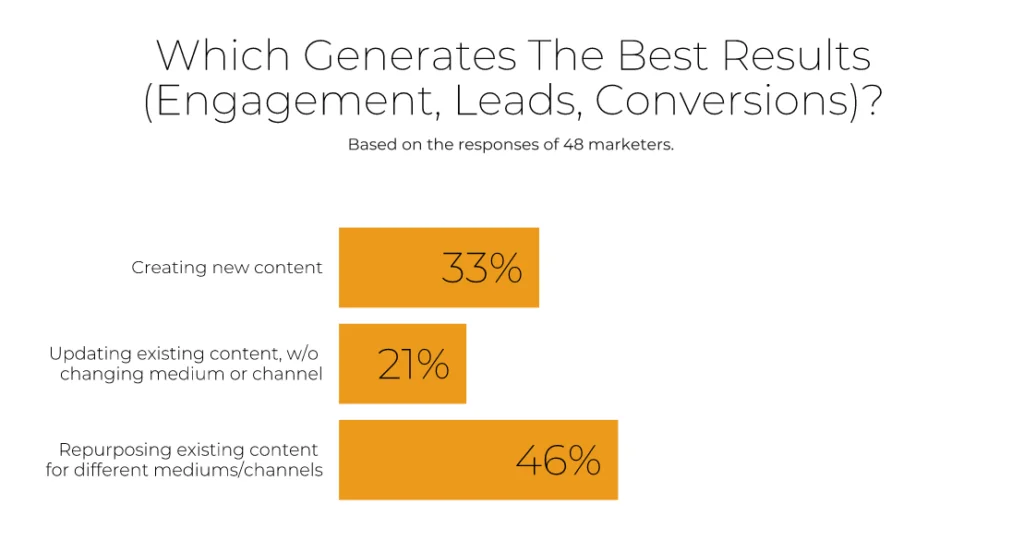
Short on ideas?
Here’s how to repurpose one blog post for multiple promotional channels:
Likewise, you can also turn audio or video content into written assets.
📒 Free resources for content repurposing:
Content development is a system. This section explains how to build one for your company.
Online marketing success depends on understanding how people buy from you.
Talk to your sales team and map typical customer journeys. Then strategize which content strategies can speed up the buying process.
Start with a standard sales funnel:
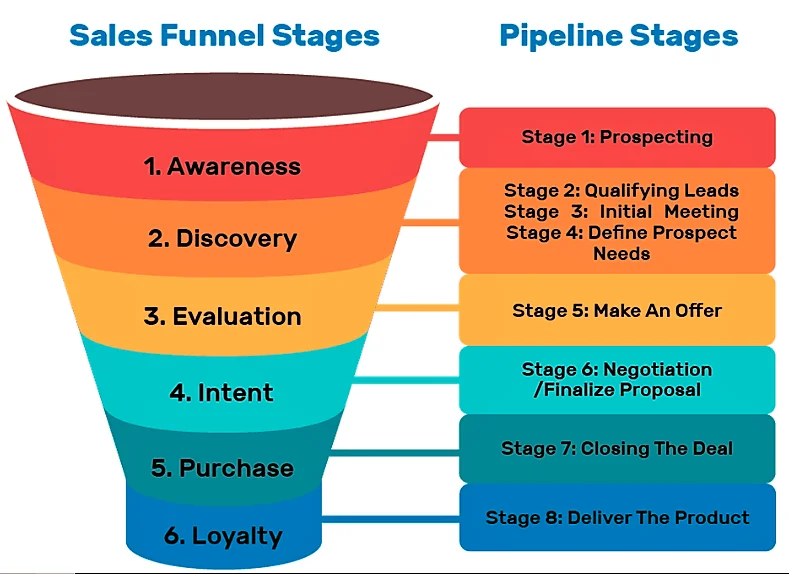
Analyze different customer journey paths during the awareness stage.
Most market to several target audiences.
Hence, it makes sense to group your TOFU content by different:
For example, you are a content developer for a vegan meal kit delivery service. Your core audience is vegans. But among them, you have people who:
These customer personas will have somewhat different buyer journeys. Your content strategy has to fit them.
Next, think about your TOFU assets. Depending on the average sales cycle length, your free content can either lead to a paid offer – or provide another path for conversion (email newsletter sign-up, for example).
Analyze different purchase scenarios based on user search intent and readiness to purchase. Then develop several content flows for different targets.
Let’s say you want to convert meal kit novice users. They’ve learned about your service via a podcast ad and now peruse your website content: blog articles, recipes, service pages, etc.
A good percentage will be interested but not ready to order from you yet.
Place an email form promising a discounted first order on pages where most organic traffic lands.
You can also add a free vegan recipe book in exchange for their email in the recipes section. In the eBook, create a content segment about how your service works to help with consideration.
Finally, if you are upgrading an existing content development process, perform a content inventory.
Make a list of all published content assets. Assign them to specific content funnel stages and map them to different audience personas. Then strategize which other assets your marketing strategy needs.
📒Free resource for content planning:
After a strategic planning session, you have:
Time to chart the path forward and set your content development goals.
Content Marketing Institute suggests using this pyramid for measurement:
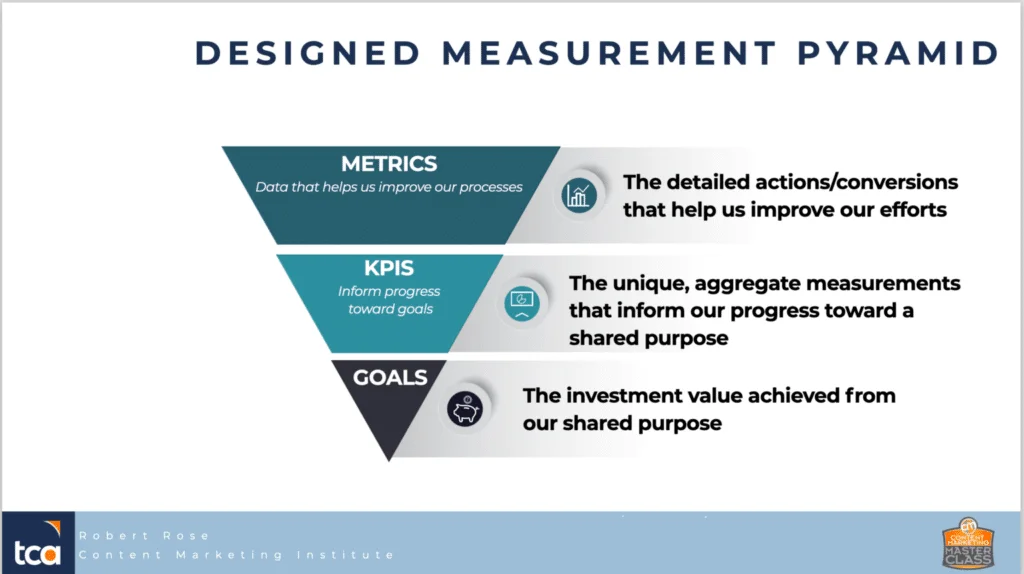
Start with a measurable marketing goal: keep our cost-per-acquisition (CPA) from content marketing at $100 per user.
Then set up lower-level team KPIs for measuring your progress:
At the highest level, select data-backed metrics for your strategy:
Google Analytics, HubSpot Marketing Analytics, or Salesforce can help you track and report on these metrics.
🎯 Learn more about content marketing metrics selection.
Time to pack some content ideas into your editorial calendar.
For each topic, you need to prepare:
Then, you need to figure out the optimal cadence for publishing content around different content pillars.
Jay Buyer of Convince & Convert calls this doing “content shows.”
“Think about what social media initiatives you can execute on a regular basis, keeping in mind your audience and objectives for that platform. Then, create and distribute these “shows” consistently. This gives your audiences something to recognize, engage with, and (hopefully) look forward to regularly.”
Your content pillars are the main topics for your content shows. Your editorial calendar creates a cadence for running them in the right order.
When you work on your content calendar, think about themes.
First, plan a content topic cluster (TOFU+MOFU) for one segment of buyers. Then plan another one and another one.
Work with your team to determine the optimal “programming” cadence for running different content themes across channels.
You now have topic clusters (themes) and several content assets to be done for each.
To move from the planning to the content development stage, you need to set up a content production pipeline:
You should share these steps among several content development team members — strategist/manager, writer(s), editors, social media manager, growth marketer.
Don’t expect one person to handle all of the above.
If your goal is to publish 10 long-form blog posts per month, you need to have:
You can “get away” with having fewer people in-house if you partner with a content writing team that takes over brief development, editing, and publishing tasks.
Plan what happens after a new blog post goes live:
Schedule new blog posts for distribution on popular social media channels.
Conduct outreach to industry experts.
Distribute content marketing assets via a newsletter.
You need to have a documented content promotion checklist for your team to follow.
Content development is an iterative process.
You need to test your assumption against tracked metrics to understand if your strategy works or not.
Apart from monitoring selected content performance metrics, pay attention to the following.
Best and worst-performing assets. Try to reverse-engineer what makes successful content ideas and why others flop.
Promo techniques with the best ROI. Analyze which channels drive relevant, “sticky” traffic and double down on using them.
Lead generation volume per asset(s). Your goal is to understand which content clusters, formats, and topics drive the most qualified leads.
Perform in-depth content performance audits at least once a month and revise your strategy based on findings.
Content development is a multi-stage process.
To be successful, you need to cultivate excellence at every stage.
Hire brilliant content strategists and experienced content marketers to lead your program. Give them a reasonable budget and enough decision-making autonomy.
Then let them hire the best freelance writers and editors to support their effort.
Allocate budgets towards content promotion and repurposing. Or else you’ll struggle to get a good ROI.
Lastly, invest in good analytics tools and set up content performance dashboards to track your progress.