


Content Marketing ROI Statistics and Facts for 2024
To help you make a data-driven decision, I’ve rounded up the most important statistics for 2022 that prove the long-term ROI of content marketing.
Updated 9 min read


To help you make a data-driven decision, I’ve rounded up the most important statistics for 2022 that prove the long-term ROI of content marketing.
Content marketing generates a high return on investment for both B2B and B2C marketers. Data shows that marketers are satisfied with the ROI of content marketing and are seeing a steady ROI increase each year.
To help you make a data-driven decision, I’ve rounded up the most important statistics for 2024 that prove the long-term ROI of content marketing.
Before we jump into the topic of content marketing ROI, let’s delve a little bit into audience behavior statistics. These statistics are very important for your marketing strategy as they can give you valuable insight into the types of content your audience finds important.
Learning what types of content your audience finds most relevant in every step of the marketing funnel can help you use content marketing to reach out to them in an effective way.
Demand Gen’s Report on B2B Buyers’ preferences from 2018 revealed that customers are becoming increasingly more selective in the content they consume and tend to rely on trustworthy sources.
Every business needs to calculate the ROI of every facet of its content strategy to see what works and what doesn’t. After all, savvy businesses don’t operate on blind guesses – they strategize based on solid data.
However, if you’re still brainstorming your strategy, the wealth of stats on content marketing ROI and related metrics that are already available can be a good starting point when you’re trying to gauge what type of content to invest in. Checking what the majority of your competitors are investing in is always a good tactic.
The CMI’s reports on B2B content marketing attest to the importance of the role content marketing has played for brands in the last decade.
Their report for 2020 showed that marketers are highly focused on producing content but are making changes to the ways they measure, distribute, and create it.
The stats below prove that B2B marketers are becoming more confident with their content strategy, with 95% of them stating that their organization represents a valuable and trusted content resource to their audience.
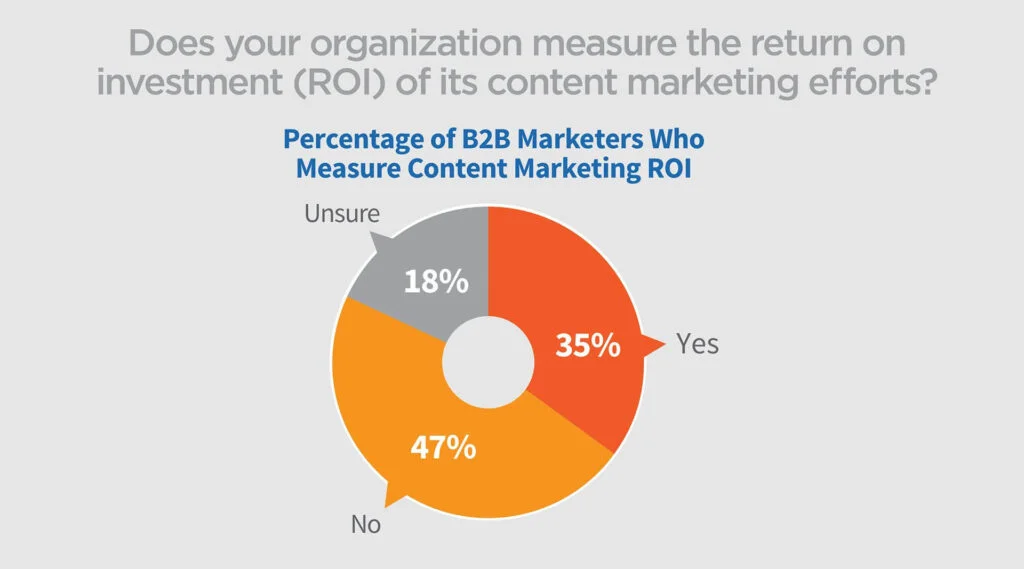
What’s more, the Content Marketing Institute’s report for 2018 showed that 89% of the most successful B2B marketers have a content marketing strategy.
The CMI’s 2019 report on B2C marketing revealed that creating brand awareness is a top goal for B2C marketers. Cultivating relationships with customers is another great concern, with 82% of marketers stating that their organization is interested in creating content that builds loyalty with customers.
The survey suggested that in order to keep creating content that brings a high return on investment, in the future, B2C marketers need to focus on content that nurtures their audience and generates leads.
Are you having doubts about whether email marketing is still a relevant marketing technique? There’s no need for those assumptions – email marketing is still rocking the charts.
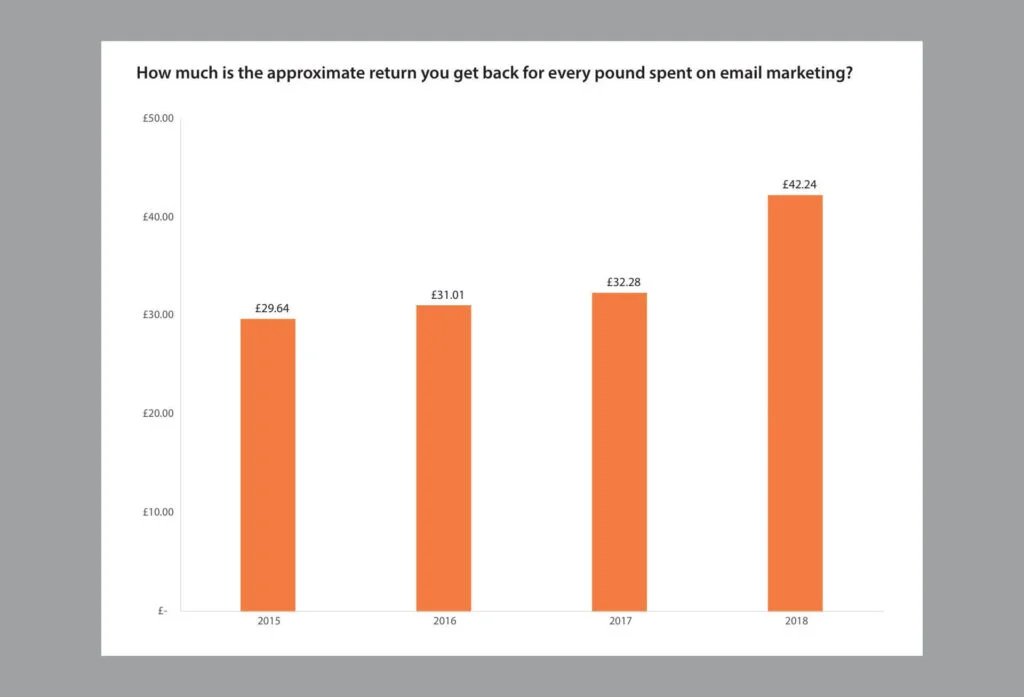
In 2015, email marketing generated $38 for every dollar spent, and one in five companies reported an ROI of over 70:1. But what about now?
The DMA Marketer Email Tracker for 2019 showed that in 2018 marketers expected their email campaigns to perform better the following year. And 58% of the interviewed marketers stated that they expected that their ROI would continue to increase.
Litmus has surveyed hundreds of brands to find out which email marketing practices lead to a higher return on investment. Here are the findings:
Brands that use A/B tests in their email marketing campaigns drive an ROI of 48:1, compared to an ROI of 35:1 for those who don’t make use of A/B tests.
Brands that incorporate double opt-ins in their email marketing campaigns drive an ROI of 45:1, compared to an ROI of 40:1 for those who use single opt-ins.
Brands that implement dynamic content often or always drive an ROI of 44:1, compared to an ROI of 36:1 for those who never use dynamic content.
Brands that use live content in their emails often or always generate an ROI of 50:1, compared to an ROI of 39:1 for those who never use live content.
Brands that add animated gifs in their email marketing campaigns generate an ROI of 46:1, compared to an ROI of 38:1 for those who never use animated gifs.
Brands that make use of external email analytics tools provided by their email service generate an ROI of 48:1, compared to an ROI of 39:1 for those who never use email analytics tools.
Brands that use an extensive pre-send checklist generate an ROI of 48:1, compared to an ROI of 38:1 for those who don’t use pre-send checklists.
Currently, visual content is huge, and video, in particular, is becoming a giant player. It’s estimated that video drove $28 billion in revenue in 2024, and this lucrative industry shows no signs of stopping.
There are some exciting predictions about the future of video, with marketers expecting that it will reach $47.89 billion in revenue by the end of 2024.
Now, go out there and make better decisions based on data.