

SEM vs SEO: Where Your Next Dollar Should Go
Paid search wins when you need a visit this week and you do not already rank. SEO wins when you can wait months for a click you stop paying for.
Updated 17 min read

Paid search wins when you need a visit this week and you do not already rank. SEO wins when you can wait months for a click you stop paying for.
Paid search wins when you need a visit this week and you do not already rank. SEO wins when you can wait months for a click you stop paying Google for.
The average Google Ads click in WordStream's 2026 set is $5.42, and the average lead is $66.69. Only 1.74% of new pages reached the top 10 within a year.
SEM here means paid search on Google Ads, not a scanning electron microscope. SEO means an unpaid ranking.
Dimension | SEM (paid search) | SEO |
|---|---|---|
Best for | A visit this week on a term you do not rank | A click you stop renting after you rank |
Cost shape | Auction CPC every month you want the click | Labor and tools, click or no click |
Published cost | $5.42 avg CPC, $66.69 avg CPL | $1,001 to $2,500/mo, most common retainer |
Time | Eligible ads can serve this month | 1.74% of new pages hit top 10 in a year |
Key strength | You pick the query, the ad, and the page | Extra clicks are unpaid while you rank |
Key weakness | You can pay for a click you already owned | Rankings lapse; the retainer does not |
At organic rank 1 | About half of ad clicks still incremental | The unpaid listing, if the query sends one |
Brand query | Defense when a rival is bidding | Pause when you own the name alone |
Two definitions are still in print, and they are not the same budget.
In 2001, Danny Sullivan popularized "search engine marketing" as an umbrella: unpaid rankings, paid listings, and the directories of that era. A 4 March 2010 essay said the paid-only usage annoyed him. He left the Search Liaison role on 1 August 2025 and is a Director within Google Search, so that essay is not a 2026 ruling.
The American Marketing Association still teaches the umbrella on its 15 August 2024 page, and that page also calls SEM a short-term effort. Neither sentence is the whole definition.
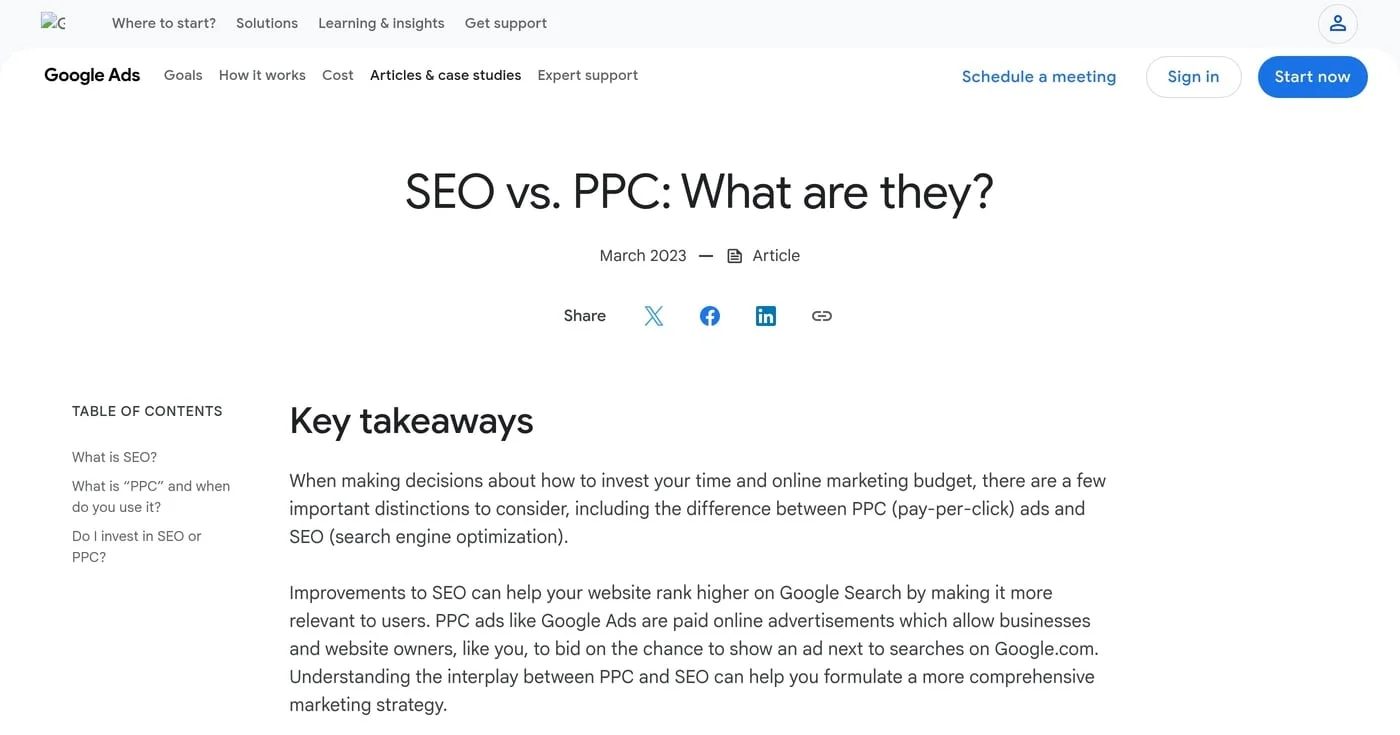
The usage you can budget is narrower. Wikipedia records that commercial teams use SEM to mean pay-per-click, and that those teams have a reason to prefer the narrow word. Google never uses SEM on its March 2023 comparison: the page frames the choice as SEO versus PPC, and says the ad will not improve organic rankings.
PPC is how that paid meaning bills you. You bid, and you pay when someone clicks.
The software is a separate decision. Start with SEM tools.
That table's cost-per-lead commentary covers Google and Microsoft Ads. A low click price is not a cheap customer.
SEO is the unpaid listing. It is not a free click.
Google says there is no cost to appear in organic results. That sentence is true of the engine's price per click. It is false as a total-cost claim.
The check goes to people and software, whether or not the visit arrives. Part of that check is the crawl and index work in technical SEO, not a blog calendar alone.
For its 2026 pricing guide, Backlinko surveyed more than 300 SEO professionals. The most common monthly retainer was $1,001 to $2,500. Entry retainers under $500 were 7% of providers in the US, UK, and Australia in that survey.
A $100 to $5,000 band sometimes gets attached to this survey. It is not on the pricing page.
Time is the other cost. In September 2023, Ahrefs checked 1 million URLs first seen by its crawler. 1.74% ranked in the top 10 within a year, down from 5.7% in a 2017 cut.
The average page in position 1 was 5 years old. 72.9% of pages already in the top 10 were more than 3 years old.
Skip the "about two years" line and the "19 times more organic clicks" line. The Ahrefs page those time claims cite does not say two years. The First Page Sage click report those click claims cite does not say 19 times.
In that panel, organic position 1 drew a 3.6% click rate with an AI answer, and 22.6% without one.
Those rates are the study's AI-answer split, not a comparison-only cut.
An eligible ad can send a click before a new URL has a ranking history. The visit ends when the budget stops.
SEO's clock is the Ahrefs cohort: 1.74% of new pages in the top 10 within a year.
Fund paid search when the offer expires, the domain is new, or you need a visit before a page has had a year to earn one. Fund SEO when you can carry the retainer through that year.
Winner: SEM. The auction sells a visit in the month you fund it. SEO's measurable path to page one is a minority outcome inside a year.
Paid search has a posted auction, not a menu price.
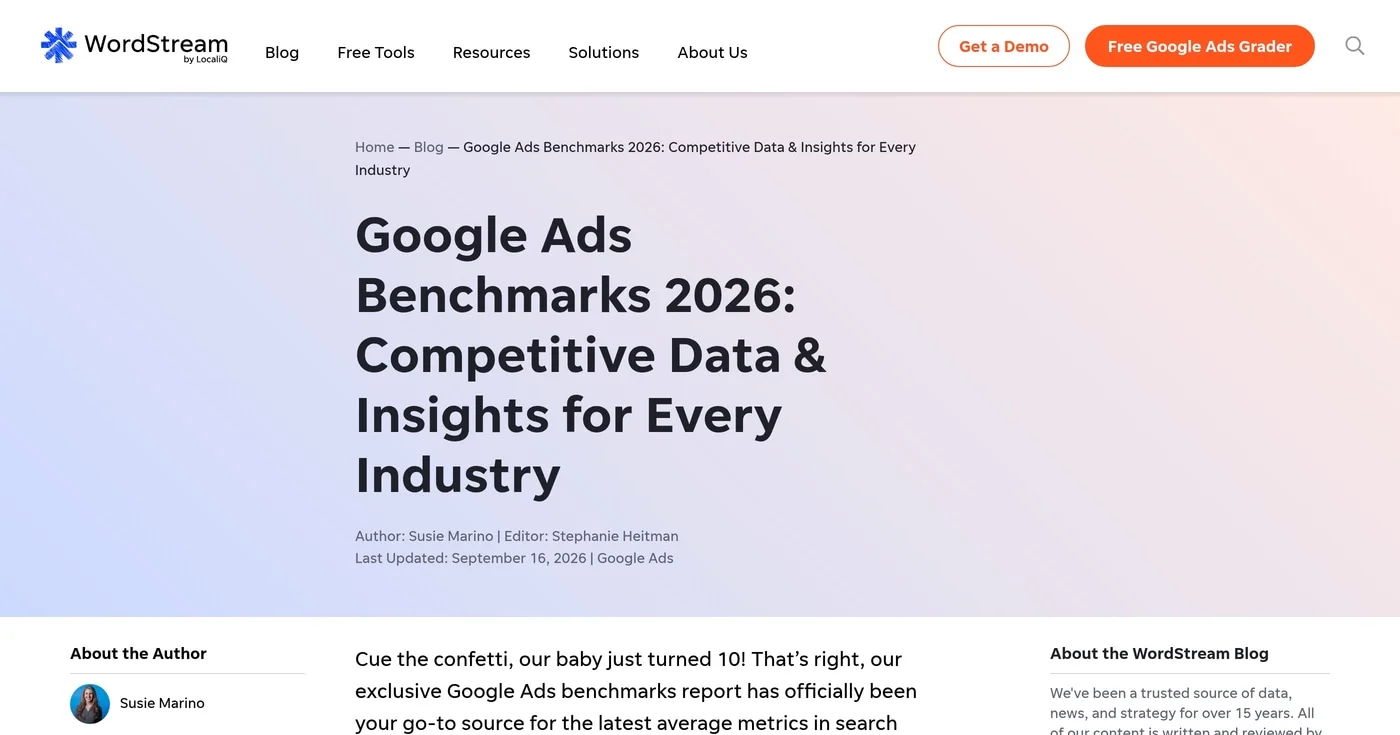
Susie Marino's WordStream by LocaliQ page, updated 16 September 2026, covers 13,474 US search campaigns across 23 industries, from 1 April 2025 through 31 March 2026.
The page labels click rate, CPC, conversion rate, and cost per lead as Google Ads, and it says those averages are medians. The same page also reports Microsoft Ads.
Google Ads click-through rate was 6.64%. CPC was $5.42. Conversion rate was 8.18%.
Cost per lead was $66.69.
The ten-year line on that page runs from a $2.32 CPC to $5.42. Cost per lead moved from $59.18 in 2016 to $66.69. The report calls 2026 the first year-over-year cost-per-lead decline it has measured in five years, across Google and Microsoft Ads.
The lead did not get cheap. It stopped rising for a year.
A $1.63 arts click and a $9.87 legal click are not the same product. A $3.39 finance click still produced a $74.44 lead in that set.
SEO's curve is labor, paid up front. An extra click gets cheaper only while the page keeps ranking. Backlinko's most common retainer is $1,001 to $2,500 a month.
You write that check in months when the page sends nothing.
You still pay the auction every month you want the click. A wider paid-benchmark set sits in these PPC statistics.
Winner: SEO, on the shape of the curve, and only after a page holds a ranking you would otherwise rent. SEM wins month one. That win repeats, and it does not compound.
Google's 2012 pause studies still show when an ad click is a new visit. The data are from 2011. Use the paper for substitution, not for this year's return.
Chan, Kumar, Ma, and Koehler pooled 390 pause studies from advertisers who cut search spend by 95% or more between April and October 2011. About 81% of ad impressions and 66% of ad clicks had no associated organic result. Those clicks were about 100% incremental.
At organic rank 1, 50% of ad clicks were still incremental (plus or minus 4 points). At rank 2 to 4, 82% (plus or minus 14). At rank 5 or worse, 96% (plus or minus 11).
The outcome is clicks, not profit.
Leave a rank 2 to 4 term on if the only argument for pausing is that you already rank.
Run a pause at rank 1.
Clicks are not profit. Blake, Nosko, and Tadelis studied eBay in an NBER paper (May 2014; later in Econometrica, January 2015). Brand-keyword ads showed no measurable short-term sales benefit, because users took the organic result.
Non-brand ads moved new and infrequent users, and still lost money on average, because frequent buyers absorbed the spend. Ordinary regression on the same behavior produced an ROI over 4,100% with no controls, or over 1,400% with time and geography controls. A non-brand pause cut advertising clicks 41% and total clicks 2%.
eBay already owned the organic slot. Separate brand bidding from non-brand acquisition. A new site does not inherit eBay's average return.
On 27 November 2024, Ahrefs looked at about 2.3 million keywords and 4.99 million top ads. 37.9% of advertised sites already ranked in the top 10 for that keyword. 15.7% of advertised URLs, the page rather than the domain, were in the top 10.
In 51.09% of cases where they advertised a top-10 page, no competing ad was present. That overlap does not prove the ad was wasted or required.
One 2026 pause separates profit from revenue. Anna Crowe reported turning off about $113,000 a month across brand, non-brand, Shopping, and Performance Max, in four markets. Thirteen weeks later, 65% of paid-attributed revenue had come back through organic and direct.
Top-line revenue was still down about $30,000 to $40,000 a month. Estimated net P&L was $5,000 to $20,000 a month higher after the media savings. One firm.
On r/SEO, operators still mix a click overlap with a ranking effect.
"Google Ads and organic ranking do not cannibalize each other." u/JakeHundley in r/SEO (October 2026)
Google's March 2023 page says ads do not move rankings. The 2012 paper measures clicks. Those are different claims.
Winner: SEM, when you do not rank. The ad click is close to fully incremental, and SEO cannot supply that visit yet. At rank 1 the winner flips to a pause test, not a theory.
Brand queries are where a paid report looks strongest, and where you pay for a click you already owned.
"The place you lose money is bidding on your own brand terms after organic holds position one, because that click was already yours. Non-branded is where the paid budget should sit while SEO builds." u/kemalios in r/SEO (October 2026)
"Brand ads only add value when there's real competition or when you need tight control over messaging. Otherwise you're paying for traffic that you'd get anyway." u/digitalbananax in r/PPC (December 2025)
Those are operator reports, not rates. The studies split the same way. eBay's brand ads did not move short-term sales when the organic result already owned the name.
Google's rank-1 figure says about half of ad clicks can still be incremental even then. That half is not a reason to leave the campaign on untested.
The conquest case is the other outcome. On r/googleads in January 2026, u/cole-interteam paused brand ads for a B2B SaaS client in schools while competitors were bidding the name.
The pause, meant to last a month, was reversed after about 2.5 weeks. The poster said leads doubled. That figure is one account, not a benchmark.
The opposite thread is on r/PPC. In December 2025, u/gambrinus_248 closed a brand campaign for a month after finding no competitors bidding. Organic and direct absorbed the traffic the ads had been credited with.
Same tactic. The difference was whether someone else was bidding.
Anna Crowe's branded campaign is the arithmetic version of that split. Organic was already winning 71% of overlapping clicks. Of $36,129 in branded spend, $3,945 (10.9%) looked incremental.
That 10.9% is one campaign, not a cross-site rate, and not Google's incrementality figure.
u/fathom53 (November 2025) says to run a two-to-three-month test: scale down or pause a keyword set and see what happens. The usual case is brand. The same test can run on non-brand.
Winner: SEO, when you already rank first for your name and nobody else is in the auction. SEM, when a competitor is buying that name or you need the landing page under your control.
A standing "use both" line does not tell you where the next dollar goes. Google's March 2023 page tells you to reframe "versus" as "and," and that "and" assigns no percentage of spend. No study above hands you a clean split.
"A peer's budget isn't a target. Businesses in the same industry can have very different margins, conversion rates and growth goals. Before increasing spend, ask: Will the next dollar deliver a profitable return?" Search Engine Land (September 2026)
Search Engine Land published the operating handoff on 4 September 2026. Use it as a procedure, not as a new statistic.
On r/SEO, the recurring problem is a team that turned off a working Google Ads account to fund a six-month SEO contract, then asked at month three when the ads could come back. The argument is in this thread. Three months in is early, and it is not a reason to keep a working non-brand campaign off.
If the plan pays for a result rather than a placement, the wider frame is performance marketing.
The return math sits in the marketing ROI guide. A borrowed channel average is not your return.
Winner: both, on different queries. SEM on terms you do not rank and on non-brand queries while the page is climbing. SEO on terms that already send a click you would otherwise rent.
Write two checks. Give each one a job before you add them into one search budget.
There is no SEM price list. You pay the auction, and the average is not your invoice.
Budget the industry cells, not the average. The cost-per-lead commentary covers Google and Microsoft Ads, not a Google-only price list. The table includes only industries the report printed.
Industry | CPC | Cost per lead |
|---|---|---|
Attorneys and legal services | $9.87 | $131.63 |
Home and home improvement | $8.33 | $90.92 |
Dentists and dental services | $8.00 | $72.97 |
Arts and entertainment | $1.63 | $26.84 |
Finance and insurance | $3.39 | $74.44 |
Real estate | $3.22 | $102.51 |
Automotive repair, service, and parts | $4.35 | $29.96 |
Apparel, fashion, and jewelry | $4.44 | $97.51 |
Travel | $2.14 | $44.70 |
Automotive for sale | $2.27 | $44.26 |
Real estate also posted the biggest named year-over-year CPC increase in that report, 27.27%. A $3.22 click and a $102.51 lead sit on the same row. Budget the lead, not the click.
Backlinko's 2026 survey is the retainer page to use.
Monthly retainer | What the survey says |
|---|---|
Under $500 | 7% of providers in the US, UK, and Australia |
$501 to $1,000 | Established small business |
$1,001 to $2,500 | Most common range |
$2,501 to $5,000 | Competitive industry |
$5,000 and up | Enterprise |
The pricing page does not print a response rate. Treat the bands as what those professionals reported charging, not as a quote you have already received.
A Clutch survey of 600 marketing professionals, collected in August 2025, found that 56% already put 10% to 40% of total marketing spend into SEO and PPC. Among the marketers in that survey who run those channels, 9% do not track performance. That is what peers allocate.
It is not your next dollar.
A click is no longer the only outcome on a comparison query. The studies below measure organic clicks or visit mix. They are not a paid click rate.
SparkToro, using Similarweb clickstream, found that 68.01% of US Google searches in January through April 2026 ended with no click. Rand Fishkin published that on 9 June 2026. He is CEO of SparkToro, and he flags a panel change versus 2024.
On 24 April 2026, Seer Interactive covered 53 brands, 5.47 million queries, and 2.43 billion organic impressions from January 2025 through February 2026. Comparison queries triggered an AI Overview 95.4% of the time (267 of 280).
Organic click rate on queries with an AI answer fell to 1.3% in December 2025 and rebounded to 2.4% in February 2026. Those rates are the AI-answer split, not a comparison-only cut.
Citation in the AI answer was associated with 120% more organic clicks per impression than no citation.
Assume an AI answer on a comparison query.
Danny Goodwin, writing up a Semrush analysis on 16 December 2025, put ads beside AI Overviews at about 3% of those results in January 2025 and roughly 40% by November.
First Page Sage, March through August 2026, measured organic position 1 at 3.6% with an AI answer and 22.6% without, across 1,184 domains. Do not merge SparkToro's 68.01% with a different zero-click study. Use SparkToro for searches with no click, and First Page Sage for the position-1 gap.
Semrush's visit study for calendar 2025 counts visits, not Google clicks. Paid search visits grew 76%. Organic search was still 16.04% of web visits, not of Google clicks, and grew 2.38%, while declining in 13 of 17 industries.
AI referral traffic was 0.14% of visits.
Winner: SEM, for a slot you can buy beside the AI answer this month. SEO, if you can earn the citation and you do not need the visit before that citation exists.
Choose SEM if you do not rank for the query, the offer expires this month, or a competitor is buying a term you only partly own. Pay the auction for a visit organic cannot supply. Keep non-brand on while a page is climbing.
A cheap click in arts is not a cheap lead in legal.
Choose SEO if you can fund a retainer in the Backlinko band and wait through a year in which 1.74% of new pages reached the top 10. You are buying a chance at a click you stop paying Google for. You are not buying a two-year guarantee.
Run both when the queries are different. Test brand separately from non-brand. Cut the ad when organic holds position 1 and a two-to-three-month pause does not move total conversions.
Leave the ad on when the pause shows you were buying visits you do not otherwise get.
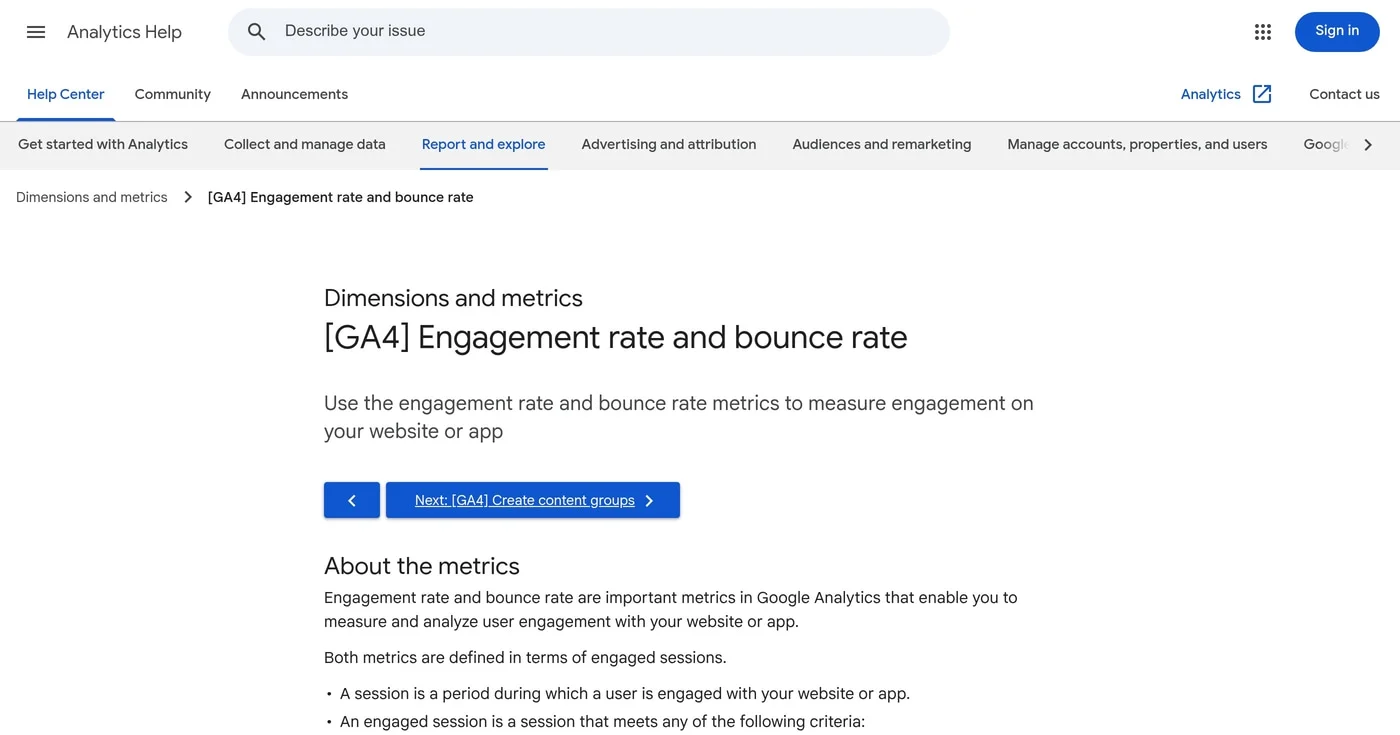
Bounce rate in GA4 is the share of sessions that were not engaged. See how that differs from Universal Analytics, why samples disagree, and what to check first.
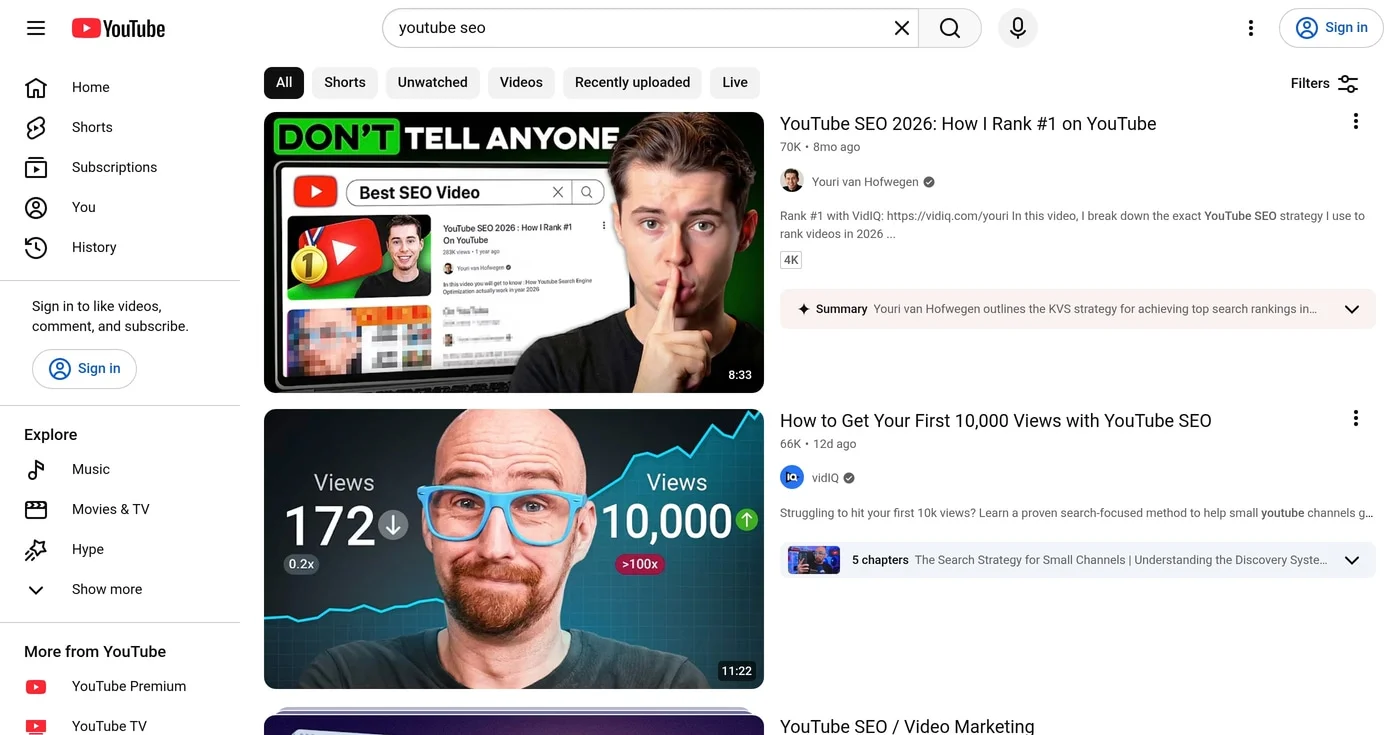
YouTube SEO matches a video to a query. See the ranking factors YouTube names, the official metadata limits, and why retention has no published cutoff.

A marketing qualified lead and a sales qualified lead are different bars. See who sets each label, the handoff criteria, and why no score is universal.
