
January 13, 202632 min readMarketing Operations

10 Best MRM Software Solutions for 2026

Discover the top 10 best MRM software solutions for 2026. Compare features, pricing, and capabilities to find the perfect marketing resource management tool.

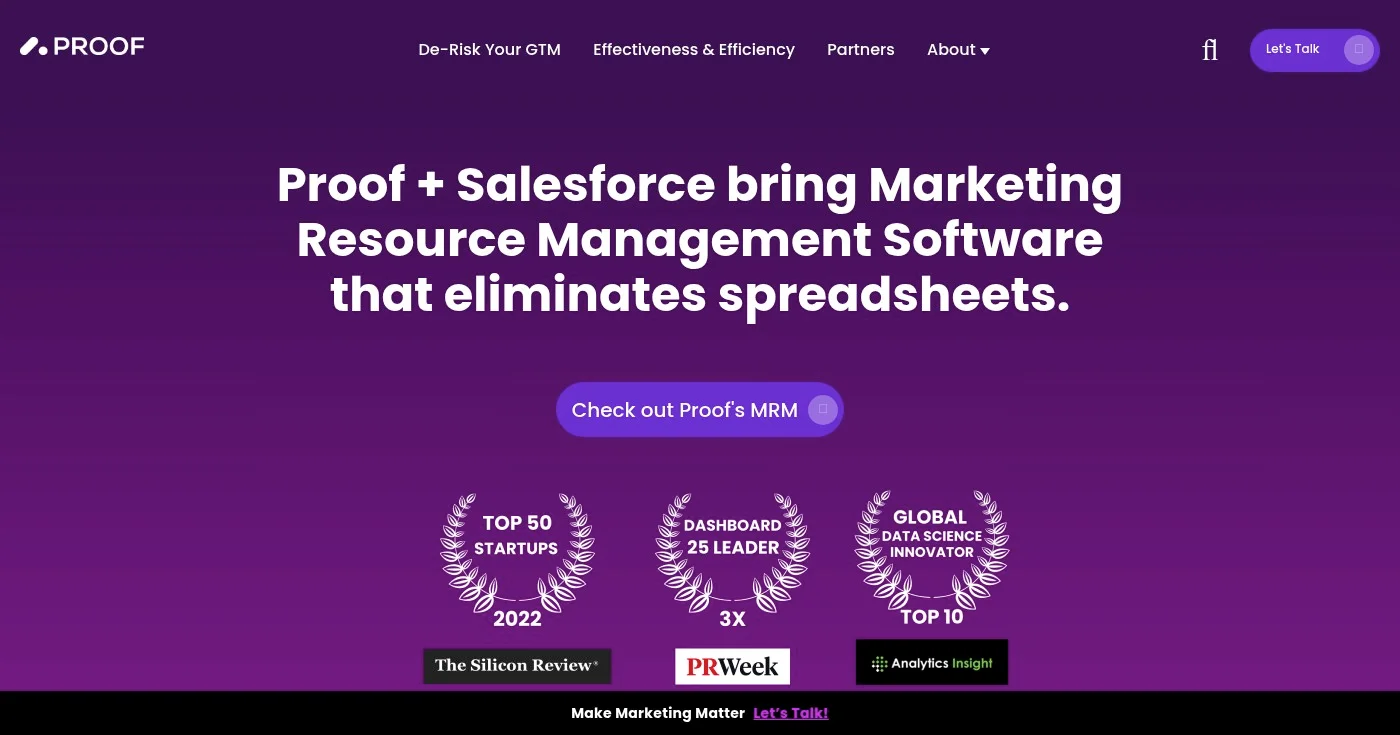
Screenshot of Proof Analytics homepage

Marketing resource management software has become essential for organizations looking to streamline their marketing operations, optimize budgets, and improve campaign coordination.

As marketing teams manage increasingly complex multi-channel campaigns, MRM platforms provide the centralized control needed to coordinate activities, track spending, and maximize ROI.

The global MRM market is experiencing significant growth, valued at approximately $5.16 billion in 2024, it's projected to reach $12.57 billion by 2032, growing at a 12.57% CAGR.

Other analysts project even faster growth, with MarketsandMarkets forecasting a 10.9% CAGR and Grand View Research estimating 12.4% CAGR through 2030.

In this guide, you'll explore the top 10 picks available in 2026 to make an informed decision.

Key Takeaways

  • Enterprise-grade MRM solutions like Infor and Kantata offer comprehensive budget tracking, resource optimization, and workflow automation for large marketing departments
  • Work management platforms such as monday.com and Wrike provide flexible MRM capabilities with AI-powered analytics at more accessible price points starting from free plans
  • Specialized solutions like Proof Analytics integrate directly with Salesforce to eliminate spreadsheet-based processes and manage billions in marketing spend
  • Modern MRM software increasingly incorporates AI features for predictive analytics, automated resource allocation, and intelligent workflow optimization

Evaluation Criteria

To identify the best marketing resource management software for 2026, I analyzed each platform's core MRM capabilities, pricing transparency, integration ecosystem, and user feedback. I prioritized solutions that offer comprehensive budget tracking, resource optimization, workflow automation, and strong reporting capabilities. The evaluation considered both enterprise-grade platforms designed for large marketing departments and more flexible work management solutions that can be adapted for marketing resource management needs. Special attention was given to AI-powered features, ease of implementation, and the ability to scale with growing marketing operations.

  • Budget Management and Financial Tracking: When evaluating MRM software, you need robust budget management capabilities that provide real-time visibility into marketing spend across campaigns, channels, and departments. Look for features like multi-currency support, cost allocation, variance tracking, and financial forecasting to ensure you can optimize your marketing investments and demonstrate ROI to stakeholders.
  • Resource Planning and Capacity Management: Effective resource management is critical for maximizing team productivity and preventing burnout. The best MRM platforms offer visual resource allocation tools, capacity planning features, skills-based assignment capabilities, and workload balancing to help you optimize how your marketing team's time and expertise are deployed across projects.
  • Workflow Automation and Approval Processes: Marketing operations involve numerous repetitive tasks and approval workflows that can slow down campaign execution. Evaluate how well each platform automates routine processes, manages creative approvals, handles review cycles, and streamlines handoffs between team members to reduce bottlenecks and accelerate time-to-market.
  • Integration Capabilities and Ecosystem: Your MRM software needs to connect seamlessly with your existing marketing technology stack, including CRM systems, marketing automation platforms, digital asset management tools, and analytics solutions. Strong integration capabilities ensure data flows smoothly between systems and eliminate manual data entry that leads to errors and inefficiency.
  • Reporting, Analytics, and Visibility: Comprehensive reporting and analytics capabilities enable data-driven decision-making and demonstrate marketing's business impact. Look for customizable dashboards, real-time reporting, predictive analytics, campaign performance tracking, and executive-level visibility features that help you identify trends, optimize strategies, and communicate results effectively.
  • AI and Intelligent Automation Features: Modern MRM platforms increasingly incorporate artificial intelligence to enhance decision-making, automate resource allocation, predict project risks, and optimize workflows. AI-powered features like intelligent scheduling, automated proposal generation, sentiment analysis, and predictive forecasting can significantly improve operational efficiency and strategic planning.

Comparison Table

Tool

Best For

Key Features

Pricing

Free Plan

Platforms

Infor MRM

Large enterprises with complex multi-channel marketing operations

Digital asset management, Budget and cost tracking

Contact for pricing

No

Web

Proof Analytics

Salesforce users eliminating spreadsheet processes

Salesforce integration, Marketing spend optimization

Contact for pricing

No

Web

monday.com

Teams needing flexible AI-powered work management
Dashboards, Automations

Free plan available, paid from $9/user/month

Yes

Web, iOS, Android

Wrike

Enterprise teams with cross-functional collaboration needs
AI-powered analytics, Gantt charts

Free plan available, paid from $10/user/month

Yes

Web, Mobile

Scoro

Professional services firms managing projects and finances
Project management, Financial management

From €18.90/user/month

No

Web

Screendragon

Marketing agencies automating complex workflows
AI-powered workflow automation, Resource optimization

Contact for pricing

No

Web

Kantata

Professional services optimizing resource utilization
AI-powered Expertise Engine, Sales accelerator

Contact for pricing

No

Web

Bonsai Agency Software

Creative freelancers and small agencies
Project management, Invoice tracking

From $9/user/month

No

Web

Miro

Teams collaborating on marketing planning visually
Collaborative canvas, AI-powered workflows

Free plan available, paid from $8/user/month

Yes

Web

SAS Customer Intelligence 360

Enterprises delivering personalized customer experiences
Dynamic audience creation, Customer journey orchestration

Contact for pricing

No

Web

1. Infor Marketing Resource Management (MRM)

Best for Large enterprises with complex multi-channel marketing operations

Infor Marketing Resource Management is a comprehensive, scalable solution designed for marketing departments that need to coordinate all marketing activities across omni-channel and direct campaigns. The platform provides a centralized hub for managing digital assets, resources, projects, budgets, and creative approvals.

What sets Infor MRM apart is its advanced marketing calendar with customizable Gantt chart views that give you complete visibility into campaign timelines and dependencies. The platform excels at financial management with multi-currency budget tracking, cost allocation, and variance reporting that help you optimize marketing investments and demonstrate ROI.

Infor MRM's workflow automation capabilities streamline approval processes and eliminate bottlenecks that slow down campaign execution. The platform includes campaign and activity templates that standardize processes while maintaining flexibility for unique initiatives. With comprehensive analytics and reporting features, you can track performance across all marketing activities and make data-driven decisions to improve outcomes.

Key Features

  • Digital Asset Management: Centralized repository for storing, organizing, and distributing marketing assets across teams and campaigns with version control and usage rights management
  • Advanced Marketing Calendar: Customizable calendar views including Gantt charts that provide visual timeline management and dependency tracking across all marketing activities
  • Multi-Currency Budget Management: Comprehensive financial tracking with support for multiple currencies, cost allocation, variance reporting, and budget forecasting capabilities
  • Workflow Automation and Approvals: Automated approval processes for creative assets, campaign launches, and budget requests that accelerate execution and maintain compliance
  • Capacity Planning and Resource Management: Visual resource allocation tools that help you optimize team capacity, balance workloads, and identify resource constraints before they impact delivery

Pricing

Infor MRM uses custom enterprise pricing based on your organization's size, requirements, and deployment preferences. Contact their sales team for a detailed quote. For more information, visit their pricing page.

  • Enterprise: Contact for pricing

View pricing details

Pros

  • Centralized platform consolidates all marketing activities, eliminating the need for multiple disconnected tools
  • Advanced financial management capabilities provide granular budget tracking and cost optimization across campaigns
  • Strong workflow automation reduces manual tasks and accelerates campaign approval processes
  • Comprehensive analytics and reporting deliver actionable insights for continuous improvement
  • Campaign templates standardize processes while maintaining flexibility for unique initiatives

Cons

  • Pricing not publicly available requires contacting sales, making it difficult to assess budget fit
  • Enterprise focus may result in complexity that's unnecessary for smaller marketing teams
  • No free trial or freemium option mentioned limits ability to evaluate before committing
  • Limited information on deployment options and platform compatibility beyond web access

2. Proof Analytics

Best for Salesforce users eliminating spreadsheet processes

Screenshot of Proof Analytics homepage

Proof Analytics is a specialized MRM platform that integrates directly with Salesforce to eliminate spreadsheet-based marketing management processes. The platform is trusted by major enterprises including Amazon, Samsung, Honeywell, Deloitte, and Oracle to optimize and track billions in marketing spend.

The platform's deep Salesforce integration is its defining characteristic, allowing you to manage marketing resources within your existing CRM ecosystem without switching between systems. This integration ensures that marketing data flows seamlessly into your broader business intelligence and reporting infrastructure.

Proof Analytics focuses on eliminating the manual, error-prone spreadsheet processes that plague many marketing operations. By automating spend tracking, budget allocation, and resource management within Salesforce, the platform reduces administrative overhead and improves data accuracy. The solution is particularly valuable for organizations that have already invested heavily in the Salesforce ecosystem and want to extend its capabilities to marketing resource management.

Key Features

  • Native Salesforce Integration: Built directly into Salesforce, eliminating the need for separate systems and ensuring seamless data flow between marketing operations and CRM
  • Marketing Spend Optimization: Advanced analytics and tracking capabilities that help you optimize billions in marketing spend across channels, campaigns, and business units
  • Spreadsheet Elimination: Automated workflows replace manual spreadsheet processes, reducing errors and administrative burden while improving data accuracy
  • Multi-Channel Marketing Management: Comprehensive tools for planning, executing, and tracking marketing activities across all channels from a single platform
  • Budget Tracking and Allocation: Real-time visibility into marketing budgets with automated allocation, tracking, and variance reporting capabilities

Pricing

Proof Analytics uses custom enterprise pricing tailored to your organization's Salesforce environment and marketing operations complexity. Contact their team for a personalized quote. For more details, visit their pricing page.

  • Enterprise: Contact for pricing

View pricing details

Pros

  • Deep Salesforce integration leverages existing CRM investment and ensures data consistency
  • Trusted by major enterprises managing billions in marketing spend demonstrates enterprise-grade reliability
  • Eliminates error-prone spreadsheet processes that consume time and introduce inaccuracies
  • Comprehensive MRM capabilities within familiar Salesforce interface reduces learning curve
  • Scales to handle complex, multi-channel marketing operations across large organizations

Cons

  • Requires Salesforce, limiting options for organizations using other CRM platforms
  • No transparent pricing available makes budget planning difficult
  • Limited feature details on homepage may require extensive sales conversations to understand capabilities
  • Appears focused on enterprise market, potentially pricing out smaller organizations

3. monday.com

Best for Teams needing flexible AI-powered work management

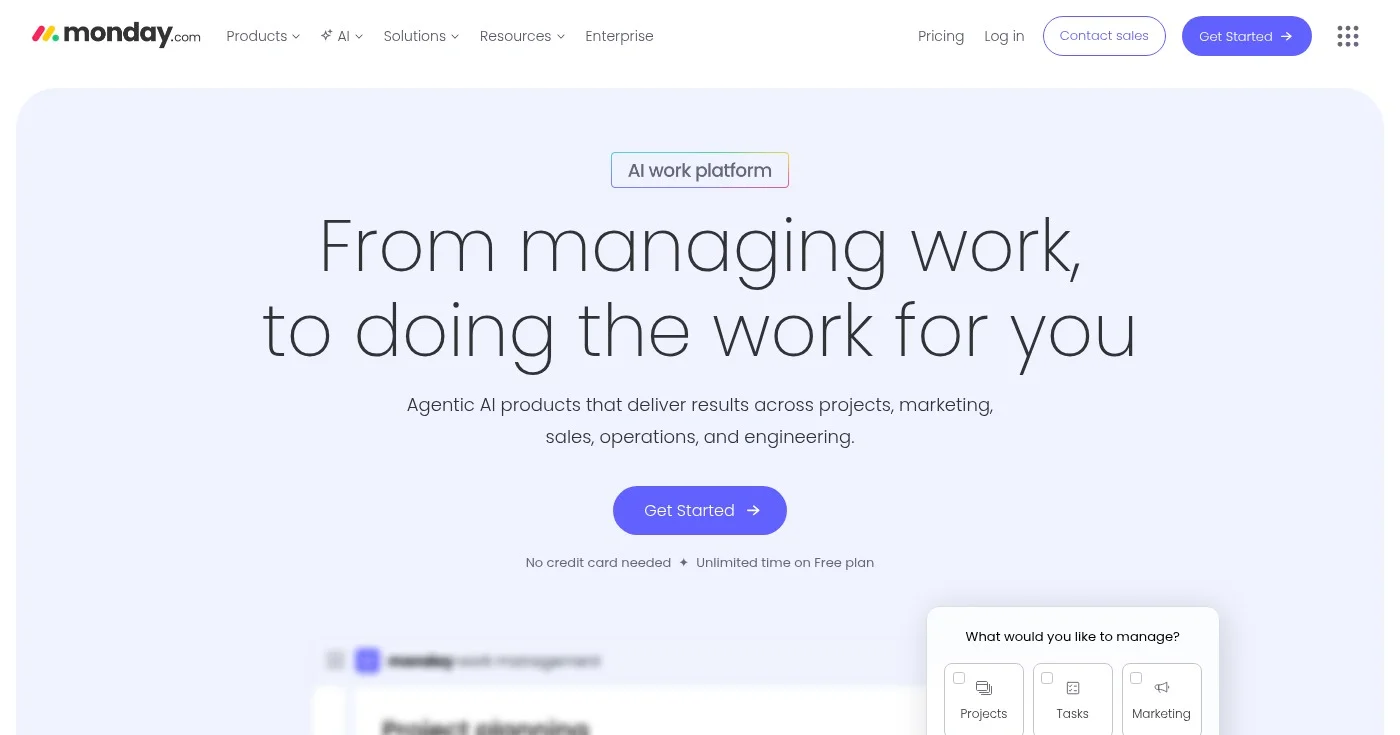
Screenshot of monday.com homepage

monday.com is an AI-powered work platform that offers flexible solutions for project management, CRM, marketing campaigns, and operations. While not exclusively an MRM platform, its comprehensive feature set and marketing-specific capabilities make it an excellent choice for teams that need adaptable marketing resource management.

The platform's strength lies in its flexibility and visual interface that makes complex workflows easy to understand and manage. You can customize boards, dashboards, and automations to match your specific marketing processes without requiring technical expertise. The AI-powered features help automate routine tasks, provide intelligent insights, and accelerate decision-making.

monday.com offers specialized products including monday Campaigns specifically designed for marketing teams to plan, execute, and track campaigns from a single platform. The platform's extensive integration ecosystem connects with your existing marketing tools, while the mobile apps ensure your team stays connected whether they're in the office or working remotely. With a generous free plan and transparent pricing starting at just $9 per seat monthly, it's accessible for teams of all sizes.

Key Features

  • Customizable Dashboards and Boards: Visual, flexible boards that you can customize to match your marketing workflows, with real-time updates and multiple view options including Kanban, Gantt, and calendar
  • AI-Powered Automation: Intelligent automations that eliminate repetitive tasks, trigger actions based on conditions, and provide AI-driven insights to optimize workflows
  • monday Campaigns: Specialized marketing campaign management product with tools for planning, collaboration, asset management, and performance tracking
  • Extensive Integrations: Connects with hundreds of popular marketing tools including Slack, Google Workspace, Adobe Creative Cloud, and social media platforms
  • Mobile Apps: Full-featured iOS and Android apps ensure your team can manage marketing resources and stay updated from anywhere

Pricing

monday.com offers a free plan with unlimited time and no credit card required. Paid plans start at $9 per seat/month for the Basic tier, with Standard at $12/month, Pro at $19/month, and custom Enterprise pricing available. For complete details, visit their pricing page.

  • Free: $0
  • Basic: $9/seat/month
  • Standard: $12/seat/month
  • Pro: $19/seat/month
  • Enterprise: Contact sales

View pricing details

Pros

  • Free plan with unlimited time allows you to test the platform thoroughly before upgrading
  • Highly flexible and customizable to match any marketing workflow without technical expertise
  • AI-powered features automate routine tasks and provide intelligent recommendations
  • Transparent pricing with multiple tiers makes it accessible for teams of all sizes
  • Comprehensive mobile apps keep teams connected and productive from anywhere

Cons

  • Not purpose-built for MRM may require more setup and customization than specialized platforms
  • Feature-rich interface can have a learning curve for new users
  • Advanced features and automations require paid plans
  • May need multiple products (Work Management + Campaigns) for complete MRM functionality

4. Wrike

Best for Enterprise teams with cross-functional collaboration needs

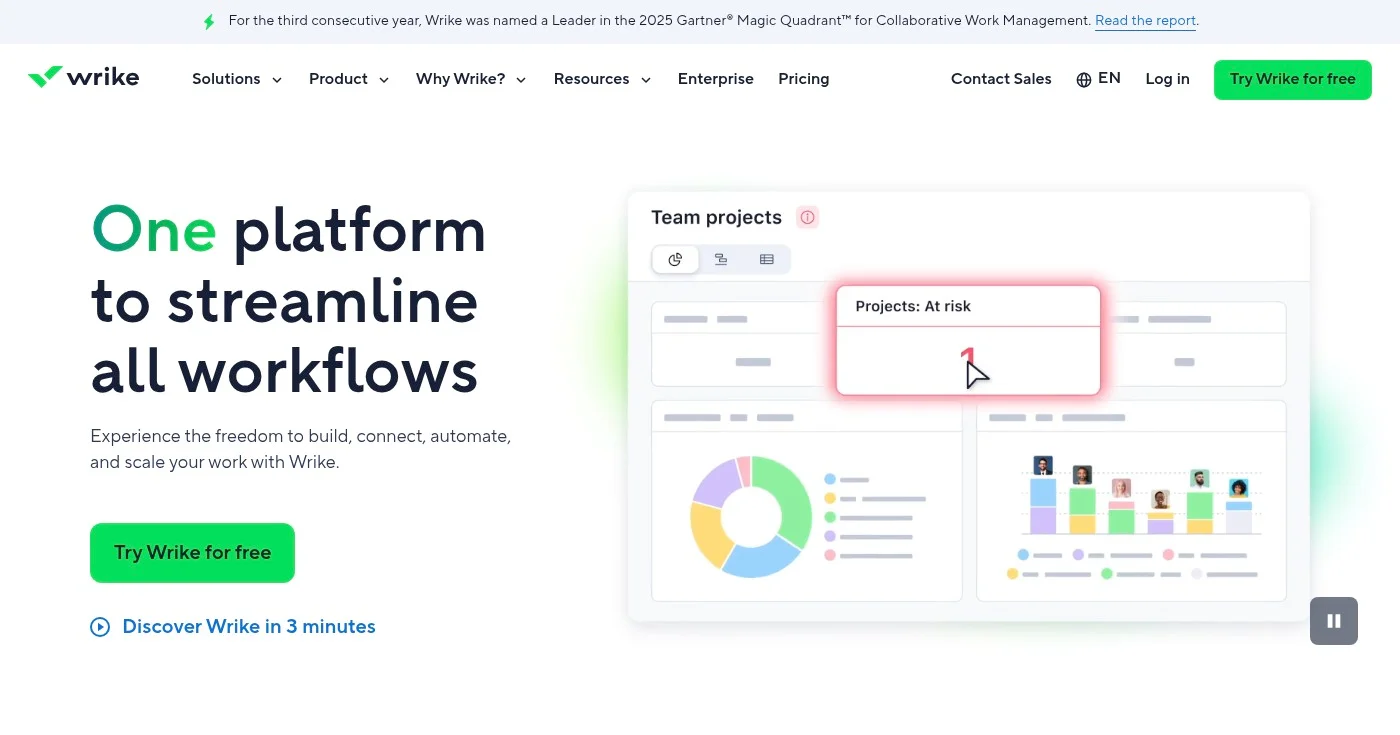
Screenshot of Wrike homepage

Wrike is an AI-powered enterprise work management platform recognized as a Leader in the 2025 Gartner Magic Quadrant. The platform provides comprehensive tools for managing marketing resources across the entire workflow lifecycle, from ideation and planning through execution, reporting, and analysis.

Wrike's 360° visibility capabilities give you complete transparency across projects, departments, and resources, making it ideal for large marketing organizations with complex cross-functional workflows. The AI-driven analytics provide predictive insights and risk identification that help you proactively address issues before they impact delivery.

The platform excels at resource management with visual allocation tools, capacity planning, and workload balancing features that optimize how your marketing team's time is deployed. Proofing and approval workflows streamline creative review processes, while real-time dashboards keep stakeholders informed without requiring manual status updates. Trusted by over 20,000 organizations including major enterprises, Wrike scales to handle the most demanding marketing operations while remaining accessible through a free plan for smaller teams.

Key Features

  • AI-Powered Analytics and Risk Prediction: Intelligent analytics that identify trends, predict project risks, and provide data-driven recommendations to optimize marketing operations
  • 360° Visibility Across Projects: Comprehensive dashboards and reporting that provide complete transparency into all marketing activities, resources, and performance metrics
  • Advanced Resource Management: Visual resource allocation, capacity planning, and workload balancing tools that optimize team utilization and prevent burnout
  • Proofing and Approval Workflows: Streamlined creative review processes with markup tools, version control, and automated approval routing that accelerate campaign launches
  • Request Forms and Intake Management: Customizable intake forms that standardize project requests, capture requirements, and automatically create tasks with proper assignments

Pricing

Wrike offers a free plan for small teams. Paid plans start at $10 per user/month for the Team tier and $25 per user/month for Business. Enterprise pricing is available through their sales team. For complete pricing information, visit their pricing page.

  • Free: $0
  • Team: $10/user/month
  • Business: $25/user/month
  • Enterprise: Contact sales

View pricing details

Pros

  • Named Leader in 2025 Gartner Magic Quadrant demonstrates industry recognition and reliability
  • AI-powered analytics provide predictive insights that help you proactively manage risks
  • 360° visibility ensures complete transparency across complex, cross-functional marketing operations
  • Free plan available allows teams to start without financial commitment
  • Trusted by over 20,000 organizations including major enterprises proves enterprise-grade scalability

Cons

  • Enterprise-focused feature set may be overwhelming for small marketing teams
  • Learning curve for advanced features requires training investment
  • Mobile app functionality may be limited compared to web version
  • Pricing for higher tiers not disclosed on website requires sales contact

5. Scoro

Best for Professional services firms managing projects and finances

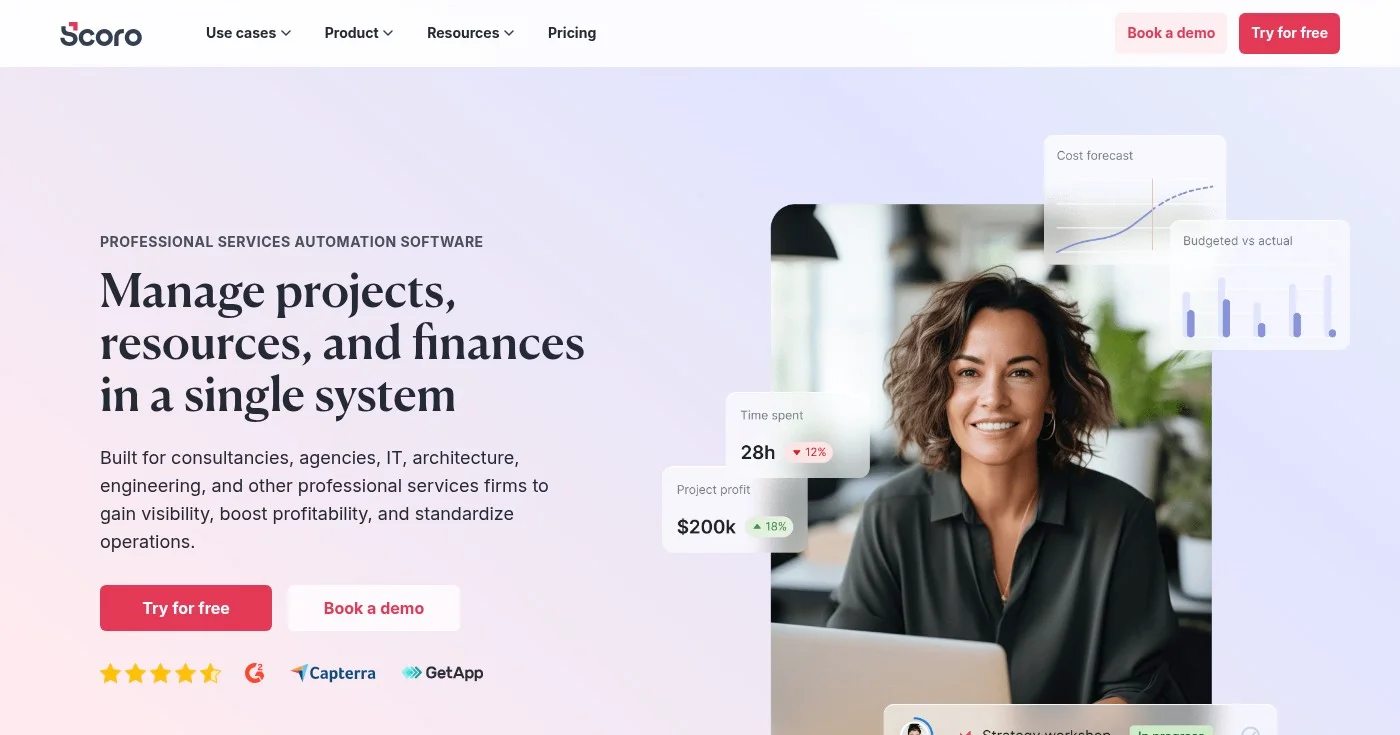
Screenshot of Scoro homepage

Scoro is a comprehensive Professional Services Automation (PSA) platform that combines project management, resource planning, and financial management in a unified system. While designed for professional services firms, its robust capabilities make it an excellent choice for marketing agencies and in-house marketing teams that need tight integration between project delivery and financial tracking.

The platform's strength lies in its end-to-end workflow coverage, taking you from initial quote and budgeting through project delivery, time tracking, invoicing, and financial reporting. This quote-to-cash approach ensures nothing falls through the cracks and provides complete visibility into project profitability.

Scoro's resource planning capabilities help you optimize team utilization with visual scheduling, capacity planning, and skills-based assignment features. The financial management tools provide real-time visibility into budgets, costs, and profitability at both project and portfolio levels. Role-based functionality ensures team members see relevant information for their responsibilities, whether they're project managers, creatives, account managers, or executives. The platform supports multiple industries including agencies, consultancies, and software development firms.

Key Features

  • Quote-to-Cash Workflow: Complete project lifecycle management from initial quoting and budgeting through delivery, invoicing, and financial reporting in one unified system
  • Resource Planning and Scheduling: Visual resource allocation with capacity planning, skills-based assignment, and workload balancing to optimize team utilization
  • Financial Management and Profitability Tracking: Real-time visibility into budgets, costs, and profitability at project and portfolio levels with comprehensive financial reporting
  • Time Tracking and Invoicing: Integrated time tracking with automated invoicing and cost control features that ensure accurate billing and project profitability
  • Sales and CRM Integration: Built-in CRM capabilities that connect sales activities with project delivery, ensuring smooth handoffs and complete client visibility

Pricing

Scoro's Core plan starts at €18.90 per user/month (or €15.90/month billed annually), Growth at €29.90/month (€26.90 annually), and Performance at €49.90/month (€43.90 annually). Enterprise pricing is available through their sales team. For complete details, visit their pricing page.

  • Core (monthly): €18.90/user/month
  • Core (annual): €15.90/user/month (billed annually)
  • Growth (monthly): €29.90/user/month
  • Growth (annual): €26.90/user/month (billed annually)
  • Performance (monthly): €49.90/user/month
  • Performance (annual): €43.90/user/month (billed annually)
  • Enterprise: Contact sales

View pricing details

Pros

  • Comprehensive PSA solution eliminates need for multiple disconnected tools
  • Strong financial management provides real-time profitability tracking at project and portfolio levels
  • Quote-to-cash workflow ensures nothing falls through the cracks from sales to delivery
  • Role-based functionality tailors interface and features to different team member needs
  • Supports multiple industries including agencies, consultancies, and professional services firms

Cons

  • Web-based only with no native mobile apps may limit accessibility for field teams
  • Comprehensive feature set may be complex for small teams with simple needs
  • Pricing in Euros may create currency conversion considerations for non-European organizations
  • Learning curve for full platform utilization requires training investment

6. Screendragon

Best for Marketing agencies automating complex workflows

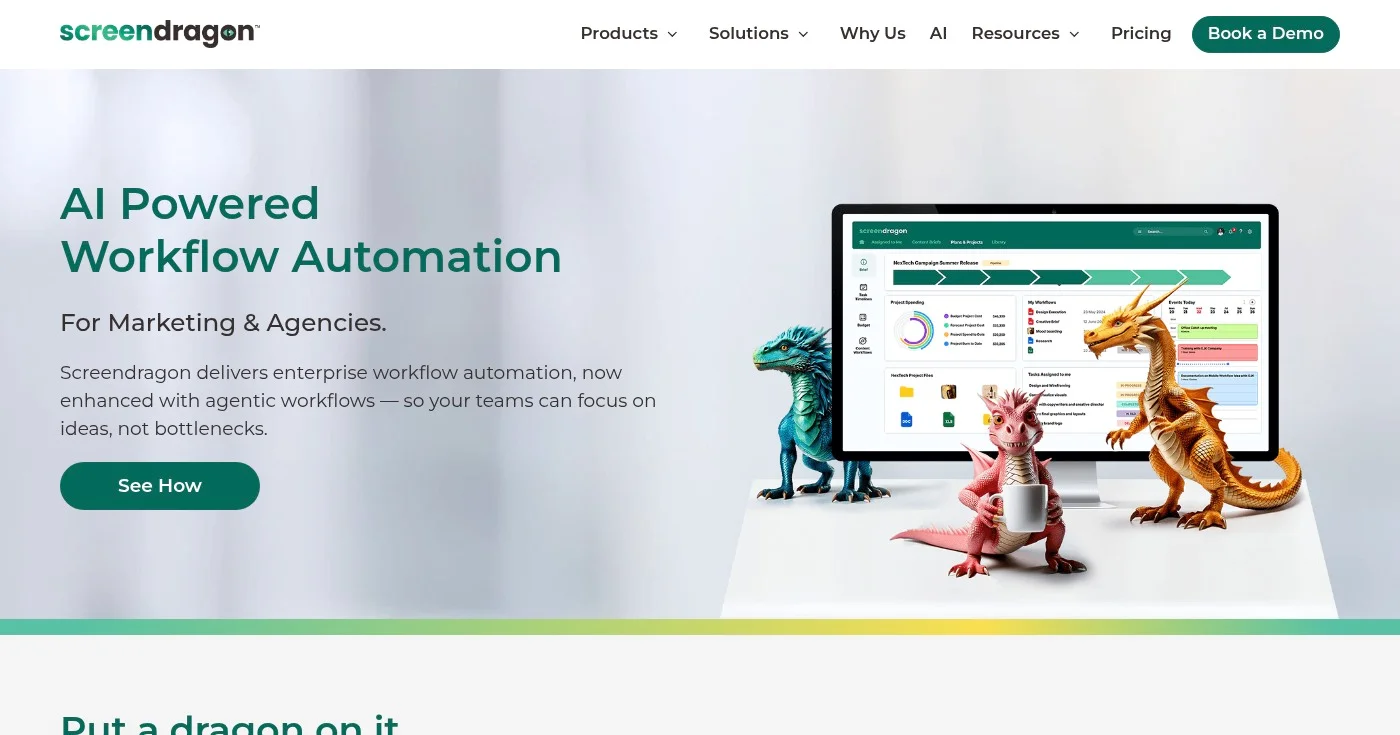
Screenshot of Screendragon homepage

Screendragon is an AI-powered workflow automation platform specifically designed for marketing teams and agencies. The platform focuses on eliminating bottlenecks and streamlining complex marketing operations through intelligent automation and real-time visibility.

What distinguishes Screendragon is its emphasis on workflow automation that handles the tedious manual tasks that slow down marketing operations. The platform automates proposals, briefs, reviews, and approvals, freeing your team to focus on strategic and creative work rather than administrative processes.

The platform provides real-time visibility into team capacity and resource allocation, helping you optimize utilization and prevent overallocation. Project and client profitability tracking ensures you understand which engagements are most valuable and where to focus your efforts. The agentic workflow capabilities adapt to your specific processes and continuously optimize based on patterns and outcomes. Screendragon is particularly well-suited for agencies and large marketing departments that manage complex, multi-stakeholder workflows across numerous concurrent projects.

Key Features

  • AI-Powered Workflow Automation: Intelligent automation that eliminates manual tasks by automatically handling proposals, briefs, reviews, approvals, and routine administrative processes
  • Real-Time Resource Visibility: Live visibility into team capacity, workload, and availability that helps you optimize resource allocation and prevent overallocation
  • Project and Client Profitability Tracking: Comprehensive financial tracking that shows profitability at both project and client levels, helping you focus on the most valuable engagements
  • Bottleneck Elimination: Automated identification and resolution of workflow bottlenecks that slow down campaign execution and project delivery
  • Agentic Workflow Capabilities: Adaptive workflows that learn from your processes and continuously optimize based on patterns, outcomes, and team behavior

Pricing

Screendragon uses custom enterprise pricing based on your organization's size, workflow complexity, and specific requirements. Contact their team for a personalized quote and demo. For more information, visit their pricing page.

  • Enterprise: Contact for pricing

View pricing details

Pros

  • AI-powered automation eliminates tedious manual tasks and accelerates campaign execution
  • Real-time visibility into team capacity prevents overallocation and optimizes resource utilization
  • Project profitability tracking helps you focus on the most valuable clients and engagements
  • Purpose-built for marketing agencies and teams with complex, multi-stakeholder workflows
  • Agentic workflows adapt and optimize based on your specific processes and patterns

Cons

  • No free plan available requires financial commitment to evaluate
  • Pricing not publicly disclosed makes budget planning difficult
  • Enterprise focus may result in complexity unnecessary for small teams
  • Requires demo and consultation to understand full capabilities and pricing

7. Kantata

Best for Professional services optimizing resource utilization

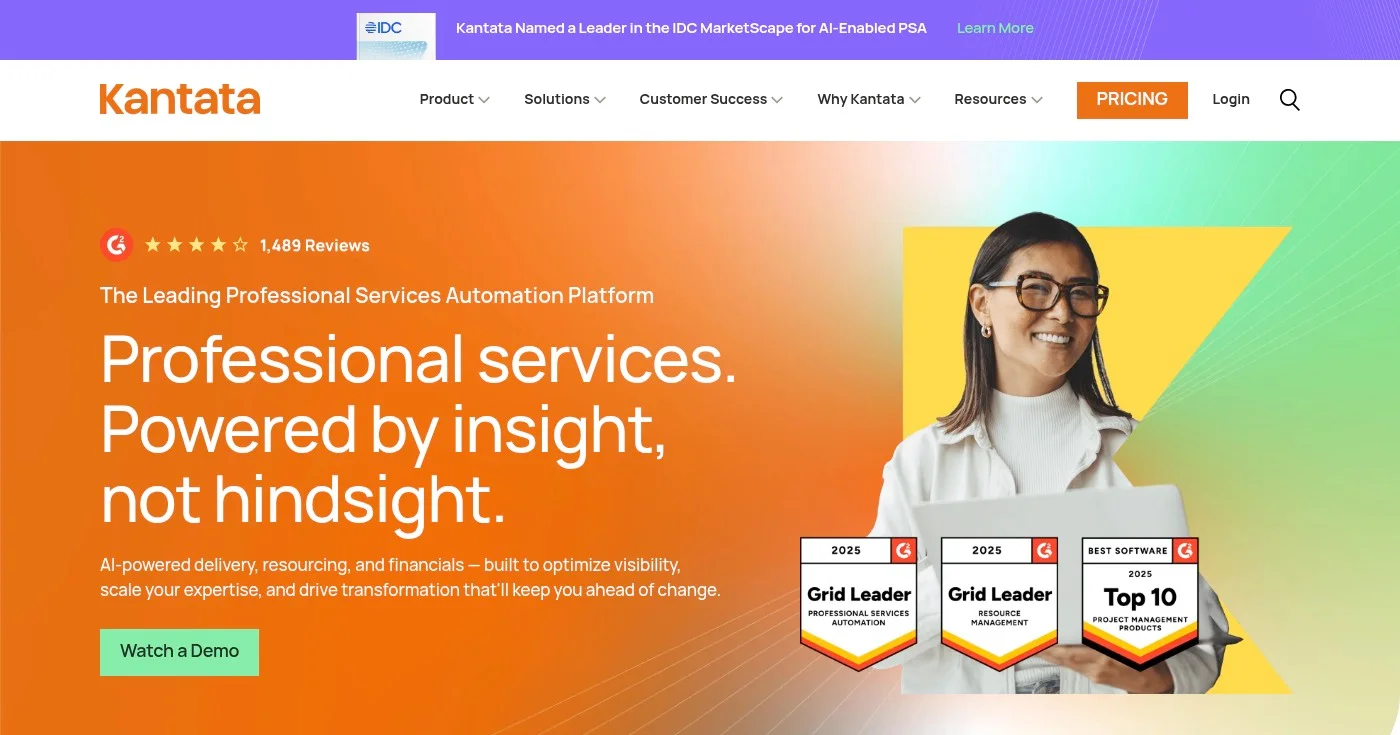
Screenshot of Kantata homepage

Kantata is an AI-powered Professional Services Automation platform built around its proprietary Expertise Engine™ that optimizes delivery, resourcing, and financials for professional services firms. While focused on professional services, its sophisticated resource optimization capabilities make it valuable for large marketing organizations and agencies.

The platform's AI-powered accelerators transform key business processes: the Sales Accelerator automates proposal generation with intelligent scoping and pricing, the Resourcing Accelerator assembles optimal teams based on skills and sentiment analysis, the Delivery Accelerator provides real-time project guidance with risk prediction, and the Forecast Accelerator delivers revenue predictions with scenario planning.

Kantata's strength lies in its ability to dramatically improve resource utilization—customers report an 82% increase in resource utilization after implementation. The platform scales expertise without increasing hours by intelligently matching resources to projects based on skills, availability, and past performance. Real-time project insights and risk prediction help you proactively address issues before they impact delivery or profitability.

Key Features

  • AI-Powered Expertise Engine™: Proprietary AI system that optimizes resource allocation, project delivery, and financial forecasting based on skills, sentiment, and historical performance
  • Sales Accelerator: Automated proposal generation with AI-driven scoping and pricing that reduces sales cycle time and improves win rates
  • Resourcing Accelerator: Intelligent team assembly that matches resources to projects based on skills, availability, sentiment analysis, and past performance
  • Delivery Accelerator: Real-time project guidance with predictive risk identification that helps you proactively address issues before they impact outcomes
  • Forecast Accelerator: Revenue prediction with scenario planning capabilities that improve financial forecasting accuracy and strategic planning

Pricing

Kantata uses custom enterprise pricing tailored to your organization's size, complexity, and specific requirements. Contact their team for a detailed quote and demonstration of the Expertise Engine™. For more details, visit their pricing page.

  • Enterprise: Contact for pricing

View pricing details

Pros

  • AI-powered automation dramatically reduces manual work across sales, resourcing, delivery, and forecasting
  • 82% increase in resource utilization reported by customers demonstrates measurable ROI
  • Real-time project insights and risk prediction enable proactive issue resolution
  • Scales expertise without increasing hours by optimizing resource allocation
  • Comprehensive PSA capabilities cover entire project lifecycle from sales to delivery

Cons

  • No free plan available requires enterprise-level commitment
  • Pricing not transparent on website necessitates sales conversations
  • Enterprise focus may be overkill for small marketing teams or agencies
  • Learning curve for AI-powered features requires training investment

8. Bonsai Agency Software

Best for Creative freelancers and small agencies

Screenshot of Bonsai Agency Software homepage

Bonsai Agency Software is a business management solution designed specifically for creative freelancers and small agencies. While simpler than enterprise MRM platforms, it provides essential tools for managing projects, clients, and finances in one centralized platform.

The platform focuses on the core needs of creative professionals: project management to track deliverables and deadlines, client management to maintain relationships and communication, and financial tools for invoicing, payment tracking, and expense management. This all-in-one approach eliminates the need for multiple disconnected tools.

Bonsai includes contract templates that help you quickly create professional agreements, proposal generation tools to win new business, and time tracking capabilities to ensure accurate billing. The platform is particularly valuable for freelancers and small agencies that need professional business management tools without the complexity and cost of enterprise solutions. With pricing starting at just $9 per user monthly, it's accessible for independent professionals and growing creative businesses.

Key Features

  • Project Management: Tools to track deliverables, deadlines, and project progress with task lists, milestones, and client collaboration features
  • Client Management: Centralized client database with communication history, project tracking, and relationship management capabilities
  • Invoice and Payment Tracking: Professional invoicing with payment tracking, automated reminders, and integration with payment processors for easy collection
  • Contract Templates: Pre-built contract templates for common creative services that you can customize and send for electronic signature
  • Time Tracking: Built-in time tracking that ensures accurate billing and helps you understand project profitability

Pricing

Bonsai's Basic plan starts at $9 per user/month, Essentials at $19/month, Premium at $29/month, and Elite at $49/month. Annual billing is available at the same monthly rates. For complete pricing details, visit their pricing page.

  • Basic: $9/user/month
  • Basic (annual): $9/user/month (billed annually)
  • Essentials: $19/user/month
  • Essentials (annual): $19/user/month (billed annually)
  • Premium: $29/user/month
  • Premium (annual): $29/user/month (billed annually)
  • Elite: $49/user/month
  • Elite (annual): $49/user/month (billed annually)

View pricing details

Pros

  • All-in-one solution eliminates need for multiple tools for freelancers and small agencies
  • Designed specifically for creative professionals with relevant features and workflows
  • Affordable pricing starting at $9/user/month makes it accessible for independent professionals
  • Contract templates and proposal tools help you win business and protect your interests
  • Centralized client and project management improves organization and professionalism

Cons

  • Limited information available about advanced features and capabilities
  • May lack sophistication needed by larger agencies with complex workflows
  • Web-only platform without native mobile apps may limit accessibility
  • No free plan available requires paid subscription to evaluate

9. Miro

Best for Teams collaborating on marketing planning visually

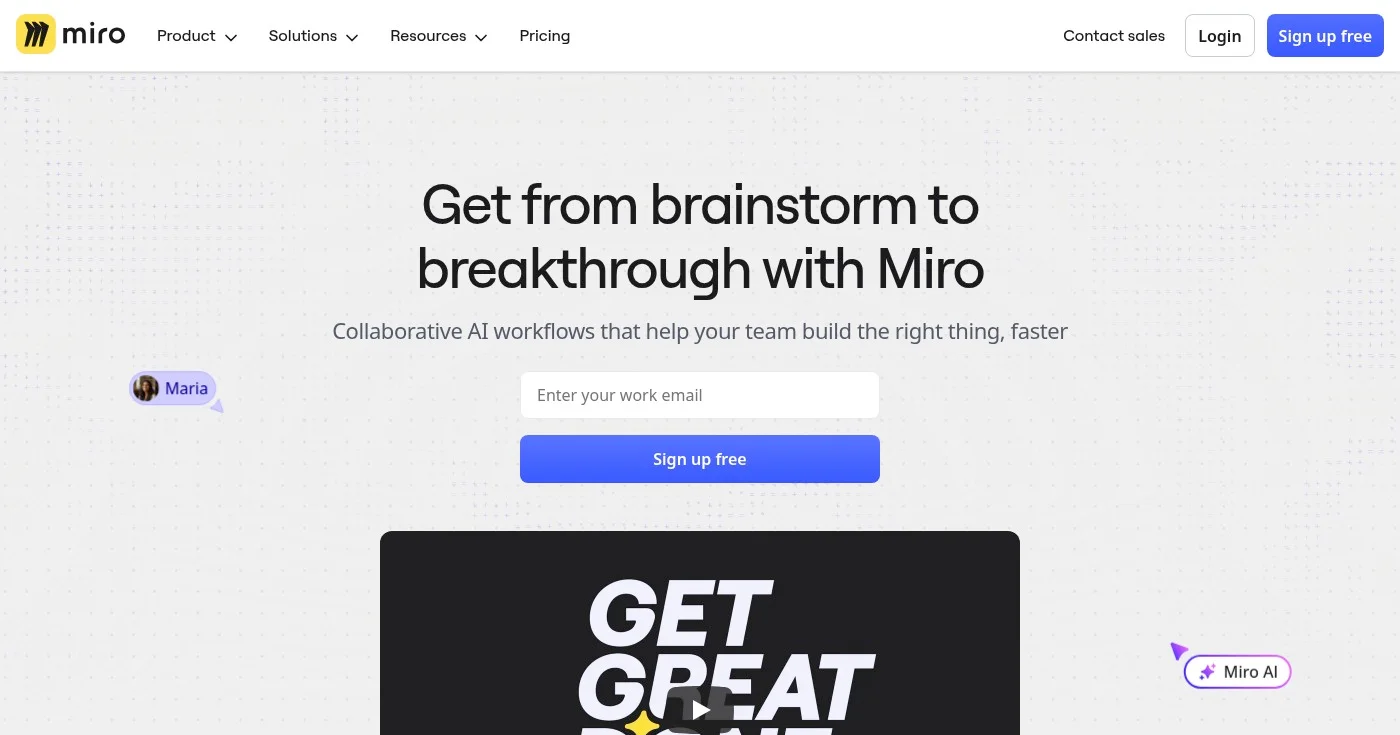
Screenshot of Miro homepage

Miro is a collaborative AI-powered workspace built around an infinite canvas that enables teams to brainstorm, plan, and execute projects visually. While not a traditional MRM platform, its visual collaboration capabilities make it valuable for marketing planning, campaign ideation, and cross-functional coordination.

Used by over 100 million users and 250,000 companies, Miro excels at bringing teams together for creative collaboration. The infinite canvas provides unlimited space for brainstorming sessions, campaign planning, customer journey mapping, and strategic planning. AI-powered workflows help you move from ideas to outcomes faster by automating routine tasks and providing intelligent suggestions.

Miro's strength lies in its real-time collaboration features that make remote and hybrid teamwork feel natural. Multiple team members can work simultaneously on the same board, with changes appearing instantly. The platform includes extensive template libraries for marketing planning, project management, and strategic frameworks. Data visualization tools help you transform complex information into clear, actionable insights. With a free plan and affordable paid tiers starting at $8 per user monthly (billed annually), Miro is accessible for teams of all sizes.

Key Features

  • Infinite Collaborative Canvas: Unlimited workspace for brainstorming, planning, and visual collaboration with real-time updates as team members contribute
  • AI-Powered Workflows: Intelligent automation and suggestions that help you move from ideation to execution faster with less manual work
  • Extensive Template Library: Pre-built templates for marketing planning, customer journey mapping, campaign calendars, and strategic frameworks
  • Data Visualization Tools: Transform complex data and insights into clear visual representations that make information actionable
  • Real-Time Team Collaboration: Multiple team members can work simultaneously with instant updates, comments, and reactions that make remote collaboration natural

Pricing

Miro offers a free plan with core features. The Starter plan costs $10 per user/month (or $8/month billed annually), Business at $20/month ($16 annually), and Enterprise pricing for teams of 30+ members. For complete details, visit their pricing page.

  • Free: $0
  • Starter (monthly): $10/user/month
  • Starter (annual): $8/user/month (billed annually)
  • Business (monthly): $20/user/month
  • Business (annual): $16/user/month (billed annually)
  • Enterprise: Contact sales (starting from 30 members)

View pricing details

Pros

  • Used by 100M+ users and 250,000 companies demonstrates widespread adoption and reliability
  • Infinite canvas provides unlimited space for creative collaboration and planning
  • AI-powered features accelerate ideation and execution
  • Free plan available allows teams to start without financial commitment
  • Real-time collaboration makes remote and hybrid teamwork feel natural

Cons

  • Not purpose-built for MRM requires adaptation for marketing resource management workflows
  • Visual, freeform nature may lack structure needed for complex project management
  • Can become cluttered with large, complex boards requiring organization discipline
  • Limited financial management and resource allocation features compared to dedicated MRM platforms

10. SAS Customer Intelligence 360

Best for Enterprises delivering personalized customer experiences

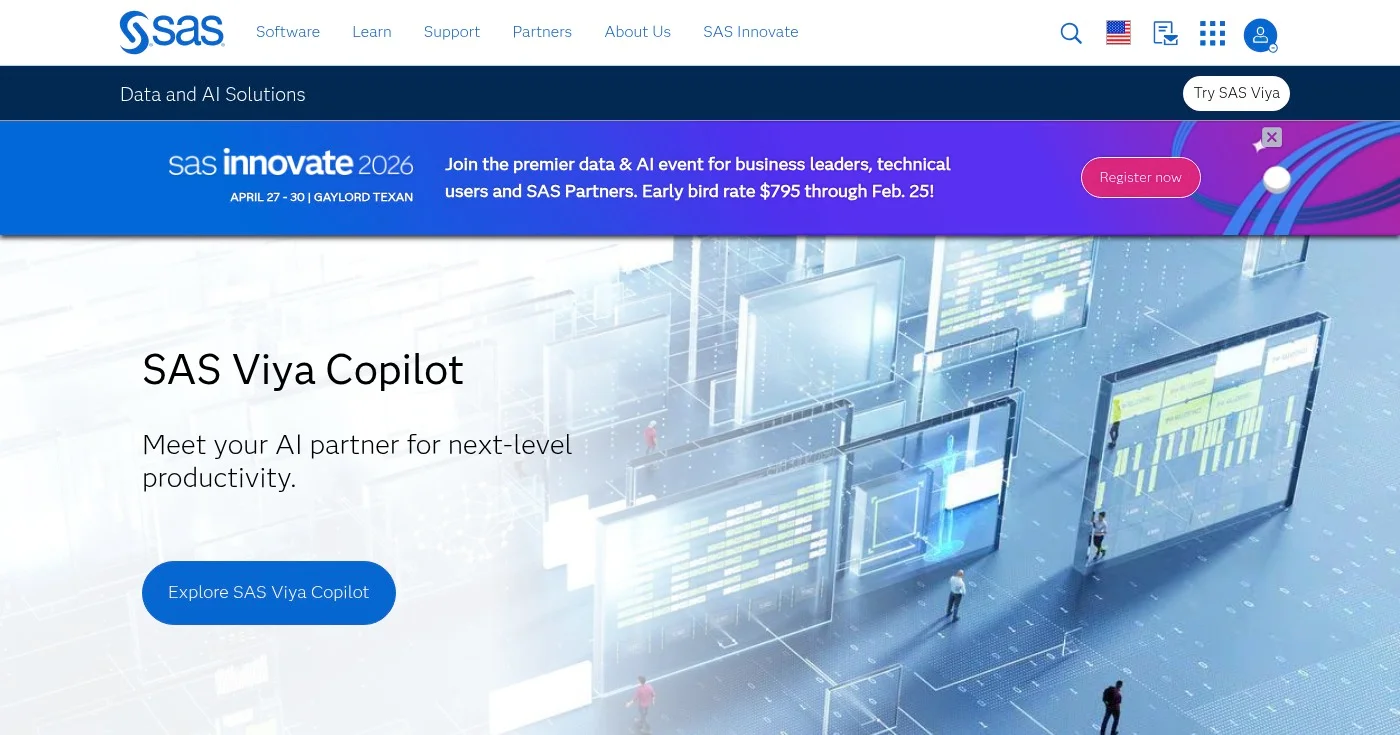
Screenshot of SAS Customer Intelligence 360 homepage

SAS Customer Intelligence 360 is an AI-powered customer intelligence platform that enables organizations to deliver hyper-personalized experiences by connecting to data wherever it lives. While focused on customer experience rather than traditional MRM, its sophisticated marketing orchestration capabilities make it valuable for large enterprises managing complex, multi-channel marketing operations.

The platform's strength lies in its ability to create dynamic audiences and orchestrate targeted customer journeys across all channels without requiring data migration. This approach maintains data privacy and security while enabling sophisticated personalization. The real-time decisioning capabilities ensure you engage customers with the right message at the right moment.

SAS Customer Intelligence 360 leverages trusted AI and advanced analytics to automate decision-making and optimize customer engagement strategies. The platform provides a unified approach to customer experience that connects marketing planning, execution, and measurement. It's particularly valuable for enterprises with complex data environments that need sophisticated personalization while maintaining strict data governance and privacy standards.

Key Features

  • Dynamic Audience Creation: Build and update customer segments in real-time based on behavior, preferences, and engagement patterns without manual intervention
  • Customer Journey Orchestration: Design and automate targeted customer journeys across all channels with intelligent branching based on customer actions and preferences
  • Real-Time Decisioning: AI-powered decision engine that determines the best next action for each customer in real-time based on context and objectives
  • Data Integration Without Migration: Connect to data wherever it lives without requiring migration, maintaining data governance and security while enabling analytics
  • Trusted AI and Advanced Analytics: Enterprise-grade AI capabilities with explainability, bias detection, and governance features that ensure responsible AI usage

Pricing

SAS Customer Intelligence 360 uses custom enterprise pricing based on your organization's size, data complexity, and specific requirements. Contact their team for a detailed quote. For more information, visit their pricing page.

  • Enterprise: Contact for pricing

View pricing details

Pros

  • Connects to data without migration maintains security and governance while enabling sophisticated analytics
  • Real-time decisioning ensures customers receive relevant, timely engagement
  • Trusted AI with explainability and governance features meets enterprise compliance requirements
  • Unified approach connects marketing planning, execution, and measurement
  • Hyper-personalization capabilities drive improved customer engagement and conversion

Cons

  • Enterprise pricing likely expensive for smaller organizations
  • Requires contacting sales for pricing information makes budget planning difficult
  • Complexity may require significant implementation and training investment
  • Focus on customer experience rather than traditional MRM may not fit all use cases

How to Choose

Selecting the ideal marketing resource management software depends on your organization's size, complexity, and specific operational needs. When evaluating MRM platforms, you need to consider how well each solution aligns with your marketing workflows, budget constraints, and growth trajectory.

  • Organization Size and Complexity: Enterprise organizations with large marketing departments, multiple business units, and complex approval workflows typically need comprehensive MRM platforms like Infor MRM, Kantata, or Screendragon that offer advanced budget tracking, resource optimization, and compliance features. Mid-sized teams may find better value in flexible work management platforms like monday.com or Wrike that can be adapted to marketing needs without enterprise complexity. Small agencies and freelancers should consider streamlined solutions like Bonsai that provide essential project and client management without overwhelming features.
  • Integration Requirements: Your MRM software must connect seamlessly with your existing marketing technology stack. If you're heavily invested in Salesforce, Proof Analytics' native integration eliminates the need for separate systems. Organizations using diverse tools should prioritize platforms with extensive integration ecosystems like monday.com or Wrike. Consider whether you need connections to CRM systems, marketing automation platforms, digital asset management tools, financial systems, and analytics solutions to ensure data flows smoothly without manual intervention.
  • Budget and Pricing Transparency: MRM platforms range from free plans to enterprise pricing requiring sales conversations. If you need to evaluate options within a specific budget, prioritize platforms with transparent pricing like monday.com (from $9/user/month), Wrike (from $10/user/month), or Miro (from $8/user/month). Enterprise solutions like Infor MRM, Kantata, and SAS Customer Intelligence 360 use custom pricing that may offer better value for large organizations but require sales engagement. Consider total cost of ownership including implementation, training, and ongoing support beyond subscription fees.
  • Specialized vs. Flexible Solutions: Decide whether you need a purpose-built MRM platform or a flexible work management solution you can adapt. Specialized MRM platforms like Infor MRM and Screendragon offer marketing-specific features like campaign calendars, creative approval workflows, and marketing budget tracking out of the box. Flexible platforms like monday.com, Wrike, and Miro require more configuration but offer broader capabilities for managing non-marketing work. If your marketing team collaborates extensively with other departments, flexible platforms may provide better cross-functional visibility and coordination.

Common Misconceptions: A common misconception is that more expensive enterprise MRM platforms are always better than flexible work management solutions. In reality, many marketing teams find that adaptable platforms like monday.com or Wrike provide sufficient MRM capabilities at a fraction of the cost, especially when they don't need specialized features like multi-currency budget tracking or compliance workflows. Another misconception is that MRM software alone will solve operational inefficiencies—successful implementation requires process optimization, team training, and ongoing governance to realize the platform's full value.

Industry Trends

The marketing resource management software landscape is evolving rapidly as AI capabilities, automation, and data integration become standard expectations. Several key trends are shaping how organizations manage marketing operations in 2026.

  • AI-Powered Resource Optimization: Modern MRM platforms increasingly incorporate artificial intelligence to automate resource allocation, predict project risks, and optimize team utilization. Solutions like Kantata's Expertise Engine™ and Screendragon's agentic workflows demonstrate how AI is transforming professional services automation by matching resources to projects based on skills, sentiment analysis, and historical performance rather than manual assignment.
  • Integration Without Data Migration: Organizations are prioritizing MRM platforms that connect to existing data sources without requiring migration, as demonstrated by SAS Customer Intelligence 360's approach. This trend reflects growing concerns about data privacy, security, and governance while enabling sophisticated analytics and personalization capabilities across distributed data environments.
  • Unified Marketing and Customer Experience Platforms: The lines between marketing resource management and customer experience platforms are blurring as organizations seek unified solutions that connect planning, execution, and measurement. Platforms like SAS Customer Intelligence 360 demonstrate how marketing operations and customer intelligence are converging to enable hyper-personalized experiences while maintaining operational efficiency and budget control.

Frequently Asked Questions

What is the best resource management software?

The best resource management software depends on your organization's size and needs. For large enterprises, Infor MRM and Kantata offer comprehensive resource optimization with advanced budget tracking and AI-powered allocation. Mid-sized teams often find better value in flexible platforms like monday.com or Wrike that provide strong resource management at $9-10 per user monthly. Professional services firms should consider Scoro or Kantata for their integrated project and resource planning capabilities. Small agencies and freelancers may prefer streamlined solutions like Bonsai that focus on essential resource management without enterprise complexity.

What is the best project management software for marketing?

For marketing-specific project management, monday.com and Wrike stand out with their marketing campaign features, visual collaboration tools, and AI-powered analytics. monday.com offers a dedicated Campaigns product with marketing-specific templates and workflows starting at $9 per user monthly. Wrike provides 360° visibility across marketing projects with proofing and approval workflows ideal for creative teams. For agencies managing client work, Screendragon's workflow automation and profitability tracking excel at complex marketing operations. Teams prioritizing visual collaboration for campaign planning should consider Miro's infinite canvas approach.

Which CRM is best for marketing?

While traditional CRMs like Salesforce focus on sales, marketing resource management platforms increasingly incorporate CRM capabilities. Proof Analytics integrates directly with Salesforce to extend its marketing resource management functionality, making it ideal for organizations already using Salesforce. monday.com offers a dedicated CRM product that integrates with its work management platform for unified marketing and sales operations. SAS Customer Intelligence 360 provides sophisticated customer intelligence and journey orchestration for enterprises needing advanced personalization. For smaller teams, Scoro includes built-in CRM that connects sales activities with project delivery.

What is the best software for marketing?

The best marketing software depends on your primary needs. For comprehensive marketing resource management, Infor MRM and Screendragon offer purpose-built solutions with campaign calendars, budget tracking, and workflow automation. Teams needing flexible work management with marketing capabilities should consider monday.com or Wrike, both offering free plans and affordable paid tiers. Agencies managing client profitability should evaluate Scoro or Kantata for their integrated financial tracking. For visual marketing planning and brainstorming, Miro excels with its collaborative canvas. Enterprises requiring sophisticated customer experience orchestration should consider SAS Customer Intelligence 360.

How much does marketing resource management software cost?

MRM software pricing varies significantly based on features and target market. Flexible work management platforms like monday.com, Wrike, and Miro offer free plans with paid tiers starting at $8-10 per user monthly, making them accessible for small to mid-sized teams. Professional services platforms like Scoro start at €18.90 per user monthly with transparent pricing. Enterprise MRM solutions including Infor MRM, Proof Analytics, Screendragon, Kantata, and SAS Customer Intelligence 360 use custom pricing based on organization size and requirements, typically requiring sales conversations for quotes. When evaluating costs, consider implementation, training, and integration expenses beyond subscription fees.

Conclusion

Selecting the right marketing resource management software is crucial for optimizing your marketing operations, improving team productivity, and demonstrating ROI. The platforms covered in this guide offer diverse approaches to marketing resource management, from comprehensive enterprise solutions like Infor MRM and Kantata to flexible work management platforms like monday.com and Wrike that can be adapted to marketing needs.

For large enterprises with complex multi-channel operations and substantial budgets, purpose-built MRM platforms like Infor MRM, Screendragon, or SAS Customer Intelligence 360 provide the advanced budget tracking, compliance features, and workflow automation needed to manage sophisticated marketing operations. Organizations heavily invested in Salesforce should strongly consider Proof Analytics for its native integration that eliminates spreadsheet-based processes.

Mid-sized marketing teams and agencies often find better value in flexible platforms like monday.com, Wrike, or Scoro that offer strong resource management, project tracking, and financial visibility at transparent, accessible price points starting from free plans. These solutions provide the core MRM capabilities most teams need without enterprise complexity or custom pricing negotiations.

Small agencies and freelancers should evaluate streamlined solutions like Bonsai that focus on essential project, client, and financial management without overwhelming features. Teams prioritizing visual collaboration for marketing planning and brainstorming will appreciate Miro's infinite canvas approach.

Ultimately, the best MRM software aligns with your organization's size, workflow complexity, integration requirements, and budget constraints while providing room to grow as your marketing operations mature.

Related Articles