


20 Demand Generation Tools for B2B: Ranked by Funnel Stage, Priced, and Compared
Ranked by funnel stage: 20 demand generation tools for B2B in 2026, with full pricing comparison table and stack recommendations by company size.
Updated 31 min read


Ranked by funnel stage: 20 demand generation tools for B2B in 2026, with full pricing comparison table and stack recommendations by company size.
HubSpot Marketing Hub leads the demand generation category for B2B teams with a 27/30 score in the Starr Conspiracy's May 2026 benchmark and 299,000+ customers across all plans. 6sense identifies anonymous accounts actively researching your category across 5,000+ B2B publisher sites, the strongest enterprise pick for catching buyers before the shortlist closes. Clay runs waterfall enrichment across 150+ data providers from $185/month, giving lean GTM teams enterprise-grade data without the enterprise price tag.
Below, 20 tools ranked by funnel function, with full pricing, stack recommendations by company size, and the attribution fix most demand gen articles skip entirely.
Demand generation and lead generation aren't interchangeable. Demand gen creates awareness and preference before a buyer fills out a form; lead gen captures intent that already exists. Evaluating demand gen tools on MQL volume leads teams to buy the wrong software, a mistake confirmed across practitioner threads on Reddit and X.
Ordered by functional category (all-in-one MAP, ABM and intent, data enrichment and outbound, engagement and conversion, webinars, advertising, AI-native), then by overall market fit within each group.
Software | Best For | Key Features | Pricing | Free Plan | Platforms |
|---|---|---|---|---|---|
All-in-one inbound MAP | CRM, automation, Breeze AI, AEO tools | $15/seat/mo (Starter) | Yes | Web, iOS, Android | |
Enterprise MAP | Advanced scoring, Salesforce sync, ABM | $3,000–$8,333+/mo (contact) | No (demo) | Web | |
AI sales engagement | AI SDR, multi-channel sequencing, pipeline analytics | Contact for pricing | No | Web, iOS, Android | |
Enterprise dark funnel | 5,000+ publisher network, predictive scoring, multi-channel | ~$5,000+/mo (contact) | No | Web | |
ABM advertising + AI pipeline | 575K+ intent keywords, display + LinkedIn + CTV ads | Contact for pricing | No | Web | |
B2B contact database | 600M+ contacts (self-reported), Bombora intent, WebSights, GTM Copilot | $1,250+/mo (contact) | No (trial) | Web, API | |
Intent data (direct) | 12K topics, 5K publisher co-op, 70% exclusive data | $1,000–$2,083/mo (direct) | No | API, integrations | |
Enrichment-led outbound | 150+ providers, Claygent AI, waterfall enrichment, CRM sync | $185/mo (Launch) | Yes (100 credits) | Web | |
GDPR-compliant B2B data | Diamond Data (phone-verified), EU coverage, Bombora intent | $1,250–$2,500+/mo (contact) | No (trial) | Web, API, CRM | |
Cold email infrastructure | Unlimited accounts, auto-warmup, deliverability analytics | $37/mo (Growth, annual) | No (trial) | Web | |
Inbound lead routing | Instant scheduling, AI routing rules, ChiliCal | $1,250/mo (15-seat base) | No | Web, Salesforce, HubSpot | |
AI website deanonymization | AI Autopilot, TAM Agent, 3rd-party intent bundled | $833/mo (AI Deanon) | No | Web | |
SMB visitor intelligence | Company-level ID, GDPR-native, CRM alerts | Yes (€0 Lite) | Web, CRM | ||
Interactive demo demand gen | HTML + screenshot demos, Buyer Reveal, AI personalization | $40/mo (Starter) | Yes (1 demo) | Web | |
Affordable interactive demos | AI translation, personalization, analytics | $40/mo (Solo) | Yes (5 demos) | Web | |
Webinar-led pipeline | Credit-based pay-per-attendee, 3K live seats (Enterprise), SOC 2 | ~€2.50/attendee credit (Pro); Enterprise: custom | Yes (limited) | Web | |
CTV B2B advertising | AI audience targeting, Verified Visits attribution, QuickFrame AI | dCPM model (contact) | No | CTV, Web | |
B2B display retargeting | AI audience targeting, cross-device, ML bid optimization | $36/mo (AdRoll Starter) | No (trial) | Web, social | |
AI campaign orchestration | Multi-channel AI agents, landing pages, ad creative generation | Contact for pricing | No | Web | |
AI inbound qualification | Conversational AI SDR, Salesforce-native, real-time routing | Contact for pricing | No | Web, Salesforce |
20 best demand generation tools at a glance
Best for all-in-one inbound demand generation
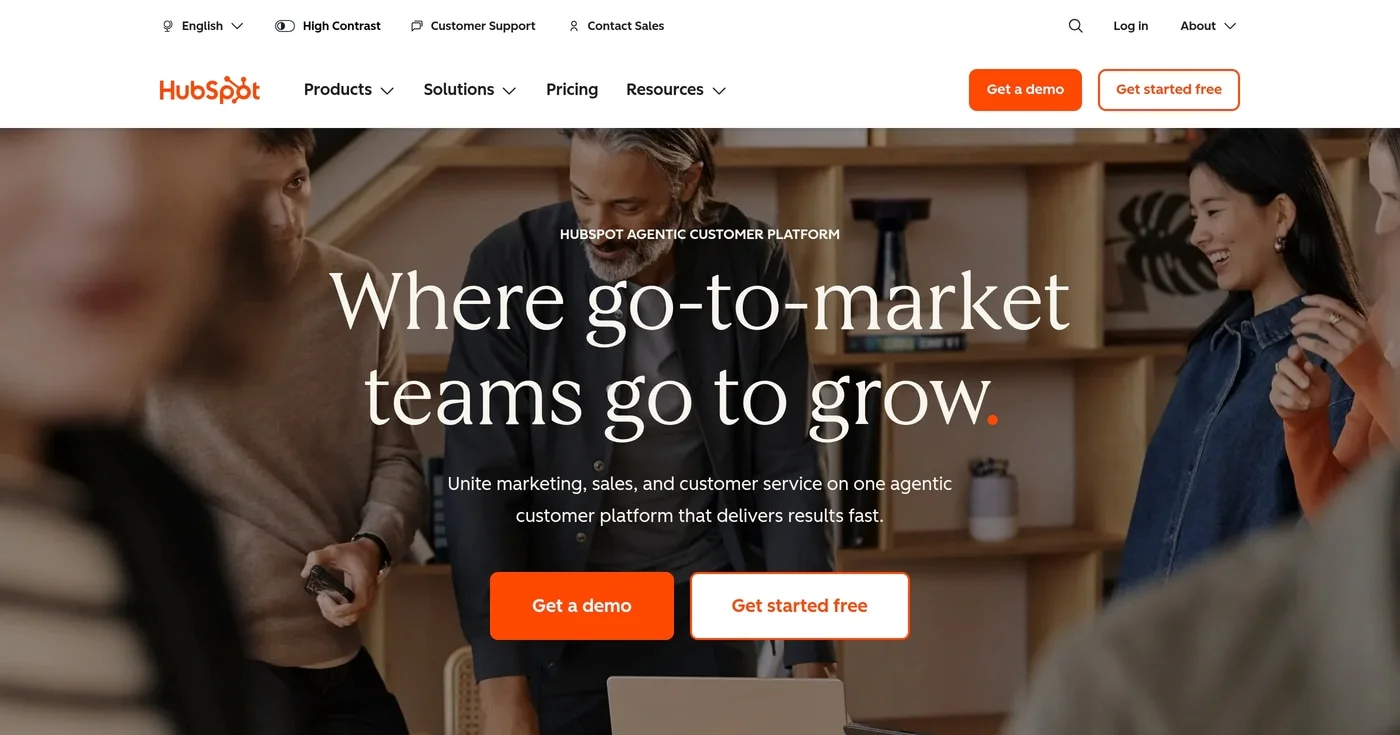
HubSpot Marketing Hub is the most accessible full-stack demand gen platform for B2B teams. Email automation, landing pages, a built-in CRM, social publishing, and paid ads management run in one platform, eliminating the integration overhead that slows down point-solution stacks.
The 2026 Breeze AI suite adds content creation, email optimization, and Answer Engine Optimization (AEO) tools designed to surface HubSpot-managed content in ChatGPT, Perplexity, and Google AI results. The Starr Conspiracy's May 2026 benchmark of 100+ B2B clients ranked HubSpot Breeze 27/30, the top score, driven by integration depth and minimal admin overhead rather than raw AI power.
HubSpot's free tier handles contacts, basic email, and forms for teams starting out. Paid tiers scale to Professional at $800/month for advanced automation and Enterprise at $3,600/month for multi-brand management and custom reporting.
HubSpot offers a 14-day trial on paid plans. See HubSpot Marketing Hub pricing for current tier limits and included contacts.
Best for enterprise marketing automation with deep Salesforce integration
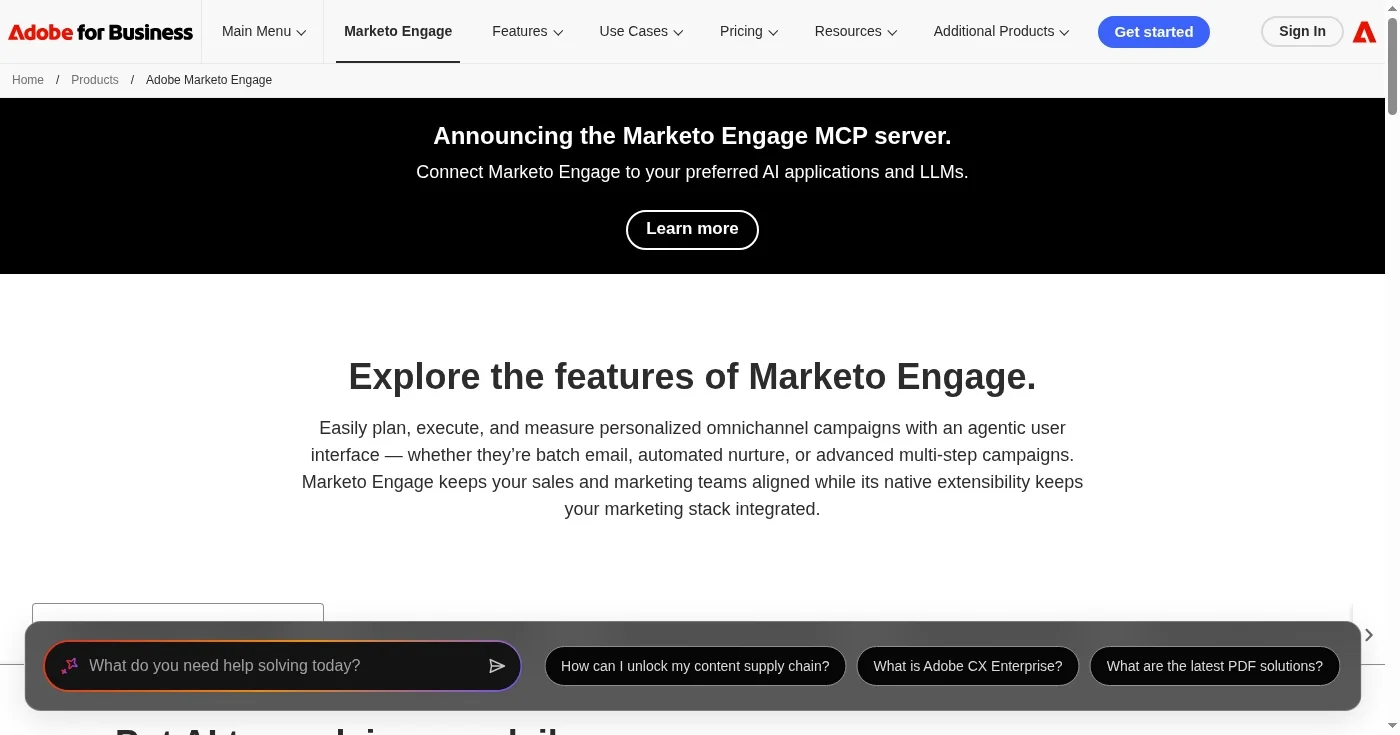
Marketo Engage (Adobe) is the enterprise MAP for teams running complex, multi-touch nurture workflows at scale. Its lead scoring engine is the most configurable in the category: behavioral scoring models can combine CRM activity, web engagement, email interaction, and third-party intent signals without custom development.
The Salesforce integration is Marketo's strongest differentiator for enterprise buyers. Native sync handles bi-directional lead, contact, opportunity, and campaign data with field-level control (something HubSpot's Salesforce connector handles adequately but not with the same configurability at large account sizes).
Adobe's ecosystem adds Marketo Measure (multi-touch attribution), Adobe Analytics (behavioral data), and Adobe Advertising Cloud (cross-channel coordination). Teams fully in the Adobe plus Salesforce ecosystem get compounding value no standalone MAP can replicate.
Contact Marketo directly for a quote; pricing depends on database size, modules, and seat count.
Best for AI-native sales engagement across inbound and outbound motions
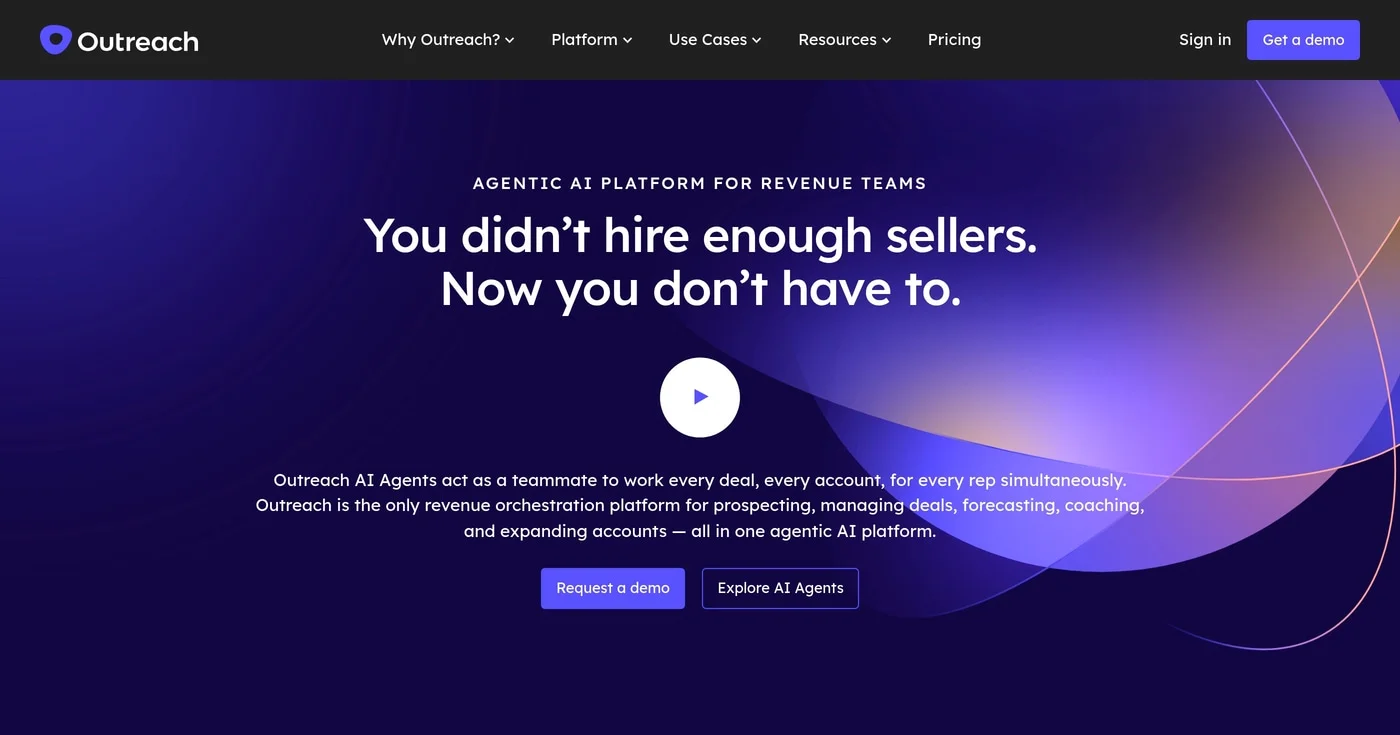
Outreach rebranded as an "Agentic AI Platform for Revenue Teams" in 2026, reflecting a genuine architectural shift. The platform runs AI SDRs for inbound qualification, multi-channel outbound sequences, pipeline management, and revenue analytics in one system.
The AI SDR capability handles inbound lead follow-up at a speed human teams can't match at scale. It responds to form fills within seconds, qualifies against ICP criteria, and books meetings before the lead visits a competitor's site. Where Outreach differs from Qualified (entry #20) is breadth: Outreach covers the full sales engagement lifecycle beyond inbound qualification alone.
Pricing is per-user and available on request. Teams evaluating Outreach against Salesloft should focus on pipeline management depth: Outreach's Deal Inspector and forecast tracking are stronger for mid-market deal cycles; Salesloft's Rhythm feed is stronger for high-volume SDR sequencing.
Pricing reflects role type (AE vs. SDR vs. manager); request a demo to get a scoped quote.
Best for enterprise-grade dark funnel visibility and predictive account scoring
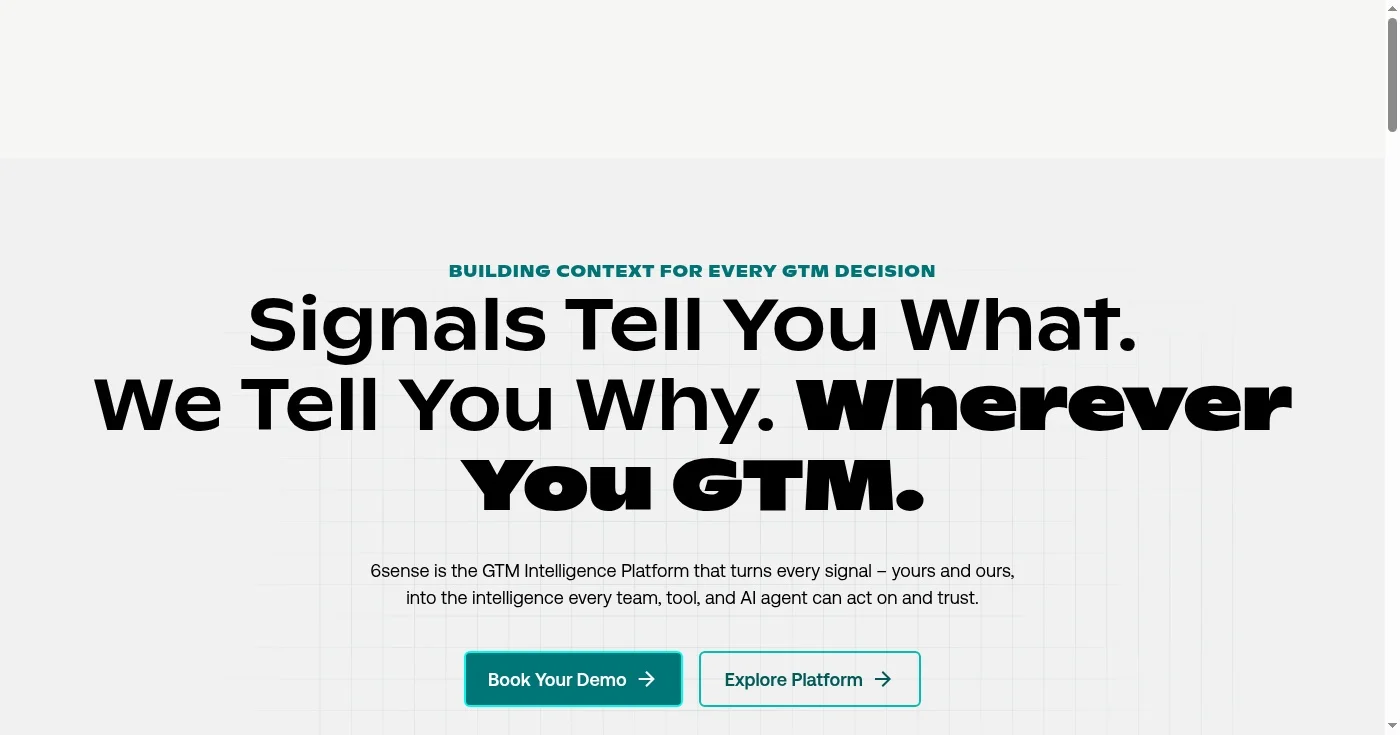
6sense identifies anonymous accounts researching your category before they fill out a form or visit your site. Its 6signal Graph tracks intent across 5,000+ B2B publisher sites, mapping companies to buying stage and account-level intent keywords without requiring a tracking pixel on the target company's site.
This is the dark funnel play: 70%+ of B2B buyers research, compare vendors, and build shortlists entirely outside a vendor's CRM or tracking footprint. 6sense lets marketing and sales intercept those accounts with coordinated campaigns before the shortlist closes and the deal is effectively lost.
The Starr Conspiracy benchmark scored 6sense 24/30, top AI and CRM scores pulled down by pricing opacity and implementation overhead. Enterprise pricing starts at ~$60K/year and commonly reaches low six figures once seats, intent add-ons, and ad spend are included.
Contact 6sense directly; pricing is custom by seat count, intent topics, and activated modules.
Best for ABM advertising execution combined with AI-powered pipeline management
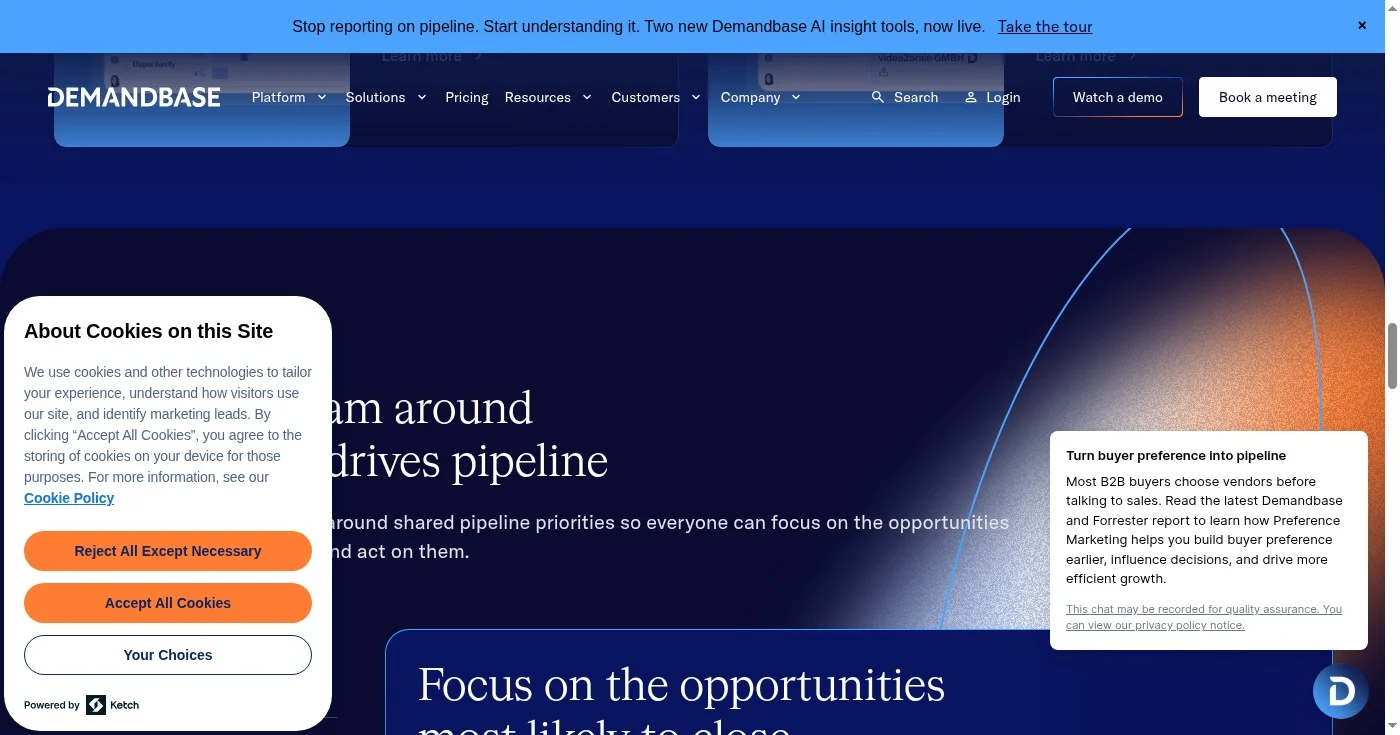
Demandbase combines account intelligence, intent data, and the broadest native ad execution in the ABM category: display, LinkedIn, and CTV campaigns all managed from one platform. It tracks 575,000+ intent keywords and processes 1 trillion intent signals per month, matching 6sense on data depth while maintaining a stronger advertising execution layer.
The April 2026 Demandbase AI launch added a predictive pipeline engine that surfaces accounts most likely to convert and recommends coordinated engagement sequences across sales and marketing. The platform's clearest insight: "intent data doesn't create pipeline, action does". Signals sitting in dashboards while prospects move on is the most common ABM platform failure, and Demandbase AI is built to close that gap.
Where Demandbase wins over 6sense: native advertising execution (display, LinkedIn, CTV from one interface). Where 6sense wins: predictive scoring sophistication and the 6signal publisher network breadth.
Contact Demandbase for current pricing; advertising and analytics modules are priced separately from the core platform.
Best for the largest and most comprehensive B2B contact database
With 600M+ business contacts, 100M+ company profiles, and 135M+ verified phone numbers, ZoomInfo holds the largest verified dataset in the B2B data category. GTM Copilot (the AI layer) and GTM Studio (60+ data provider waterfall) make it the default choice for teams where raw data breadth matters more than any other consideration.
Bombora-powered intent data bundles at enterprise tiers, WebSights tracks company-level website visitors, and Engage handles automated outbound sequencing. ZoomInfo positions itself as an integrated data plus intent plus outreach platform, not a standalone database.
One consideration for teams with EU market exposure: ZoomInfo's GDPR posture is comparatively weaker than Cognism's or Dealfront's European-native infrastructure. A formal compliance review is required before running ZoomInfo for EU outbound campaigns.
Contact ZoomInfo for a quote; limited trial access available on request.
Best for raw intent data direct access (enterprise teams with data infrastructure)
ZoomInfo, 6sense, Demandbase, and Cognism all resell Bombora signals. Going direct gives enterprise teams raw feed access to 12,000+ B2B intent topics from a 5,000+ publisher co-op, 70% of which is exclusive to Bombora and unavailable through competing data networks.
The case for going direct: eliminate platform markup and interpretation overhead. Most ABM platforms resell Bombora at significant markup and surface a curated, scored view, meaning you pay for the platform's interpretation, not the underlying signal. Teams with a data engineer, a warehouse, and a revenue ops layer to consume raw signals should evaluate direct access.
The case against: most teams don't have that infrastructure. Bombora direct without consumption capability produces a dashboard nobody activates, at a price point that makes HubSpot Professional look cheap.
See Bombora pricing on Vendr for tier guidance; contact Bombora directly for a custom quote.
Best for flexible enrichment-led outbound on a lean budget
Clay replaced the multi-vendor "scrape plus enrich plus sequence" stack for lean B2B GTM teams. It connects 150+ data providers in waterfall logic, querying Clearbit first, falling to Apollo if a field is empty, then Hunter.io, so you get the most complete contact record without paying for 10 separate subscriptions.
Claygent (the AI research agent) answers custom questions for each row in a Clay table: industry-specific firmographic context, competitor mentions in recent press, technology stack signals from job postings. Teams use Claygent for hyper-personalized outreach at scale that no template library can replicate.
One operational risk: a departing Clay power user can knock out half a team's enrichment workflow overnight. The platform's flexibility comes from individual expertise, not set-and-forget infrastructure.
Clay offers a 14-day trial on paid plans; credits price varies by data provider used.
Best for GDPR-compliant B2B contact data with strong European coverage
Cognism is the strongest data platform for B2B teams with European market exposure or compliance-first buying criteria. Its Diamond Data tier provides phone-verified mobile numbers with documented GDPR and CCPA compliance, a meaningful differentiator over ZoomInfo for any outbound motion touching EU contacts.
AVEVA generated 40%+ of outbound pipeline from Cognism-sourced prospects. A CTR case study shows LinkedIn matched audience click-through rate improving from 0.54% to 1.04% using Cognism-enriched lists, a 93% improvement from cleaner, better-matched targeting data. Bombora intent integration is available at higher tiers, eliminating a separate intent contract for teams already paying for Cognism contact access.
Contact Cognism for current packages; data region and seat count drive pricing significantly.
Best for cold email infrastructure at volume
Instantly is cold email infrastructure for teams that need sending volume, deliverability protection, and inbox management at a price point that doesn't require budget approval from finance. The Growth tier at $37/month (billed annually; $47/month month-to-month) supports 1,000 uploaded contacts and 5,000 emails per month on unlimited email accounts, with automated warmup to protect sender reputation included in every plan.
The intentional split: Instantly focuses on infrastructure (deliverability, warmup, account rotation, inbox management) rather than enrichment or list-building. You connect Clay or Apollo for contact data, then use Instantly for sending. This separation keeps the tool focused and pricing predictable.
Light Speed at $358/month handles 100,000 contacts and 500,000 emails per month on unlimited accounts, the scale point where agencies and high-volume SDR teams operate without needing enterprise contracts.
All plans include unlimited email accounts and automated warmup. Prices shown at annual billing rates; monthly billing is higher. See Instantly's pricing page for current tiers and limits.
Best for converting inbound demand into booked meetings instantly
Chili Piper reduces the time from demo form submission to booked meeting from days to under two minutes. When a prospect fills out a request-a-demo form, Chili Piper's AI routing engine matches them to the right sales rep by territory, account ownership, or product line, then presents a live calendar to book immediately.
The company reports a 10–15% revenue increase from faster inbound conversion, attributed to reduced lead response latency. Customers include Twilio, Forrester, Spotify, and Gong, a signal of proven fit for mid-market and enterprise B2B SaaS teams with high inbound volume.
The 15-seat base package at $15,000/year limits accessibility for small teams. Below 10 sales reps, Calendly or HubSpot Meetings handles basic scheduling at a fraction of the cost with no minimum seat requirement.
See Chili Piper pricing for current enterprise add-ons and Concierge routing module pricing.
Best for AI-powered pipeline automation from website visitors
Warmly identifies the companies visiting your website, then autonomously qualifies, chats, and books meetings with them without a human SDR in the loop. The AI Inbound Autopilot runs 24/7, capturing off-hours visitors that a human team would miss until the next business day, by which point intent has cooled.
The platform bundles three signal types: first-party (your site visits), second-party (Bombora intent, G2 intent), and third-party (contact data from 10+ providers). AI TAM Agent scores accounts against your total addressable market and surfaces the highest-priority buying committee members for a given company visit, not just the anonymous visitor's company name.
All plans are sold through Warmly's sales team; no self-serve tier exists. The AI Inbound Autopilot entry at $30,000/year requires meaningful inbound traffic to justify the investment.
Contact Warmly for current packaging; most clients purchase both tiers as a bundle.
Best for SMB website visitor intelligence on a lean budget
Dealfront (formerly Leadfeeder) maps website visits to company profiles with GDPR-native European infrastructure. For B2B teams with EU market exposure and a modest budget, it's the default choice in visitor intelligence.
The free Lite tier identifies 100 companies per month with no trial expiration, a practical starting point for proving whether website visitor intelligence generates actionable outreach data before paying. Paid plans starting at €99/month unlock full visit history, more identifications, and CRM integrations to Salesforce, HubSpot, and Pipedrive.
Website visitor identification tools typically match 50–60% of B2B traffic to company profiles, per The B2B Playbook. That's the operational reality: not a Dealfront limitation, but the industry ceiling across all visitor ID platforms including Warmly and ZoomInfo WebSights.
Contact Dealfront for enterprise pricing with custom data integrations; all plans are billed monthly with no minimum commitment on Lite.
Best for generating demand through interactive product demos
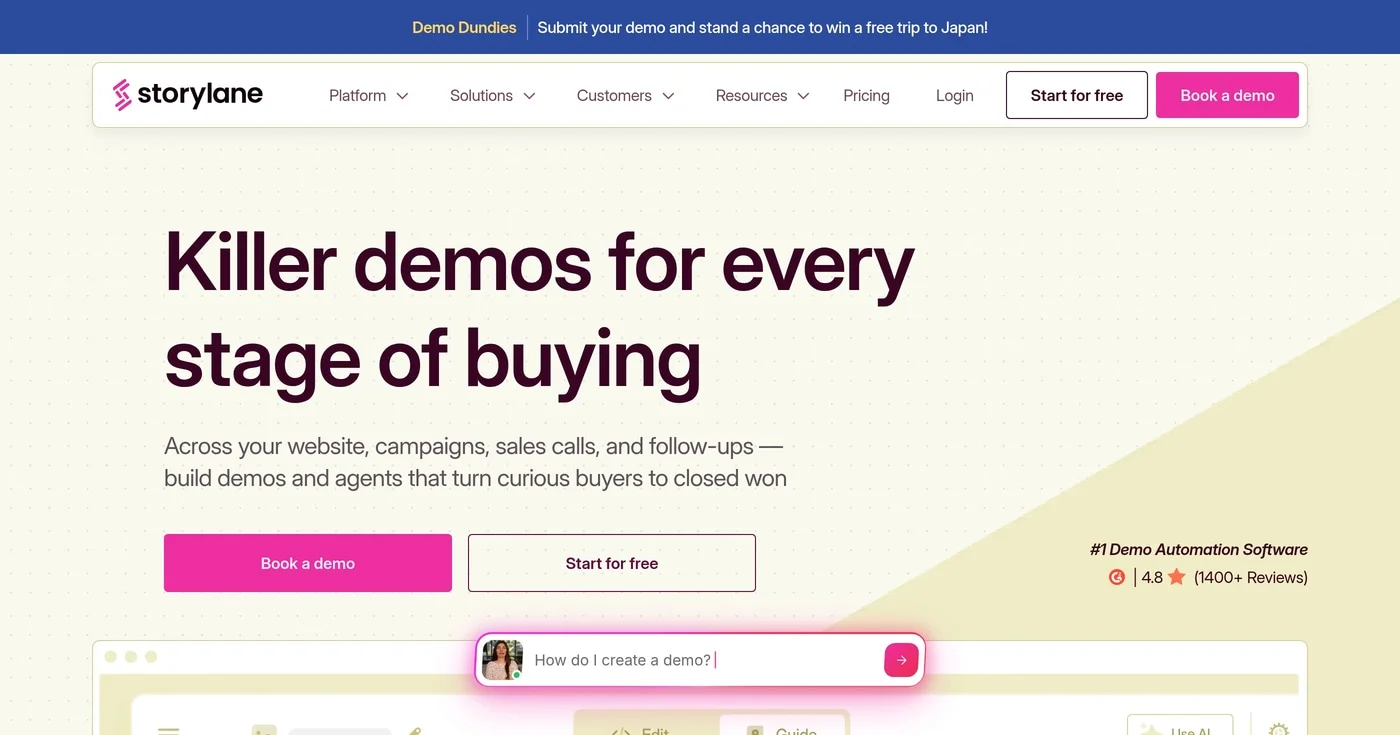
Storylane lets B2B teams build interactive product demos (screenshot-based, HTML-captured, or live sandbox environments) and embed them as demand gen assets at the top of the funnel. Rather than asking a prospect to book a demo call before understanding the product, Storylane demos let them self-guide through the product at their own pace.
Buyer Reveal identifies the companies engaging with your demos, generating first-party intent data that static video demos cannot produce. Practitioners in r/b2bmarketing report that prospects interacting with a Storylane demo before a sales call arrive with clearer stated interests and fewer early-stage objections, reducing SDR qualification time. 5,000+ GTM teams use the platform.
RepX Chat (AI demo agent) answers prospect questions inside the demo without a human rep. AI personalization adapts demo content to the viewer's industry, company size, or job title at scale.
Annual billing available with discounts; enterprise pricing on request from Storylane.
Best for startups wanting interactive demos at accessible pricing
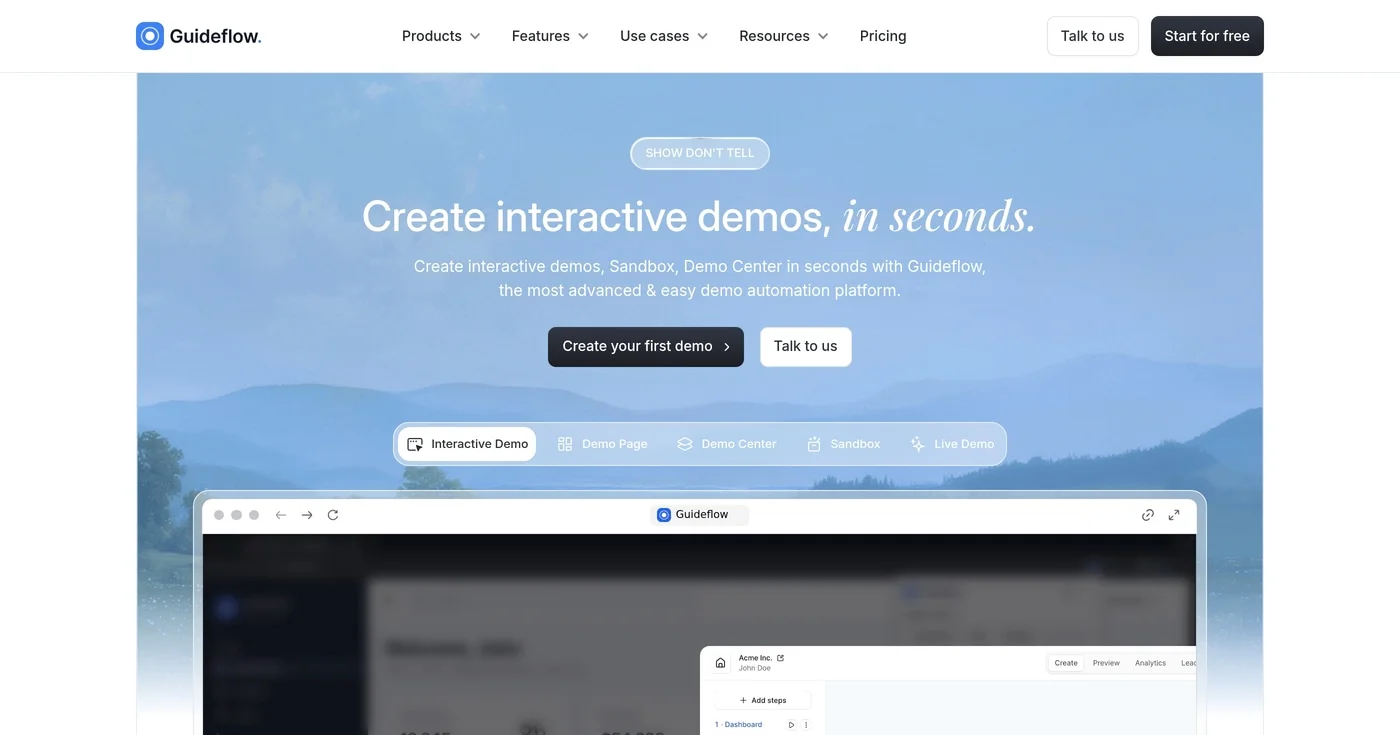
Guideflow matches Storylane's tier structure (Free, $40/month, $599/month, $1,799/month) with a simpler interface and AI translation for international campaigns. Teams running demand gen in multiple languages can localize demos without a professional localization budget.
The differentiation from Storylane is primarily complexity. Guideflow targets smaller teams that want the core interactive demo benefit (prospects self-guiding through the product) without the full AI personalization depth, advanced CRM integration, and RepX Chat that Storylane bundles at mid-tier pricing.
For early-stage teams choosing between the two: Guideflow's free tier allows 5 demos with no expiration (Storylane offers 1). Test on a single campaign, measure pipeline influence, then decide whether Storylane's Buyer Reveal intent signals justify the trade-up.
Annual billing available; enterprise pricing on request.
Best for webinar-led pipeline generation with pay-per-attendee pricing
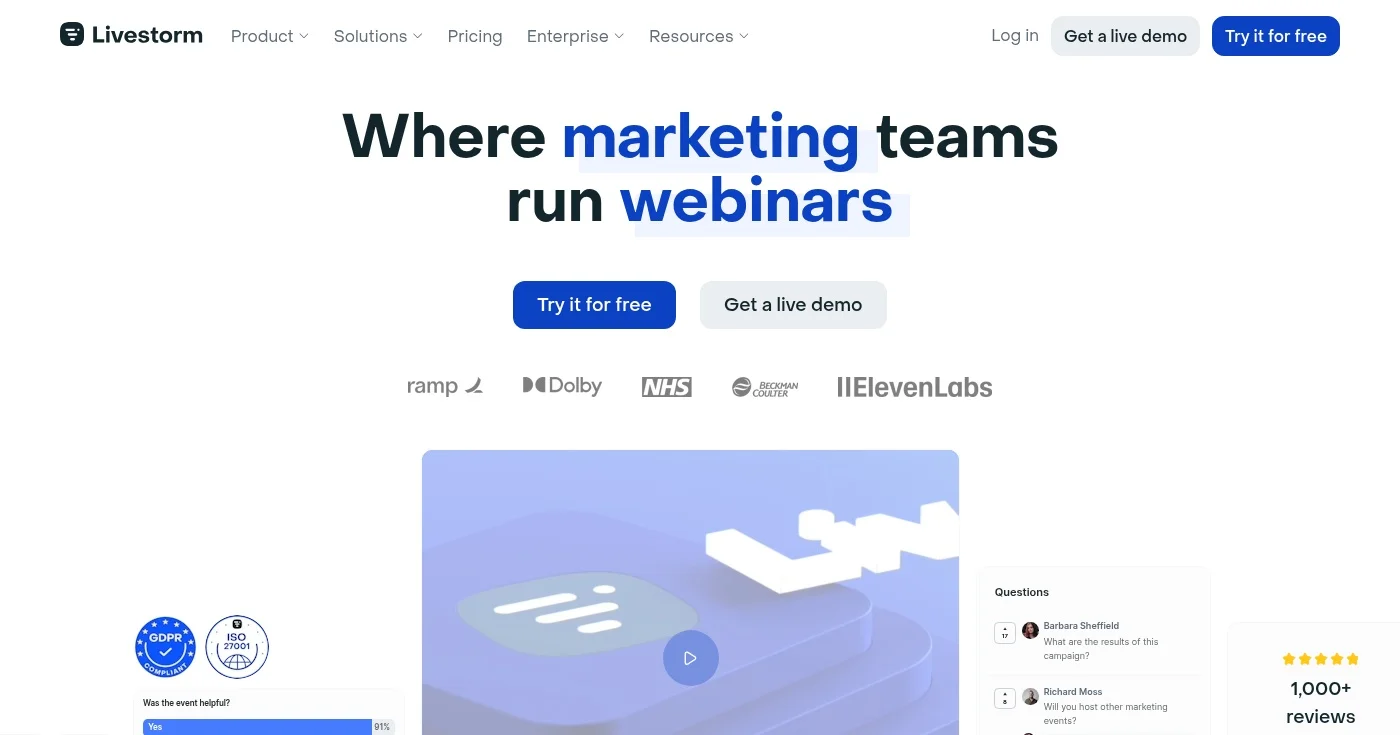
Livestorm is the browser-based webinar platform built for recurring demand gen webinars with minimal attendee friction. No download required: registrants join from a browser link, removing the software install wall that reduces attendance rates on competing platforms that require a desktop app.
Pay-per-actual-attendee credit pricing makes cost predictable for teams running monthly education webinars. You pay for the attendance you drove, not the room you reserved. Livestorm's Pro tier charges approximately €2.50 per attendee credit (roughly $1,200/year for 400 annual credits); Enterprise plans support up to 3,000 live attendees and are priced on request.
Native Salesforce and HubSpot integrations sync registrant, attendee, and poll engagement data directly into CRM records, letting SDRs trigger follow-up sequences from webinar engagement scores rather than a flat "attended" flag.
Livestorm charges per unique attendee per session rather than a flat monthly seat fee. See Livestorm's pricing page for current credit packages and annual rates.
Best for reaching B2B audiences through connected television advertising
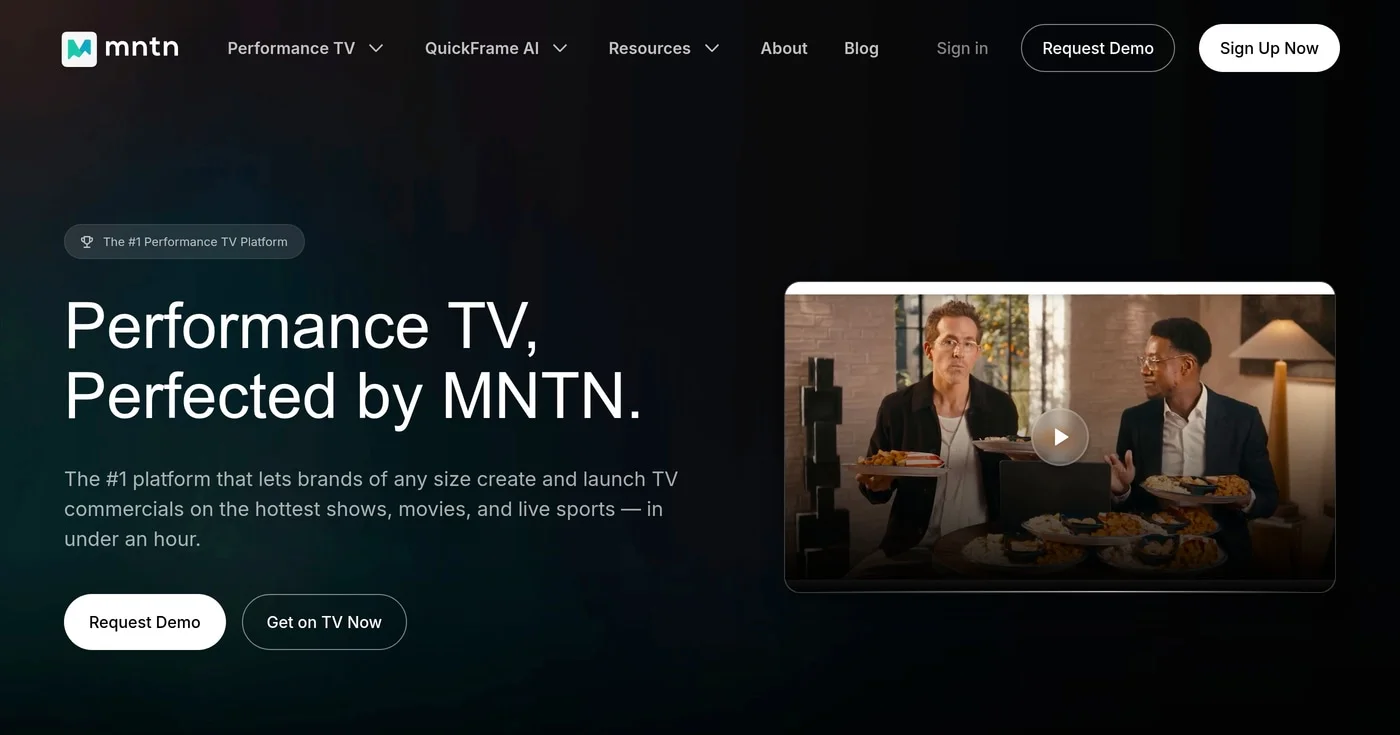
MNTN Performance TV is the only major platform positioning connected television (CTV) advertising specifically for B2B demand gen, and 9 of the top 10 SERP articles on demand generation tools don't mention it. That's the signal: CTV is a channel absent from most B2B demand gen conversations, which means early movers face less competition for the attention they buy.
MNTN Matched uses AI audience targeting built from household behavior, intent signals, and firmographic data, targeting by industry, company size, and behavioral intent at the household IP level. Verified Visits attribution tracks CTV ad impressions to website visits, giving B2B marketers a measurable demand signal from a channel previously limited to brand-lift surveys.
QuickFrame AI 3.0 (launched May 2026) generates TV-ready video commercials using AI, removing the production cost barrier that kept most B2B teams off CTV entirely.
MNTN's Q1 2026 revenue reached $73.7M (+25% YoY) with 3,874 active Performance TV customers (+46% YoY), confirming the channel is scaling past early-adopter territory.
See MNTN Q1 2026 earnings release for current financials; contact MNTN directly for pricing.
Best for B2B display retargeting before an enterprise ABM contract makes sense
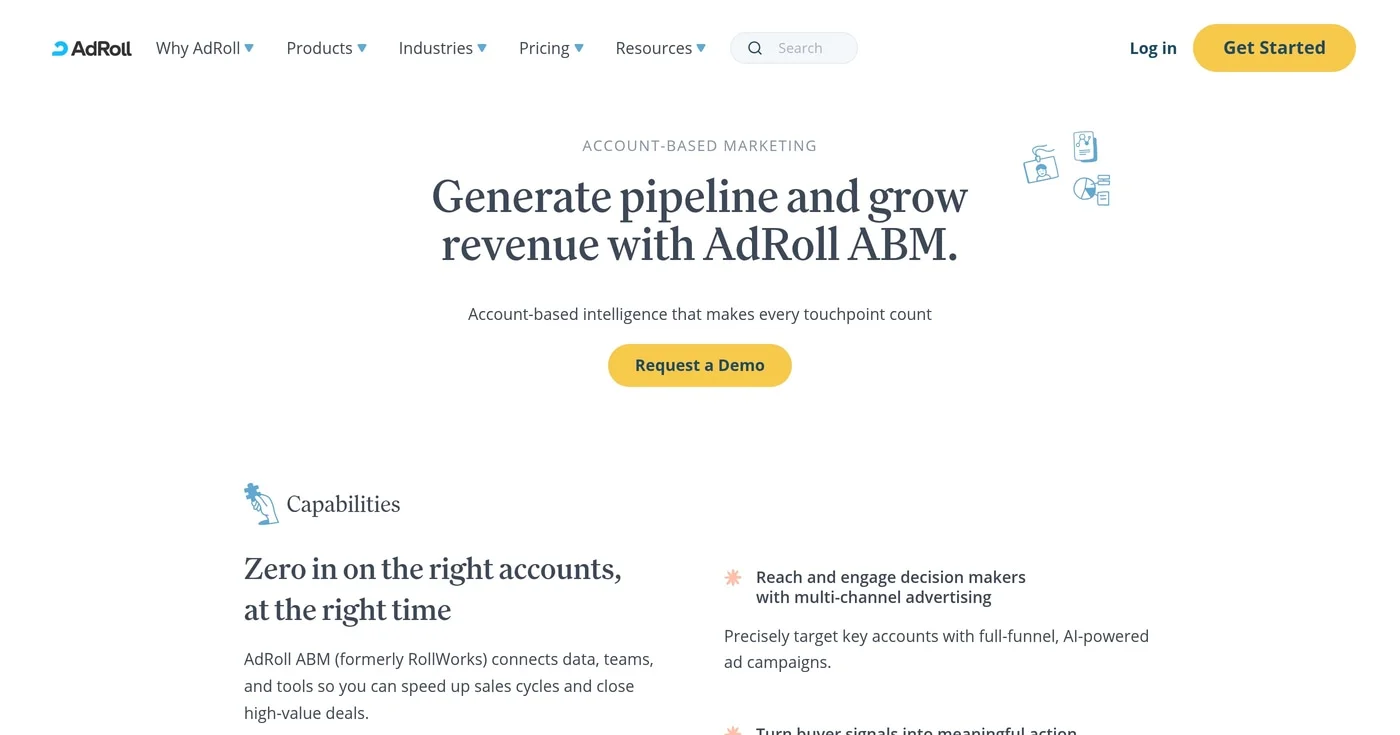
AdRoll and its B2B-focused product RollWorks offer programmatic display advertising and account-based retargeting at price points accessible well before an enterprise ABM platform justifies its contract. AdRoll's Starter plan at $36/month gives early-stage teams retargeting capability across web, social, and email, keeping brand visible to site visitors who didn't convert.
RollWorks adds account-based advertising targeting: reach specific companies and job functions with display ads, not just retargeted website visitors. ML optimization adjusts bids and placements in real time based on account engagement signals, CRM match rates, and pipeline stage data.
For teams evaluating AdRoll/RollWorks versus Demandbase or 6sense: the scale is different. AdRoll/RollWorks fits $2K–$8K/month mid-market demand gen budgets. Demandbase and 6sense become appropriate when total deal values justify six-figure annual platform investments.
Contact RollWorks for account-based advertising pricing; AdRoll self-serve plans are available directly without a sales call.
Best for AI-native multi-channel demand gen campaign orchestration
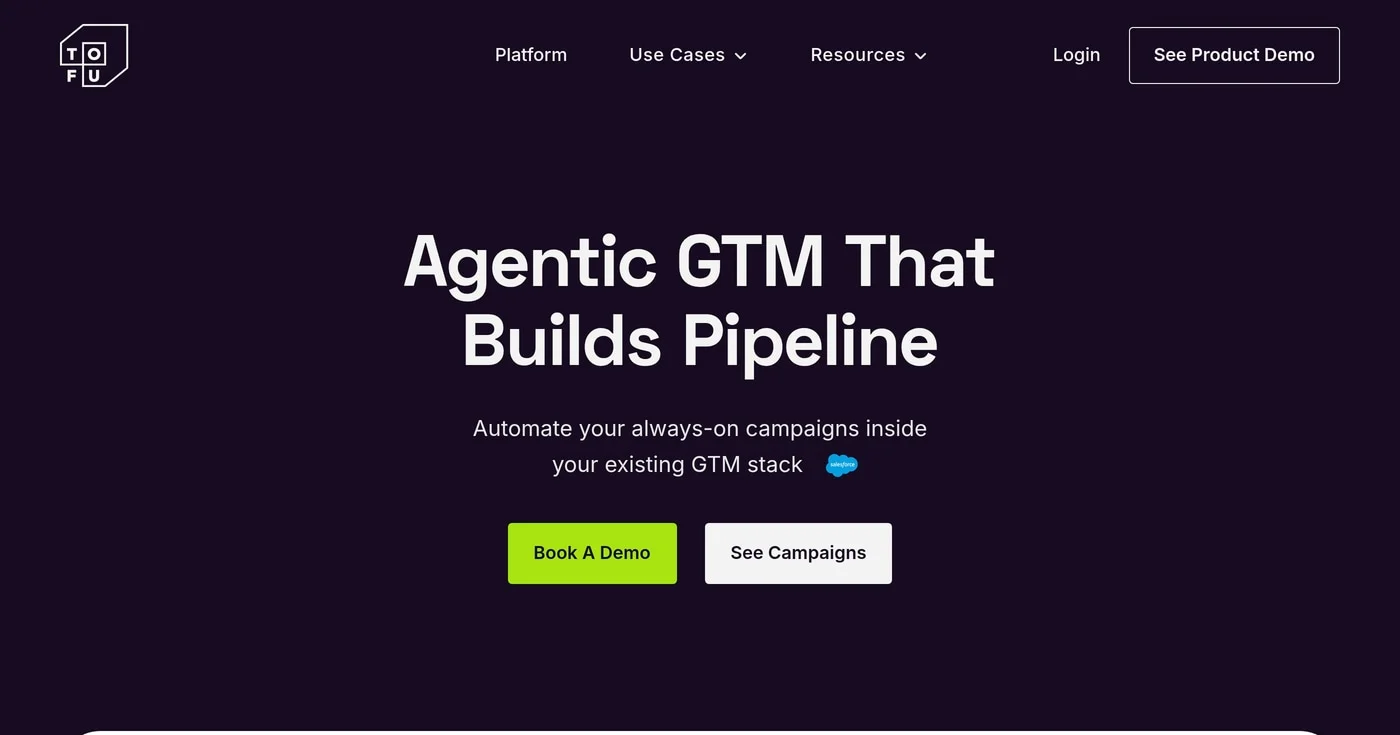
Tofu is an AI-native demand gen platform that replaces the MAP plus copywriting tool plus ad creative workflow with a single AI orchestration layer. Instead of manually creating email sequences, landing pages, and ad variants for each campaign segment, Tofu's AI agents generate and launch personalized campaigns across email, LinkedIn, web, and display. Messaging adapts to each account's industry, persona, and buying stage without a content operations team.
Where HubSpot and Marketo require a marketer to design, write, and schedule each campaign element, Tofu runs creation and launch autonomously, with human review gates before deployment. For teams with a sharp ICP but a lean content operation, it reduces campaign turnaround from weeks to hours.
Pricing is available on request. Tofu targets B2B SaaS teams at Series A and above that have validated ICP clarity but limited content bandwidth to build multi-channel campaigns manually.
Tofu targets B2B SaaS teams at Series A and above; develop ICP clarity before evaluating.
Best for autonomous inbound lead qualification at the moment of intent
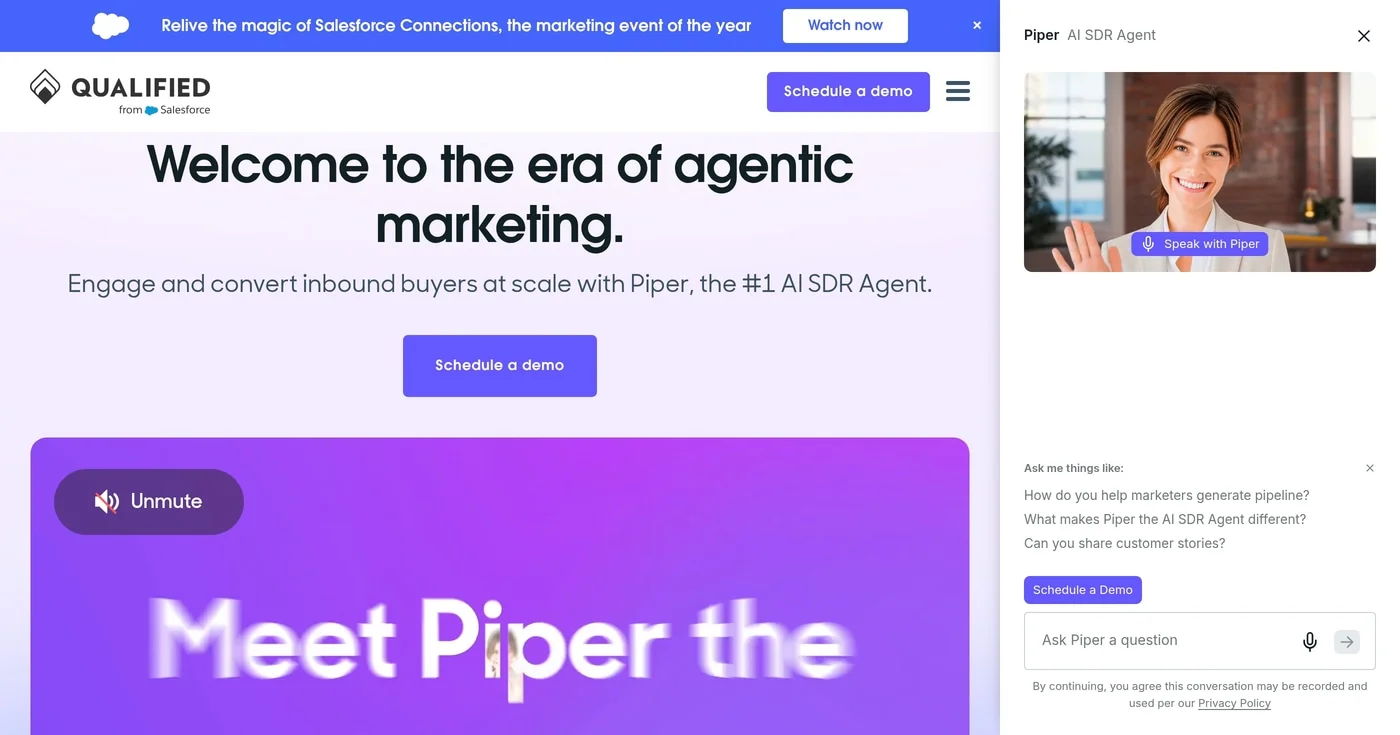
Qualified runs Piper, an AI SDR that qualifies and books meetings with inbound leads in real time through conversational AI. When a high-intent visitor arrives on your site, Piper identifies them against your ICP, initiates a conversation, handles qualification questions, and routes a calendar invite, all without a human rep in the loop.
The platform is Salesforce-native: Piper connects directly to Salesforce CRM objects, pulls account context, and writes meeting notes back to the Salesforce record without a separate integration layer. For teams running Salesforce as their primary CRM, this native architecture eliminates the middleware overhead that most chat-to-CRM connections require.
Gaetano DiNardi captured the category shift in January 2025:
"Inbound SDRs are an extension of marketing and, due to their fairly rote work, are increasingly being replaced by AI SDRs."
Qualified is the most direct expression of that trend, positioning human SDRs on outbound complexity and automating the rule-based inbound qualification workflow entirely.
Confirm Salesforce as your primary CRM before evaluating Qualified; teams on HubSpot-native stacks should evaluate Warmly or HubSpot's native chatbot instead.
Open Google Keyword Planner without treating setup as running ads, then read volume, competition, and the two bid columns for what those numbers are not.
ZoomInfo alternatives have no public platform list price. Apollo publishes a seat price, Cognism covers EU phones, and Lusha starts at $49.90 a month.

HubSpot's pricing jumps from $0 to $890/month with no mid-tier. These 10 HubSpot alternatives are segmented by sales CRM, email automation, and agency use case
