
Email Marketing Guide for 2027: Lists, Flows, Deliverability and Tools
How email marketing works: building an opt-in list, segmentation, automated flows, deliverability rules from Gmail and Yahoo, benchmarks, laws and tools.
Updated 16 min read

How email marketing works: building an opt-in list, segmentation, automated flows, deliverability rules from Gmail and Yahoo, benchmarks, laws and tools.
Email marketing is sending messages to people who chose to hear from you, so you can turn subscribers into buyers and buyers into repeat customers. It still earns its budget: in Litmus's State of Email 2025 data, 35% of marketing leaders get $10 to $36 back for every $1 spent on email, and another 30% get $36 to $50.
The programs that earn that return share a few habits. They grow a list through opt-in only, segment before they send, let automated flows do most of the revenue work, and treat deliverability as a requirement, not an afterthought. This guide covers each of those steps, the numbers to benchmark against, the laws that apply, and the tools that do the work.
Email marketing is a form of direct marketing that uses email to promote products or services, build customer relationships, and drive revenue. Businesses send emails to subscribers who have opted in, which makes it a consent-based channel you own, unlike rented reach on social platforms or paid ads.
Modern email marketing has moved away from one-size-fits-all blasts. It focuses on segmentation, personalization, and automation to reach the right person at the right moment with the right message.
You own your email list. Algorithm changes on a social network cannot take it from you, and you do not pay per click to reach it.
HubSpot's 2025 State of Marketing report ranked email the top ROI channel for B2C brands, and in its 2026 edition about 75% of marketers planned to maintain or increase their email investment. The 2026 survey also shows the channel is crowded: 22% of marketers named email a top ROI channel, fifth behind website, blog and SEO at 27%. Email works when it is done well, not by default.
Effective email marketing follows six steps, and each one depends on the one before it.
Every email marketing decision flows from who you are trying to reach. Your audience's needs, pain points, purchase behavior, and preferred cadence shape everything from your subject lines to your send frequency.
Start with customer interviews, review your CRM data, and talk to your support team. The better you understand your subscribers, the easier it is to send emails they want to open.
A healthy email list is built through opt-in, not purchased. Bought lists damage your sender reputation and rarely convert. In the UK, the ICO is explicit that the soft opt-in for existing customers does not apply to new contacts from bought-in lists.
Effective list-building tactics include:
Focus on list quality over list size. A smaller, engaged list beats a large, unengaged one, and low engagement plus spam complaints are what push mail out of the inbox.
Your platform sets the limits on what you can do with your list. Evaluate five things:
Segmentation divides your list into smaller groups based on shared traits (our guide to marketing segmentation covers the wider method). Instead of sending one message to everyone, you send targeted messages to each group.
Mailchimp's segmentation study compared about 11,000 segmented campaigns from roughly 2,000 users with the same users' non-segmented sends. Segmented campaigns got 14.31% more opens and 100.95% more clicks, with 4.65% fewer bounces and 9.37% fewer unsubscribes. The study dates from 2017, and HubSpot's State of Marketing data from 2023 points the same way: 30% more opens and 50% more clickthroughs for segmented emails.
Common segmentation dimensions include:
Automated segments update as customers act. When a subscriber moves from prospect to buyer, they enter the post-purchase sequence and leave the sales nurture emails.
Automated flows are sequences triggered by subscriber behavior. They are the highest-leverage part of email marketing because they run around the clock without manual sends.
Klaviyo's 2026 benchmarks, based on more than 183,000 customers, show flows earning revenue per recipient nearly 18x higher than campaigns. Flows also get more than 3x the click rate (5.58% vs. 1.69%), and nearly 48% of flow revenue comes from new buyers.
The five flows every business needs:
Flow | Trigger | Goal |
|---|---|---|
Welcome series | New subscriber | Introduce brand, set expectations |
Abandoned cart | Cart added, no purchase | Recover lost revenue |
Post-purchase | Order confirmed | Thank, cross-sell, request review |
Browse abandonment | Product viewed, not added to cart | Re-engage interest |
Win-back | No activity for a set period | Re-engage or clean the list |
Email design follows a simple rule: one message, one call to action. Several competing CTAs split attention.
Key writing practices:
Each email type has a different job, and mixing them up sends the wrong message at the wrong time.
Promotional emails announce offers, discounts, product launches, and limited-time deals. They are the most common type of marketing email and the easiest to overuse.
Relevance decides whether they work. Sending a discount to someone who just paid full price, or a launch email about a product the subscriber already owns, signals that you do not know your customer. Segmentation fixes this.
Newsletters build relationships over time. They deliver consistent value (content, insights, updates) on a predictable schedule and keep your brand top of mind without always asking for a purchase.
Transactional emails are triggered by a user action: order confirmation, shipping update, password reset, account activation. Recipients expect them, which makes them some of the most-read emails you send.
Many brands add a light marketing touch to them, such as a product recommendation or referral offer on a shipping confirmation. Keep the transactional content first, and check the rules where you send: in the US, the FTC's CAN-SPAM guide treats a message's primary purpose as what decides whether CAN-SPAM's commercial rules apply.
Retention emails target existing customers to reduce churn and increase lifetime value. Win-back campaigns reach subscribers who have gone inactive, often with an incentive or a direct question about whether they want to stay subscribed.
List hygiene means removing subscribers who do not re-engage after a win-back sequence. Mailing unengaged addresses drags down engagement signals and adds subscribers with no revenue.
Personalization has to go beyond a first-name greeting. The most effective personalization uses behavioral data to trigger the right message automatically.
Irrelevance gets ignored. In Attentive's 2025 survey of 3,300 consumers, 81% said they ignore irrelevant marketing messages.
Behavioral segmentation uses what subscribers do to decide what to send them. A subscriber who visits your pricing page three times in one week is at a different buying stage than one who opened a newsletter once last month. Your messaging should reflect that difference.
Some platforms predict when each subscriber is most likely to engage and send at that time. Brevo includes AI send time optimization from its Standard plan, and ActiveCampaign offers predictive sending at each contact's best time on its Pro plan.
Dynamic content blocks show different content to different subscribers within the same email. One campaign can show product recommendations based on purchase history, local events based on location, or different CTAs based on lifecycle stage. Klaviyo's benchmarks found AI product recommendations lift email click rates to 3.75% on average.
Five metrics tell you whether a program is improving or stalling.
Open rate is the share of recipients who open your email. Klaviyo's 2026 benchmarks put a good ecommerce open rate at 31% for campaigns and 32.2% for flows, with the top 10% of brands reaching 45.1% and 45.8%.
Treat open rate as a directional signal for subject lines and sender trust, not a revenue metric. A falling open rate usually points to low-quality list growth, predictable subject lines, or sending too often. Benchmark against your own industry: a B2B newsletter and an ecommerce promotion have very different baselines.
Click rate is the share of recipients who click a link. In the same Klaviyo data, a good click rate is 1.69% for campaigns and 5.58% for flows, and top-10% brands reach 3.38% and 10.48%.
A low click rate with a healthy open rate is a content problem. The subject line earned the open, but the body did not deliver. Review your CTA, your copy, and whether the email kept the subject line's promise.
Conversion rate is the share of recipients who complete the action you want: a purchase, a demo booking, a download. For ecommerce, Klaviyo's benchmarks show campaign placed-order rates around 1% in many industries (0.97% for clothing and accessories, 1.23% for electronics), with flows higher (1.62% and 2.01%).
When opens and clicks are healthy but conversions are not, the landing page is usually the problem, not the email.
Revenue per recipient (RPR) is the revenue each email generates divided by the number of recipients. It is the clearest way to compare campaigns of different sizes. Klaviyo reports top-10% flows reaching RPR as high as $7.79, and flow RPR nearly 18x that of campaigns on average.
Track net list growth: new subscribers minus unsubscribes, bounces, and spam complaints over a period. List size without a growth rate tells you little.
If your unsubscribe rate spikes after a campaign, that campaign was irrelevant, too frequent, or sent to the wrong segment.
An email that lands in spam earns nothing, so deliverability comes before copy, design, or offers.
Google's sender guidelines require every sender to Gmail to use SPF or DKIM, and bulk senders (5,000 or more messages a day to Gmail accounts) to use SPF, DKIM, and DMARC. Yahoo's sender requirements ask bulk senders for the same three.
Both providers also require bulk senders to support one-click unsubscribe for marketing mail. Most email platforms walk you through domain authentication during onboarding.
Mailbox providers judge your mail on engagement, complaints, and bounces. Google asks senders to keep the spam rate in Postmaster Tools below 0.10% and never reach 0.30%. Yahoo asks for a spam rate below 0.3% and for unsubscribes to be honored within 2 days.
Protecting your sender reputation requires:
New sending domains need to build reputation gradually. Start with small volumes to your most engaged subscribers and increase over several weeks while watching complaints and bounces.
Lifestraw's switch to Klaviyo shows why. According to Klaviyo's case study, the team was advised to warm its sending domain slowly, which meant sending from two platforms for a while and "was a lot of extra work." Once warming was complete, campaign results improved radically and deliverability was strong.
The right platform depends on your business model, list size, and technical needs. Prices below are the entry paid plans on each vendor's US pricing page, checked on 27 November 2026.
Tool | Best For | Free Plan | Entry Paid Plan |
|---|---|---|---|
Ecommerce, Shopify brands | Yes, 250 active profiles and 500 emails a month | Email plan from $20/mo (500 profiles) | |
SMBs, all-in-one marketing | Yes, under 250 contacts | Essentials from $13/mo | |
Email plus transactional and SMS | Yes | Starter from $9/mo | |
Marketing automation, B2B | No (free trial) | Starter from $15/mo billed yearly (1,000 contacts) | |
Simplicity, newsletters | Yes, up to 250 subscribers | Comfort from $10.80/mo billed yearly (500 subscribers) | |
Email inside a full CRM | Yes, up to 2 users | Marketing Hub Starter from $20/seat/mo, with limited-time discounts for new customers | |
Ecommerce automation | No (14-day trial) | $39/mo for up to 2,500 people |
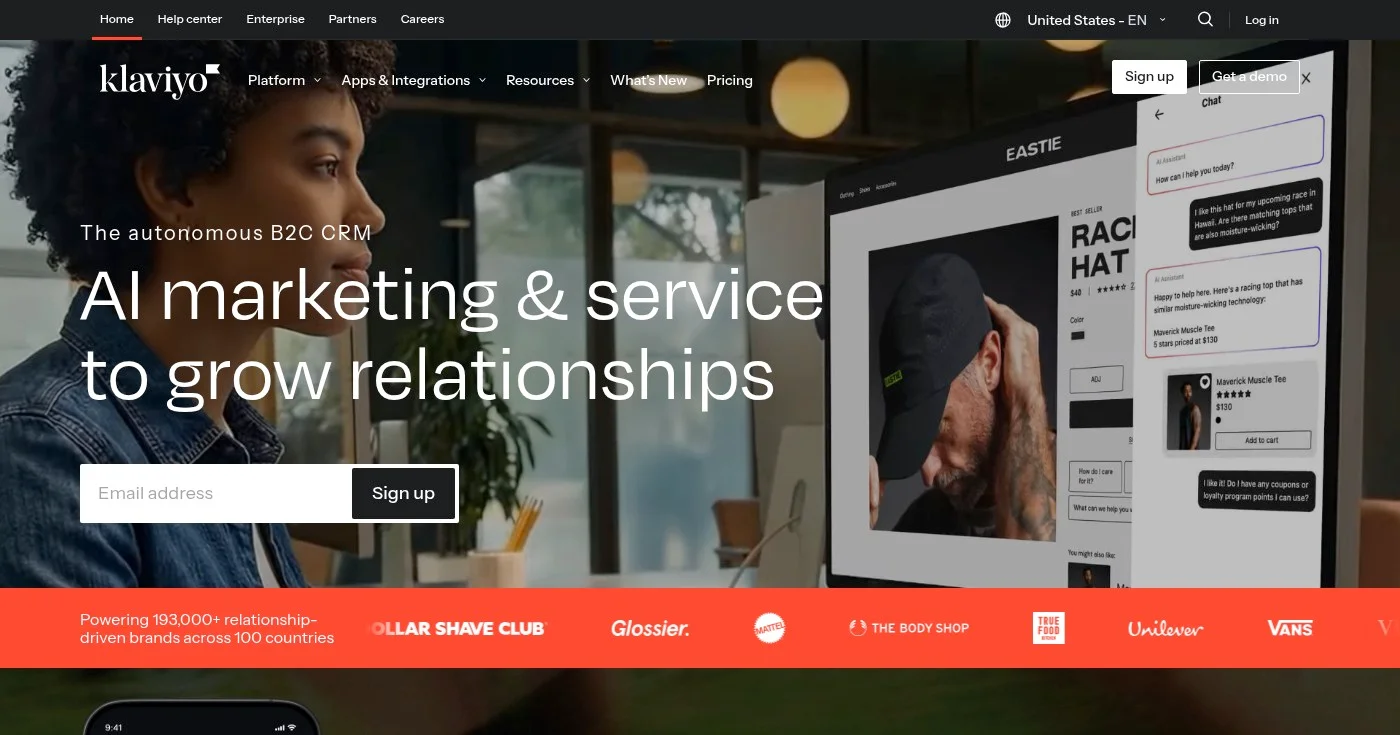
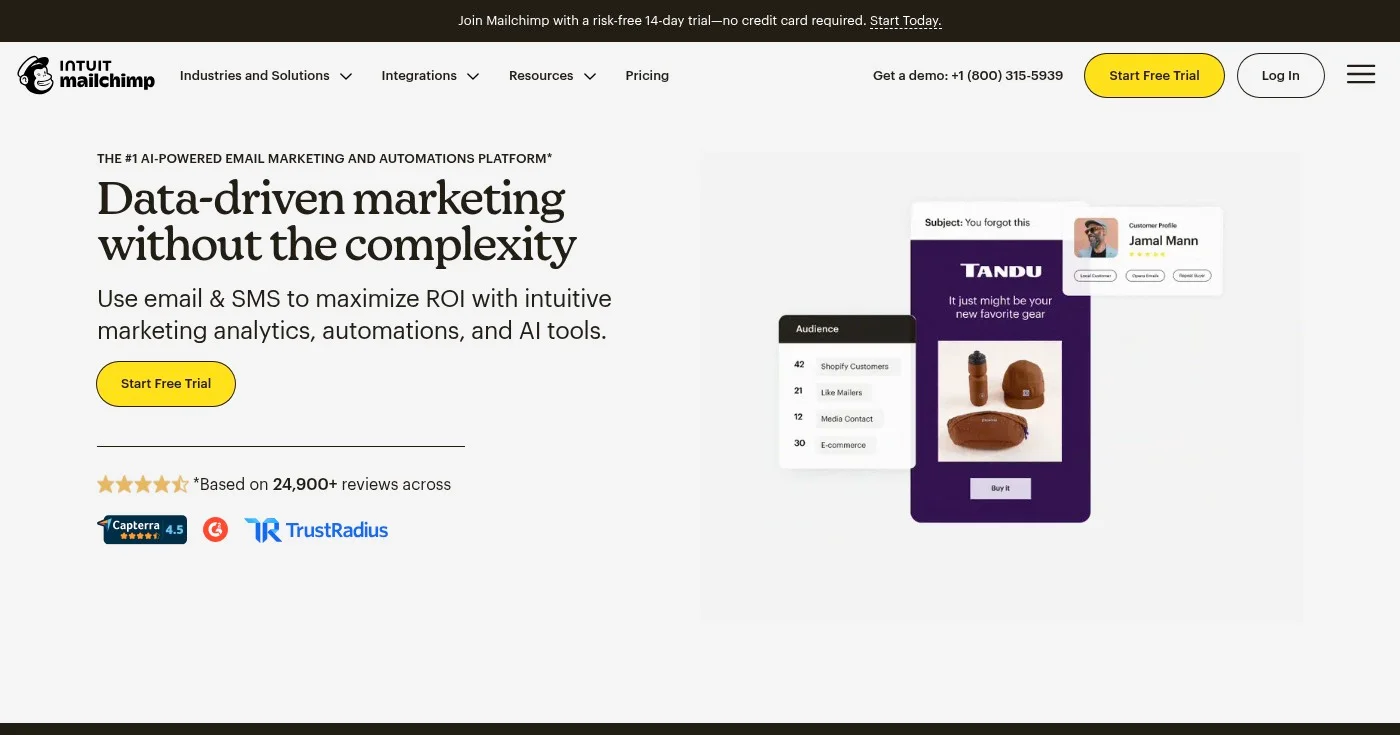
For Shopify and other ecommerce brands, Klaviyo is the strongest fit thanks to its store data sync, segmentation, and flow logic. For newsletters, content businesses, and smaller teams, Mailchimp or MailerLite offer simpler setups at a lower entry price. B2B teams should also see our comparison of B2B email marketing software.
Email marketing is regulated in most major markets. This section is a practical summary, not legal advice.
The FTC's CAN-SPAM guide requires commercial email to:
The law covers business-to-business email too, and each separate email that violates it can draw penalties of up to $53,088.
In the UK, the ICO's PECR guidance says you must not send marketing emails to individuals without specific consent. The one exception, the soft opt-in, covers existing customers who bought (or negotiated to buy) a similar product from you. They must have had a simple way to opt out when you collected their details and in every message since.
EU countries apply similar ePrivacy rules, with GDPR setting the standard for valid consent. Keep a record of when and how each person opted in.
Canada's Anti-Spam Legislation requires express or implied consent before you send commercial electronic messages. The CRTC's implied consent guidance explains that a purchase creates an existing business relationship for two years, while an inquiry or application creates one for six months. Every message also needs your identification details and an unsubscribe mechanism.
Sending the same email to everyone is one of the easiest ways to depress results. In Mailchimp's study, segmented campaigns got roughly twice the clicks of unsegmented ones. Start with at least two segments: new subscribers and past buyers.
If you do not have a welcome series and an abandoned cart flow running, you are leaving revenue on the table. Lifestraw had no automations in its old platform, not even a welcome flow, when email drove about 3% of its ecommerce revenue.
Purchased lists damage your sender reputation, fall outside consent rules such as the UK soft opt-in, and rarely convert because the people on them have no relationship with your brand. Build your list through opt-in only.
Poor deliverability means emails land in spam before any subscriber sees them. Set up SPF, DKIM, and DMARC before sending at scale, and remove hard bounces and inactive addresses on a schedule.
One email should have one goal. When you add three CTAs ("read this article," "check our sale," "book a call"), you split attention between them. Pick the single most important action and design the email around it.
Lifestraw makes water filters for home, outdoor, and emergency use. In 2020, on ActiveCampaign, email drove about 3% of its total ecommerce revenue, according to Klaviyo's case study. The team had no automations set up and no clear view of deliverability.
Head of DTC sales Eugenia Martin describes the old approach: "We didn't understand the importance of email in ecommerce. We would send one email a month, if that. There wasn't an incentive to keep going, because we weren't seeing results."
After moving to Klaviyo and warming its domain, Lifestraw hired an agency to build a welcome flow, abandonment flows, and post-purchase flows that remind customers to buy replacement filters.
After its first quarter with flows, Q4 2022, the case study says it beat its overall 2022 email revenue goals by more than 2x. Klaviyo reports that 33% of Lifestraw's H1 2024 ecommerce revenue was attributed to Klaviyo, an 11x bigger share than before the switch, with a 69x ROI.
The lesson is that email performance comes from setup and strategy (authentication, warming, flows), not from the channel alone.
Email marketing rewards fundamentals more than volume. Build a clean opt-in list, set up your welcome and abandoned cart flows, authenticate your sending domain, and segment before you hit send. Those four moves put most programs ahead of the inbox competition.
Our email marketing ROI statistics show what the gap between average and top programs is worth.
How lead scoring works, which model fits your data, and how HubSpot, Salesforce and ActiveCampaign score leads, with a worked B2B example.

Set up, verify, and optimize your Google Business Profile: Google's verification methods, top local ranking factors, review benchmarks, and 2027 AI changes.

A lookalike audience finds new users who match your best customers. Learn how the algorithm works, which platforms still support it, and what changed in 2026.
