


Marketing Segmentation: Beyond the Classic 4 Types
Marketing segmentation divides a market into groups with common needs or behaviors, then forces a strategic choice: which groups to serve and how. This guide co
Updated 17 min read


Marketing segmentation divides a market into groups with common needs or behaviors, then forces a strategic choice: which groups to serve and how. This guide co
Marketing segmentation divides a market into groups of customers who share common needs, behaviors, or motivations, then forces a choice: which groups to serve and how. Most published guides stop at four types (demographic, geographic, psychographic, behavioral), but growth teams running account-based marketing and B2B programs need three more: firmographic, technographic, and needs-based segmentation.
Done well, segmentation is not a classification exercise. It is strategic prioritization: answering "To Whom?" and "For What?" before any budget moves. EquiBrand's segmentation framework calls the failure state "Surrender Marketing": a strategy so broadly defined that it appeals to no one because it excludes no one.
Hyper-segmented campaigns generate up to 760% more revenue than standard campaigns, and 77% of marketing ROI comes from segmented, targeted, and triggered campaigns. This guide covers all seven segmentation types, the STP framework, a step-by-step strategy process, and the 2026 AI tools reshaping how teams activate segments in real time.
A market segment is a group of customers who share common characteristics: needs, motivations, behaviors, purchase drivers, or value expectations. What makes the boundary useful is response differentiation: segment members respond to a product or message differently than customers outside the group. Deciding which segments to serve and how to position your offering to each is the step most organizations skip.
The word "segmentation" often gets reduced to a labeling task: "Our customers are Millennials, SMBs, and enterprise accounts." That framing produces research, not strategy. The Marketing Juice's framework names the real failure mode: "market research theatre." Sophisticated models sit on a shelf because they were designed to feel thorough, not to inform decisions.
Strong segmentation answers two commercial questions: "To Whom?" (which customer groups represent the greatest strategic opportunity) and "For What?" (which unmet needs or jobs-to-be-done should the organization prioritize). Those two questions drive budget allocation, positioning, product roadmaps, and go-to-market investment.
The case for segmentation is a performance case. Dynamic segmentation delivers a 15% conversion lift over uniform-audience approaches.
On the consumer side, static personalization dropped 24% in effectiveness in 2026. Customers experience "lazy retargeting" (name in subject line, exact product they already bought retargeted back at them) as intrusive. Segmentation that doesn't reflect motivation and context is now counterproductive, not just insufficient.
As Bridget Oor from HubSpot puts it in her target audience video (HubSpot Marketing, 2025): "If your target audience is anyone who needs this, you don't have a strategy. Vague audiences lead to vague content, and vague content doesn't convert."
The STP framework (Segmentation, Targeting, and Positioning), codified by Philip Kotler in Marketing Management, is the organizing model connecting segment identification to strategic action. Every marketing segmentation initiative should follow this three-phase sequence.
Segment the market by dividing the total addressable market into groups with distinct characteristics. Select segmentation variables (see the seven types below) that explain behavior and needs, not just describe surface demographics. Size each segment with confidence: an unsizable segment cannot be prioritized.
Evaluate and select the segment(s) worth pursuing. The criteria: size (can you estimate it?), accessibility (can you reach those people?), profitability (is the segment large enough?), and distinctiveness (does it behave differently from adjacent segments?). Marketing strategy requires hard choices at this stage.
Define how to present your offering to the chosen segment in a way that creates a distinctive perception. Positioning without targeting is noise; targeting without positioning is traffic with no conversion logic. STP is the sequence that ties strategy to execution: segment first, choose second, position third.
Most guides cover four types. Growth teams operating in B2B environments (where ABM, ICP scoring, and intent data are standard) need the full seven. Here's a comparative view:
Type | Groups By | Best For | Data Sources |
|---|---|---|---|
Demographic | Age, income, education, gender | B2C baseline layer, media buying | Census, first-party CRM |
Geographic | Country, region, city | Retail, regulated industries, language markets | CRM, IP data |
Psychographic | Values, lifestyle, attitudes | Messaging, creative strategy, premium brands | Surveys, social listening |
Behavioral | Purchase frequency, usage, loyalty | Retention, upsell, loyalty programs | CRM, CDP, analytics |
Firmographic | Industry, company size, revenue | B2B ICP definition, ABM tiering | Enrichment tools (Clay, Apollo) |
Technographic | Tech stack in use | B2B displacement, integration fit | G2, Clearbit, technographic data |
Needs-Based | Shared problems or unmet needs | Product positioning, messaging | User research, job interviews |
Demographic segmentation groups customers by age, gender, income, education, occupation, family size, or household status. It is the most widely used type because the data is available and media platforms can buy against it.
The limitation: demographics describe who customers are but rarely explain why they behave. Two 45-year-olds with similar incomes can have completely different brand relationships, purchase drivers, and price sensitivity. Use demographics as a starting filter, not as a sufficient model.
On Reddit's r/marketing, the consensus is blunt: "No generation is a monolith. Start with age range, then move into the behaviors of the groups you think would be interested." (u/SilverSkywalkerSaber, r/marketing, July 2026)
Country, region, city, or regulatory zone defines a geographic segment. It is most useful when location genuinely changes needs or behavior: retail expansion decisions, regulatory differences (GDPR vs. CCPA), cultural context, language, and currency.
For B2B marketers in 2026, geographic segmentation is underused as a compliance and localization layer. Data-residency rules, procurement processes, and language requirements change the buying process even when the product is identical across regions. Combining geographic and firmographic variables gives B2B teams a compliance-aware ICP filter before any sales motion begins.
Psychographic segmentation groups customers by values, attitudes, lifestyle, and personality traits. It gets closer to motivation than demographics and is more useful for messaging and creative strategy.
Luxury brands use a two-layer model: segment first by income (demographic), then refine by lifestyle and attitude (psychographic). This separates aspirational buyers from established-wealth buyers, two groups responding to completely different creative and channel approaches. Psychographic segments are harder to measure and harder to buy against in most ad platforms; they work best in combination with behavioral data from your customer journey map.
Behavioral data reflects revealed preference, not stated preference. Behavioral segmentation groups customers by actions: purchase frequency, usage rate, loyalty status, buying motivations, and responses to marketing. It predicts future behavior more reliably than any survey.
Starbucks operates two distinct behavioral segments within one brand: mobile-order-and-pickup users who prioritize convenience (different messaging, different loyalty mechanics) and in-store dwell users who prioritize ambience. Same brand, same locations, different activation strategies. The most effective 2026 frameworks combine behavioral and needs-based variables to capture both what customers do and why they do it.
The B2B equivalent of demographic segmentation, firmographic groups companies by industry vertical, company size (headcount), revenue band, funding stage, and geography. It is the cheapest and most stable starting layer for any ICP model.
Firmographic variables enable ABM tiering: Tier 1 (named 1:1 accounts, full SDR coverage), Tier 2 (1:few, coordinated plays), Tier 3 (1:many, programmatic). This tiering decision drives resource allocation at the account level before any individual leads are scored. Firmographic enrichment tools like Apollo.io and Clay make it practical to build firmographic ICP models at scale without manual research.
Technographic segmentation groups prospects by the technology stack they currently use: which CRM, marketing automation platform, security tool, or data warehouse is in their environment. It is a high-intent signal for B2B vendors selling adjacent or competitive products.
A company running Marketo is a realistic displacement candidate for HubSpot Marketing Hub. A company running Snowflake is a realistic fit for Databricks CustomerLake. Technographic signals from competitive intelligence software, G2 reviews, job postings, and providers like Clearbit predict integration fit, competitive positioning, and churn risk beyond what firmographic variables reveal.
Shared problems and unmet needs define the needs-based segment, not demographic proxies or behavioral patterns. It bridges the gap between "who they are" and "what they are trying to accomplish."
McKinsey and EquiBrand both emphasize needs-based as the most strategically useful variable because it maps directly to product positioning and messaging decisions. A CRM for "track every sales touch point" teams solves a different problem than one for "reduce data entry overhead" teams: same nominal category, completely different feature priorities, pricing thresholds, and success metrics. Needs-based segments reveal which product investments will matter to which customers.
The shift from classification to prioritization changes what segmentation produces. A classification model tells you the categories your customers fall into. A prioritization model tells you where to concentrate budget, which message to lead with, and which customers are not worth chasing.
The Marketing Juice articulates the diagnostic test: "Would this segmentation have changed three recent decisions: a budget allocation, a channel choice, a creative brief? If no, your segmentation isn't doing its job." That question is a harder bar than most research projects are designed to meet.
A segment that cannot be acted on is not a segment. Apply four criteria before committing resources to any segment:
Many marketing teams resist focused targeting because it seems to eliminate volume. The evidence runs the other direction.
Nike targets performance athletes aged 15 to 45. Phil Knight: "We wanted Nike to be the world's best sports and fitness company. Once you say that, you have a focus."
Nike's FY2025 revenue was $46.3 billion, reaching well beyond the core performance-athlete segment through aspirational pull. Tight core definition brings clarity to product development, pricing, and sponsorship choices. The aspirational buyer follows the athlete's choice.
Apple follows the same pattern: premium, design-conscious, tech-forward positioning at the core, with aspirational pull generating mass adoption at the edges. Luxury brands target discerning customers to set standards, and the broader market follows the signal. Speaking to everyone eliminates the signal that makes anyone choose you.
EquiBrand documents that B2B purchases involve multiple stakeholders (economic buyers, technical evaluators, operational users, procurement). Segmenting individual leads divorced from account context produces noisy prioritization decisions. Account-level segmentation beats lead-level.
The five-layer B2B segmentation stack, ordered by implementation sequence:
Layer | Variables | When It Matters |
|---|---|---|
1. Firmographic | Size, industry, revenue, geography | First filter for ICP; ABM tiering |
2. Technographic | Current tech stack | Displacement + integration fit |
3. Behavioral | Feature usage, content consumed, support patterns | Most predictive layer for expansion/churn |
4. Intent | Third-party topics, hiring signals, vendor research | Adds timing dimension to fit score |
5. Contextual/Psychographic | Risk tolerance, innovation orientation, buying style | Differentiator in mature ABM programs |
For ABM prioritization, plot accounts on two axes: fit (ICP match across firmographic and technographic) and intent (active buying signal from layer 4). High fit and high intent accounts get full ABM coverage with named SDR assignment; high fit with low intent get nurture and retargeting. Low fit accounts get deprioritized, regardless of inbound activity: a clear use of segmentation to protect sales capacity.
The eight-step process synthesized from EquiBrand, The Marketing Juice, and Simon-Kucher:
Step 1: Start with the commercial question. What decision does this segmentation need to inform: budget allocation, audience expansion, or retention by cohort? The question shapes which variables matter. Segmentation designed to feel thorough produces research; segmentation designed to answer a specific commercial question produces decisions.
Step 2: Audit existing buyers. Before building hypothetical ICP models, analyze who is already buying, renewing, and expanding. This is your revealed-preference baseline. ICP models built from hypothetical personas before buyer analysis frequently describe the customer the team wishes it had, not the one it actually has.
Step 3: Select segmentation criteria aligned to strategic goals. Choose variables that explain behavior and needs, not just describe demographics. Use the seven-type framework above to select layers appropriate to your context: B2C programs typically layer demographic, psychographic, and behavioral; B2B programs layer firmographic, technographic, intent, and behavioral.
Step 4: Gather data. First-party sources: CRM, web analytics, CDP, mobile apps, offline transactions, support tickets. Third-party enrichment for B2B: Apollo.io and Clay for firmographic and contact data, Clearbit or HubSpot Breeze Intelligence for real-time enrichment, Bombora or G2 Buyer Intent for intent signals.
Step 5: Define segments by behavior and need, not by label. Name your segments last. Giving segments catchy names early (Innovators, Champions, Budget Hunters) creates premature closure before the data has shaped the definitions. Focus on what behavior and goals the data reveals; name once the definition is stable.
Step 6: Size and value each segment honestly. Estimate size, growth rate, profitability, and accessibility. Rank by strategic attractiveness before committing resources. A segment that passes the four criteria (measurable, accessible, substantial, distinct) still needs a rank against competing segments for resource allocation.
Step 7: Prioritize and activate. Focus resources on the highest-value segments. Deploy personalized campaigns via CDPs, marketing automation, or email sequencing. The activation gap is where most segmentation work stalls: Iterable CMO Priya Gill describes the failure as "brilliant concepts held back by technology that can't deliver the experience initially imagined."
Step 8: Test segments against real decisions. Would your segmentation have changed three recent decisions: a budget allocation, a channel choice, a creative brief? If not, the model isn't actionable yet. This self-test is the standard The Marketing Juice uses to distinguish strategy from research.
The 2026 shift is from static, quarterly-refresh segments to real-time agentic personalization. 91% of marketing firms adopted AI tools in 2026, up from 63% the prior year, driven by segmentation and personalization use cases. With 94% of marketing teams using AI tools, only 41% prove ROI from them, largely due to poor segment definition and activation gaps.
The tools changing the architecture:
Databricks CustomerLake (GA June 2026): An agentic CDP embedded in the Databricks Lakehouse. Profile Agents build Customer 360 profiles autonomously; Campaign Agents build audiences and optimize without manual workflow steps. Zero-copy segmentation eliminates the copy-data-to-CDP bottleneck, and Forrester called it "the litmus test for agentic marketing."
Resonate Signature Segmentation (launched July 28, 2026): Turns first-party data into activation-ready audience groups built on motivation and predicted behavior. Beyond demographics is the product's explicit positioning, a signal that motivation-based segmentation is now a commercial proposition, not an academic one.
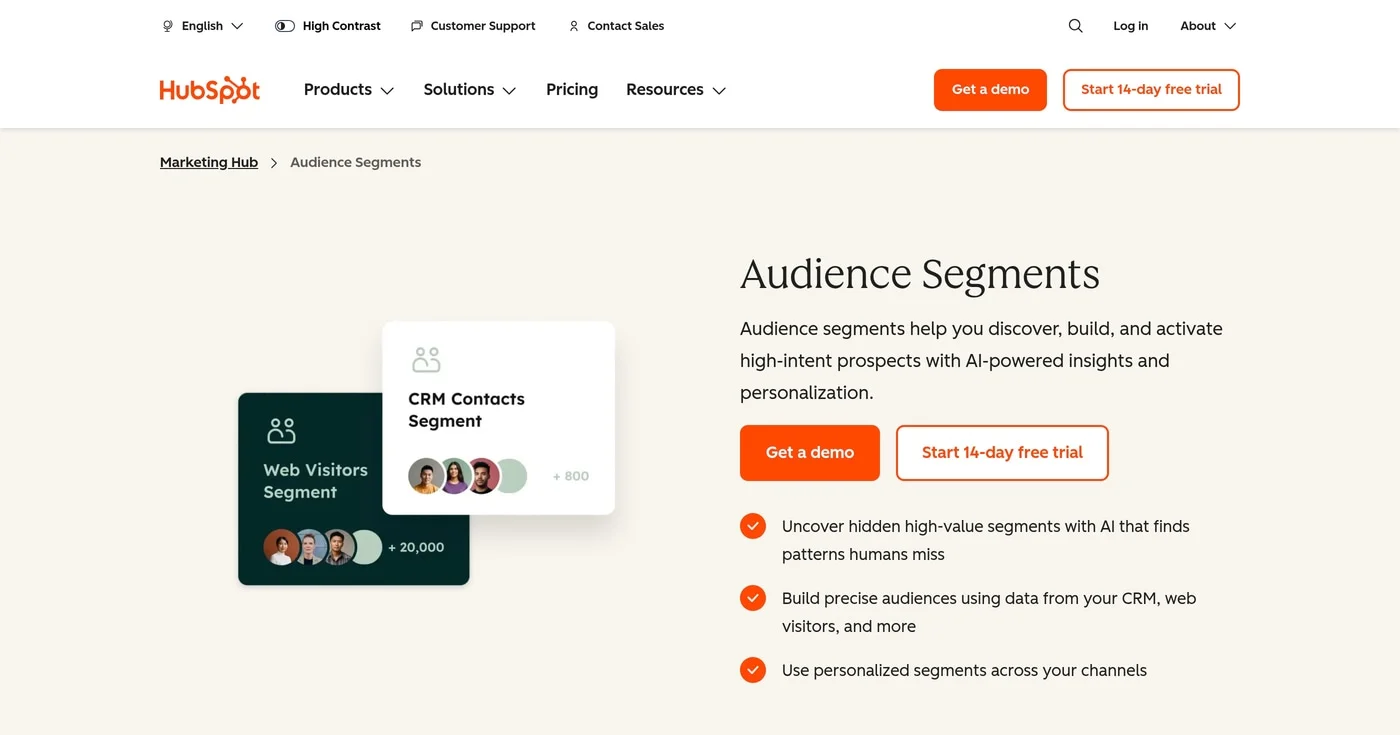
HubSpot Breeze AI: Contextual real-time signals that override campaign logic. The use case: a prospect is on your pricing page and has an open support ticket with Frustrated sentiment: Breeze intercepts the standard sales email and routes an alert to the success manager instead. This is agentic personalization at the individual level, built on segment-layer logic.
The implication for growth teams: AI tools lower the activation cost of complex segmentation but don't replace the strategic work of defining segments worth activating. Samya DasSarma, CTO at Iterable, said at Cannes Lions 2026 that hyper-personalization means optimizing for the individual, not a search engine, because AIs will be representing consumers. DasSarma's framing describes what the tools execute, not which segments are worth building for.
Tool | Best For | Pricing | Free Plan |
|---|---|---|---|
SMB-to-midmarket CRM + segmentation, all in one data model | From ~$800/mo (Marketing Hub Professional, billed annually) | Yes (limited) | |
DTC/ecommerce AI segment builder with predictive analytics | From $45/mo | Yes | |
Real-time CDP and segmentation backbone, multi-source | Custom pricing | No | |
Enterprise governance-first; compliant dynamic segments | Enterprise/custom | No | |
Agentic CDP for data-warehouse-native companies (GA June 2026) | Custom pricing | No | |
Survey-based segmentation research (conjoint, MaxDiff) | Enterprise pricing | No |
For B2B enrichment: Apollo.io for contact and firmographic data, Clay for multi-source enrichment workflows, and Clearbit (now HubSpot Breeze Intelligence) for real-time enrichment on inbound leads.
The most common failure: segmentation designed to feel thorough rather than to drive decisions. A research report that sits on a shelf after presentation completed the first step and skipped the second: deciding what to do differently. Test every segmentation initiative against the commercial question: "Which specific decisions will this change?"
Demographic segments describe who customers are; they rarely explain why customers behave. Using age and income as your primary segmentation layer produces messaging that speaks to a cohort, not a motivation. The "no generation is a monolith" critique identifies this failure exactly: generational buckets substitute for behavioral analysis when the real work is layering behavioral and needs-based variables on top.
EquiBrand names this "Surrender Marketing": defining the target market so broadly that strategy appeals to no one. It looks like safety; it functions as invisibility. The brands with the clearest positioning almost always have the tightest segment definition at their core, with the widest actual reach as a consequence (see the targeting paradox above).
A segment that your toolstack cannot reach in real time is a strategy problem masquerading as a data problem. Timeliness and context decide which channel gets which message; segment logic that can't execute at send time is theoretical.
On this, Rachel Kamel, Director of CRM at Zwift: "Most brands don't have a channel problem. They have a repetition problem: the same message, copy-pasted across every channel, hoping something sticks."
Persona names create premature closure. "The Innovator" and "The Budget Buyer" sound strategic but can lock a team into a frame before the data shows whether those descriptions match actual behavior patterns. Name last; build definitions from behavioral and needs-based data first.
Kulani Kinis, a DTC swimwear brand, connected organic social followers directly to their Klaviyo CRM to create a high-affinity behavioral segment: the Sun Chasers community. 130,000+ members and $425,000 in revenue attributed to the program in six months.
The segmentation mechanic was direct. Social followers who opted in were mapped to purchase history, content engagement, and lifecycle stage inside the CDP. The resulting segment was more predictive than any demographic variable because it reflected both affinity (follow behavior) and intent (purchase patterns).
The $425K result came from activating a clearly defined behavioral segment with consistent messaging, not from a mass-broadcast approach to the full email list.
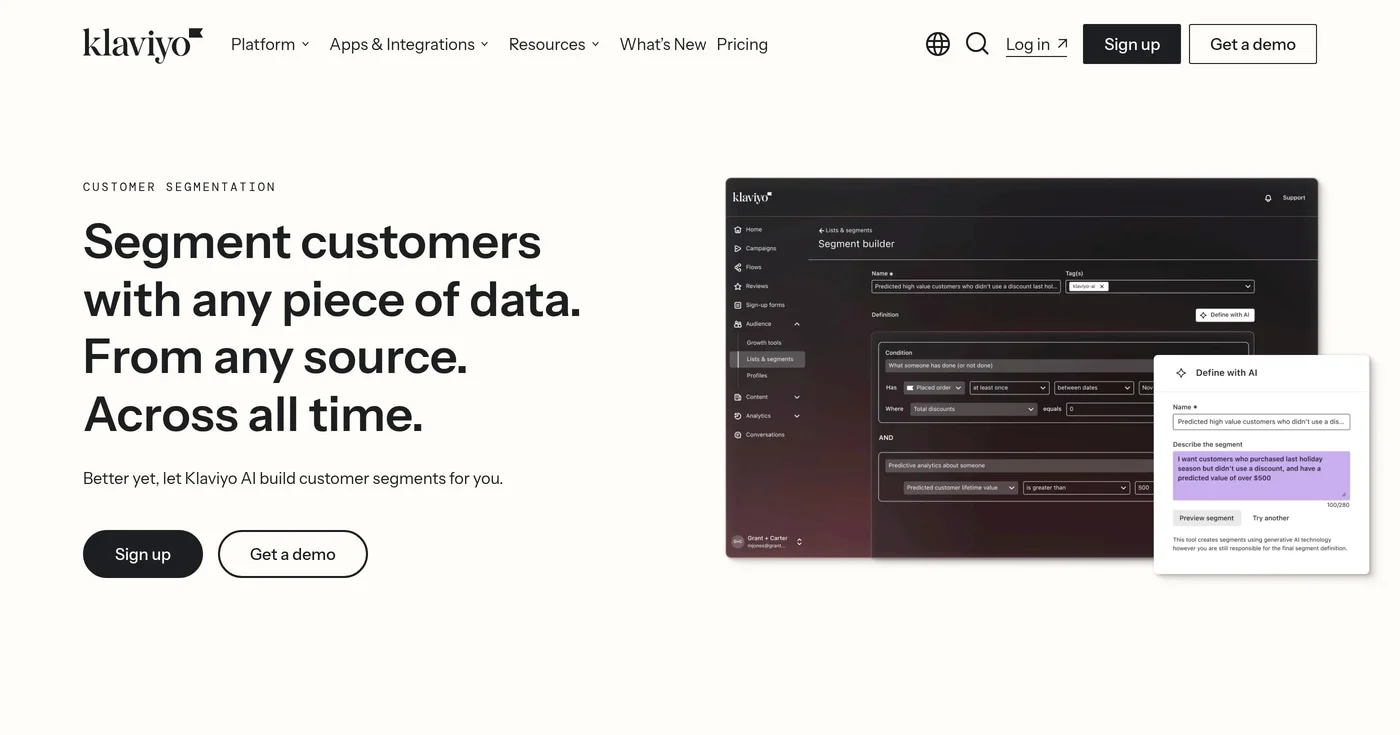
The lesson: segment by behavior and affinity, not by list size. A community of 130,000 activated buyers outperforms a list of 1.3 million passive subscribers if the segmentation is accurate and the messaging reflects it.

Paid search wins when you need a visit this week and you do not already rank. SEO wins when you can wait months for a click you stop paying for.
Bounce rate in GA4 is the share of sessions that were not engaged. See how that differs from Universal Analytics, why samples disagree, and what to check first.
YouTube SEO matches a video to a query. See the ranking factors YouTube names, the official metadata limits, and why retention has no published cutoff.
