Best Text Marketing Software: 12 Platforms Ranked by Use Case for 2027
12 SMS and text marketing platforms compared by use case, with current pricing, per-message costs, seat limits and free trial details for each one.
Updated 19 min read


12 SMS and text marketing platforms compared by use case, with current pricing, per-message costs, seat limits and free trial details for each one.
The best text marketing software depends on your stack. SlickText suits SMB teams that want every feature on every plan, Klaviyo suits DTC brands running email and SMS together, Postscript suits Shopify stores, and Twilio suits developers. SlickText holds a 4.8/5 rating on G2 across 1,954 reviews.
Below, 12 tools are ranked by use case so you can pick the right product category before you sign a contract.
SMS still earns attention. DMText reports a 98% open rate and a 45% response rate for SMS against 21.3% and 6% for email, based on 38M+ messages a month sent through its own platform. Treat vendor benchmarks like that as a ceiling: the platform matters less than whether you send messages people asked for, timed to what they did.
Ordered by overall fit for marketing teams, from general SMB platforms to vertical specialists:
Software | Best For | Key Features | Pricing | Free Plan | Platforms |
|---|---|---|---|---|---|
SMB marketing teams | All features on every plan, unlimited users, list-growth tools, RCS | 14-day trial | Web, iOS, Android | ||
Small teams | 3 users included, 306-character extended texts, AI Assist | $29/mo + $10/mo number | Free trial | Web, iOS, Android | |
Beginners and mid-market | 230,000+ businesses served, AI Compose, AI Reply, MCP servers | 14-day trial | Web, iOS, Android | ||
DTC email + SMS lifecycle | 211,000+ customers, behavioral segmentation, Customer Agent | $0/mo ($5 of mobile messages) | Yes | Web, iOS, Android | |
Shopify merchants | Shopify-native segmentation, SMS and RCS, AI products | $0/mo + $49 min spend | 30-day trial | Web (Shopify only) | |
Budget email + SMS | Email, SMS and push in one workflow, SMS from $0.007 | $0/mo (email and push) | Yes | Web | |
Enterprise ecommerce | SMS, email, RCS and push, AI personalization | Custom | No | Web | |
Pay-as-you-go senders | No monthly fee, refund on unused credit, email included | Free test credit | Web, iOS, Android | ||
Budget SMB teams | AI Voice Agents, Text-to-Pay, Google Business Reviews | Free start (50 texts) | Web, iOS, Android | ||
Sales teams (HubSpot/Salesforce) | Texting and calling inside the CRM, AI lead qualification agents | 14-day trial | Web, iOS, Android | ||
Local businesses | SMS, Google Reviews, payments, AI lead conversion | Demo only | Web, iOS, Android | ||
Developers | Programmable SMS and RCS API, usage-based pricing | Free trial | API |
12 best text marketing software tools compared
Best for SMB marketing teams that want all features without tier upgrades
SlickText is a Nashville-based SMS platform that reports powering over 124,000 text message programs. It holds a 4.8/5 rating on G2 across 1,954 reviews and was named one of G2's Top 100 Highest Satisfaction Products of 2026, ranking #57 overall in its second consecutive year on the list.
Its core structural advantage: every plan includes every feature and unlimited users, contacts and keywords. Many competitors gate automation or charge per seat; SlickText doesn't. The list-growth toolkit (popups, QR codes, text-to-join keywords, drip campaigns) is the strongest in the SMB category for teams building a subscriber base from scratch.
SlickText launched RCS support in June 2026, so businesses can send from a verified business profile that shows their brand name and logo in the recipient's messaging app.
Best for small teams that want a simple tool with three seats included
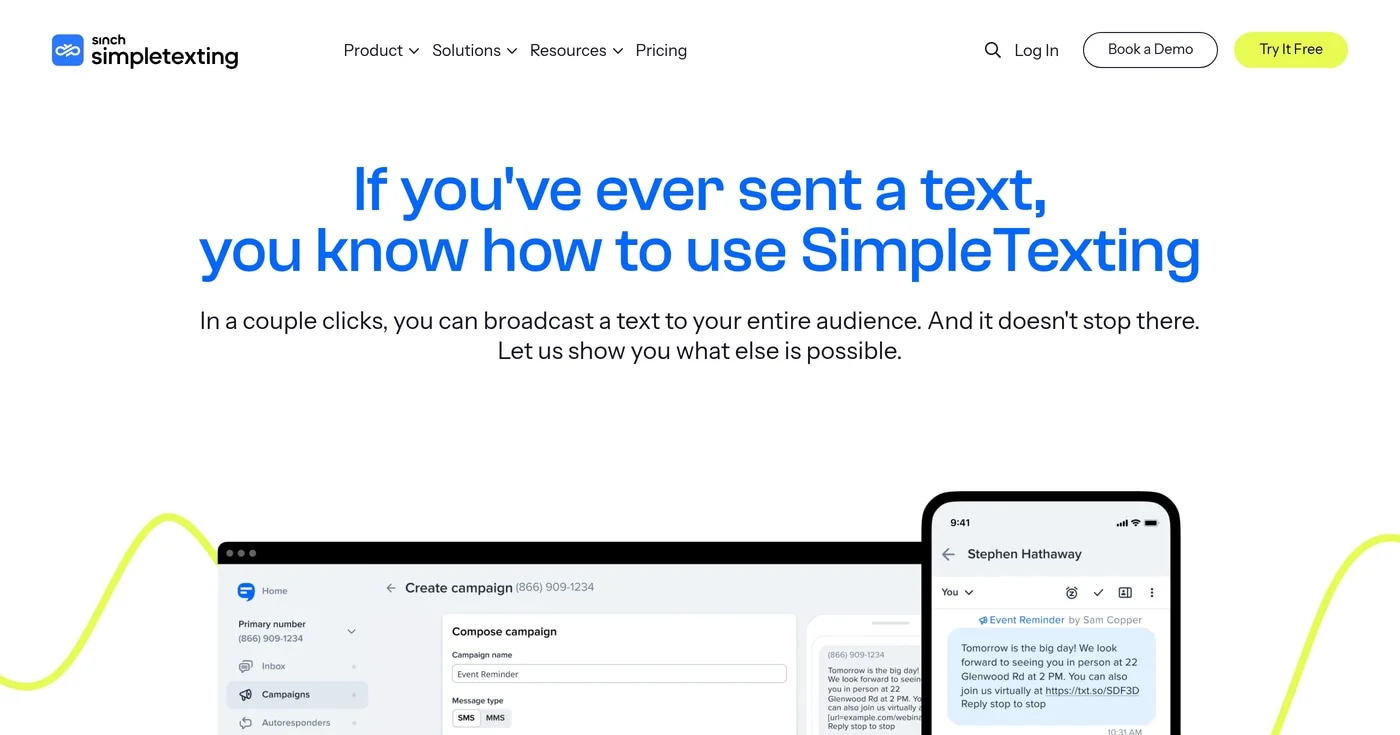
SimpleTexting keeps the SMB texting workflow simple: mass texts, two-way messaging, auto-replies, drip campaigns and an AI Assist message generator on every plan. It reports 17,000+ paying customers and more than 10 years in business.
The platform is part of Sinch. MessageMedia acquired SimpleTexting in 2020, and Sinch agreed to buy MessageMedia in 2021, which puts carrier-scale infrastructure behind a small-business interface.
SimpleTexting can stretch a message past the 160-character SMS limit to 306 characters, but each extended message costs 2 credits, so it saves splitting a text rather than saving money. All paid plans include three user seats, and it publishes 10DLC registration guidance for teams registering a local number for the first time.
Best for beginners and mid-market teams entering SMS marketing
EZ Texting has served more than 230,000 businesses since 2004 and delivered over 8 billion messages. It earned a TrustRadius Buyer's Choice Award in 2026 for the second consecutive year, and it sends SMS, MMS and branded RCS from one platform.
Its AI tools go further than most SMB platforms: AI Compose drafts messages and AI Reply answers customer questions from your website, help docs and PDFs. As of August 2026, EZ Texting's MCP servers let customers send messages, pull campaign metrics and manage contacts from Claude, ChatGPT or Cursor at no extra cost.
EZ Texting's fifth annual Consumer Texting Behavior Report (959 U.S. respondents, April 2026) found that 89% of consumers have opted into business texts. It also found they are pickier than ever about which texts earn a place in their inbox.
One pricing note: each plan includes one user, and extra seats cost $10/month per user. SlickText includes unlimited users and SimpleTexting includes three, so for teams of five or more that surcharge changes the total-cost comparison.
Best for DTC brands running email and SMS as one lifecycle
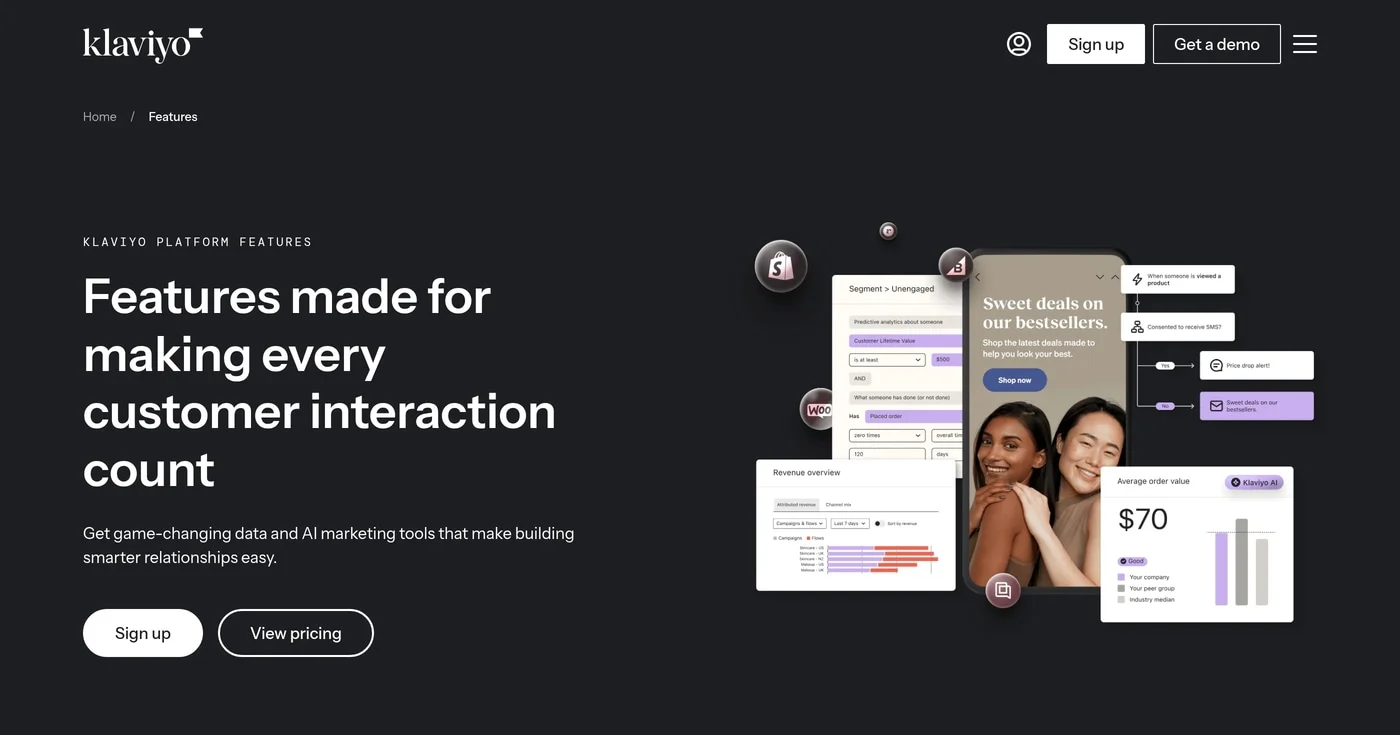
Klaviyo is a default choice for DTC brands on Shopify, WooCommerce, and Wix. It reported more than 211,000 customers and 25% year-over-year revenue growth in its third quarter of 2026, and it trades on the NYSE.
Where Klaviyo pulls ahead is behavioral segmentation: it builds segments from purchase history, browse behavior, and lifecycle stage, then triggers SMS flows inside the same automation builder as email. In one June 2026 case study, Stryv and Chronos Agency reported that 54% of a client's Klaviyo-attributed revenue came from automation.
In March 2026, Klaviyo expanded its AI agents with Composer, which builds full campaigns and flows from a single prompt (in private beta at launch). It also added retail skills to Customer Agent, which Klaviyo says resolves 65% of questions without a human agent.
Best for Shopify merchants wanting the deepest platform integration
Postscript is built around Shopify's data model: customer profiles, purchase history, product catalog, cart events, and Shopify automations. It describes itself as the AI retention platform for Shopify brands, and its segmentation uses your Shopify data directly instead of bolting SMS onto a platform designed for several commerce stacks.
Every plan includes the visual flow builder, cart and browse abandonment templates, and subscriber acquisition tools such as Onsite Opt-in. Postscript sends RCS as well as SMS. In August 2025, Postscript announced that a federal court in Delaware had granted it summary judgment against Attentive, ruling that its opt-in technology did not infringe Attentive's patents.
The hard constraint: Postscript is built for Shopify. If your store runs on WooCommerce, BigCommerce, or Magento, look at Klaviyo or Omnisend instead.
Best budget email + SMS alternative to Klaviyo
Omnisend packages email, SMS, and push notifications in one automation builder, and it pitches itself directly against Klaviyo, claiming savings of up to 35% vs. Klaviyo plus a free five-day migration.
The company started in 2014 as Soundest, an email tool for ecommerce, before adding SMS. It has built-in integrations for Shopify, BigCommerce, and WooCommerce, and its pre-built automations (abandoned cart, welcome series, post-purchase) cover the flows most stores need first.
Best enterprise ecommerce SMS platform
Attentive serves large DTC and retail brands as an SMS-first enterprise platform. It passed $500M in annual recurring revenue in 2024 and had raised $922M in funding as of March 2025.
It covers SMS, email, RCS, and push in one platform, with AI personalization across channels. Pricing depends on the number of messages you send and the size of your subscriber list, and every deal starts with a demo.
List growth is where Attentive built its name. It holds eight issued patents for its Two-Tap sign-up, and a Forrester study that Attentive commissioned found brands using its list growth tools grew SMS subscribers by up to 25% a year. Treat that as a vendor-commissioned figure, and ask for case studies from brands your size.
Best for pay-as-you-go and occasional senders
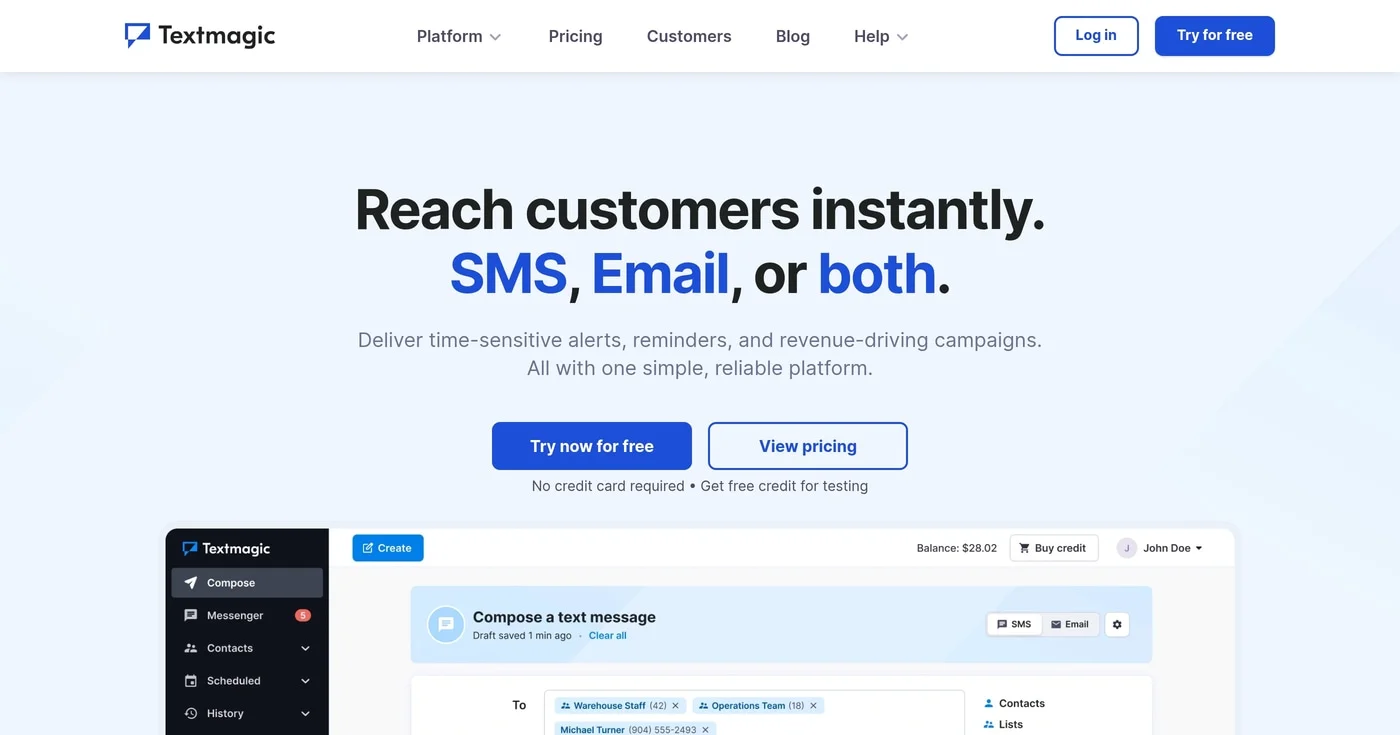
TextMagic is the oldest platform in this list, in business messaging since 2001. It reports 25K+ active paying business users and 200M+ text messages sent every year, and its parent company, TextMagic AS, is based in Tallinn, Estonia and listed on Nasdaq First North.
The core value proposition: no monthly commitment and a 100% refund on unused credit. That structure suits seasonal senders and businesses that text customers rarely enough that a monthly platform fee would exceed their actual send cost. The same credits also pay for email, and the first 10,000 emails are free once you verify your domain.
TextMagic can also connect numbers from an existing CPaaS provider: texts sent from those numbers are billed at 1¢ each instead of the standard rate.
Best for budget teams that want AI voice agents and Text-to-Pay on the entry plan
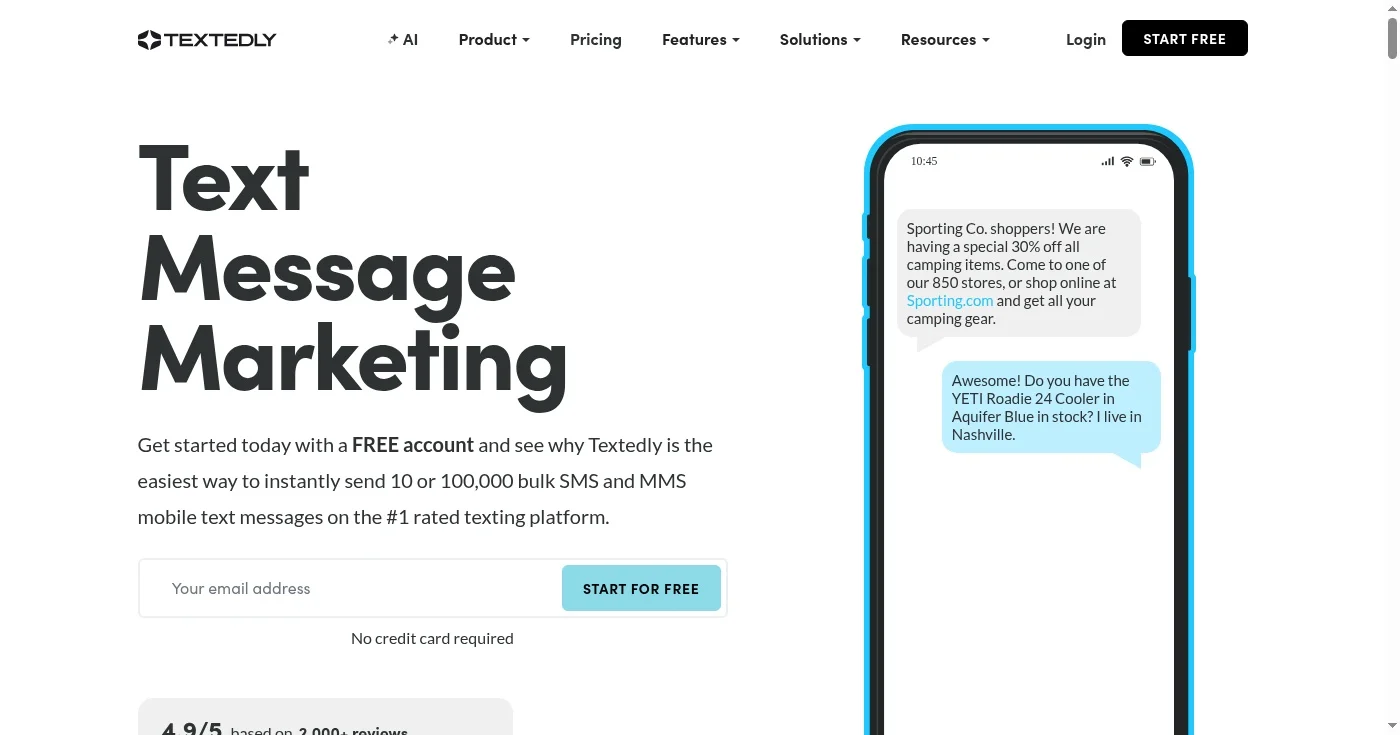
Textedly packs more into its entry plan than most SMB tools: the $29/mo Basic plan includes AI Voice Agents, Text-to-Pay for collecting payments by SMS, Google Business Reviews, a toll-free number and a 10DLC number. Every new account starts free with 50 text messages and one custom keyword, with no credit card and no time limit.
It holds a 4.6/5 rating on G2 across 1,488 reviews. Annual billing adds 20% more texts at the same monthly price, which suits teams that send in seasonal bursts.
The catch is seats: there is no cap on teammates, but each one adds $10 a month, so a shared inbox for a larger team costs more than the plan price suggests.
Best for sales teams using HubSpot or Salesforce
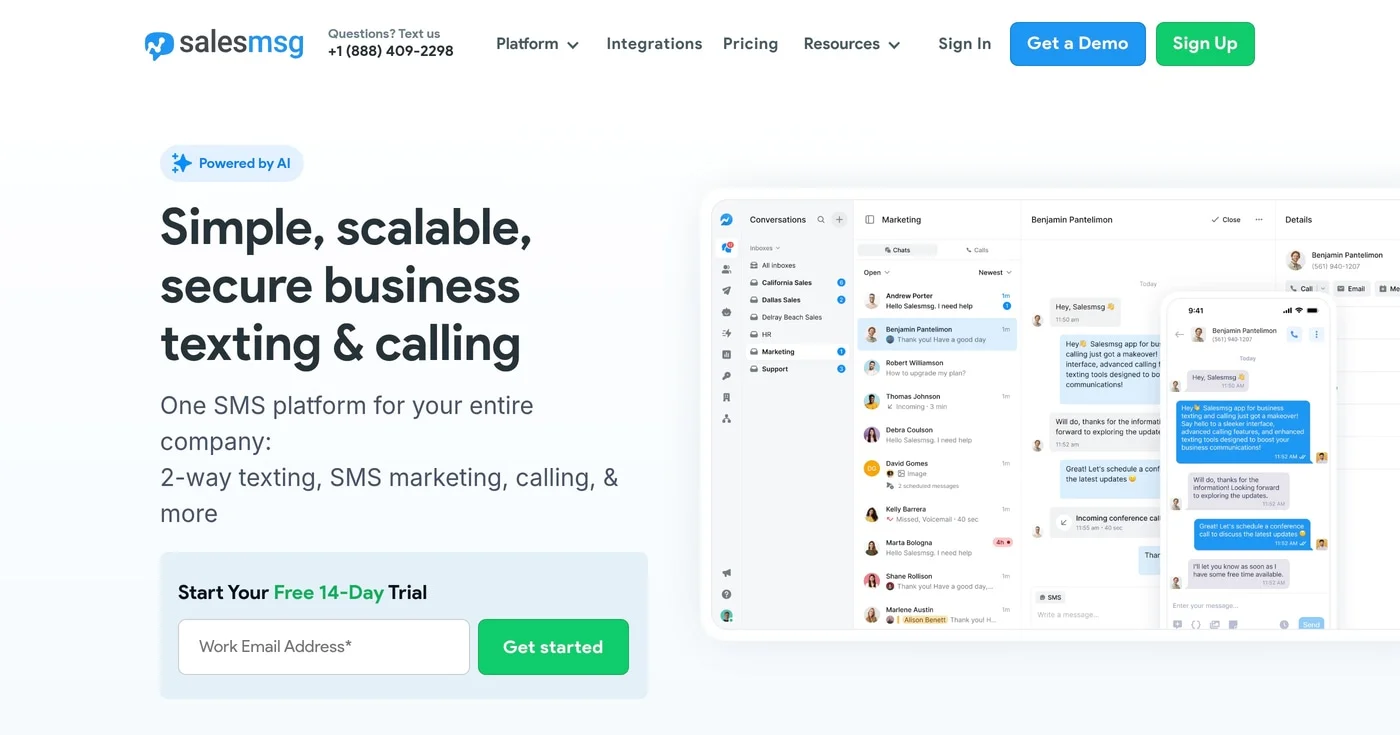
Salesmsg puts business texting and calling inside the CRM sales reps already use, with workflows in HubSpot, Salesforce and ActiveCampaign. Its AI agents qualify leads 24/7 and book meetings, so reps spend their time on the conversations most likely to close.
A three-time Inc. 5000 company (2024), Salesmsg reports 3,500+ business customers and more than 300 million texts sent. Shared team inboxes mean the whole team sees the conversation history, not just whoever texted last.
Billing runs on credits: an SMS costs 1 credit, an MMS 2 credits, and a call 1 credit per minute, so teams that mix texting and calling draw from one balance.
The limitation is intentional. Salesmsg is built for 1:1 sales and support conversations, not mass promotional blasts to large lists.
Best for local businesses combining reviews, SMS, and payments
Podium is a local business platform where SMS sits alongside Google Reviews management, payments, and AI that answers and converts inbound leads. It was valued at $3B in its November 2021 funding round, per Sacra. It serves local businesses such as car dealerships, dental offices and home services that earn revenue through appointments and repeat visits.
Podium's June 2026 LinkedIn post framed its AI value proposition plainly: "Good AI converts. Bad AI just responds." For a local business, an AI that books a service appointment overnight is worth more than a chatbot that sends a form reply.
Podium started as a review management tool, sending customers a text invitation to leave a review on Google or Facebook after a visit, and grew into a single inbox for every customer conversation. Sacra estimates it reached $389M in revenue in 2023.
Best for developers building custom SMS infrastructure
Twilio gives engineering teams a programmable communications API to build SMS and RCS experiences at scale. It was named a Leader in the 2026 Gartner Magic Quadrant for CPaaS for the fourth consecutive year and positioned highest for Ability to Execute.
US SMS costs $0.0083 per segment pay-as-you-go, plus carrier fees, with no monthly fee. Optional add-ons cost extra: the Engagement Suite (link shortening, click tracking, scheduling) adds $0.015 per outbound SMS after the first 1,000 a month.
If you want a drag-and-drop campaign builder, Twilio is the wrong tool. If your team has engineering resources and wants to build exactly the SMS experience you need, Twilio is the right foundation.
Low cadence and high relevance beat high-frequency blasting. A reminder sent when a customer is due for a service, or a follow-up after a visit, earns replies that a weekly discount blast to the whole list does not.

The 12 best AI communication tools in 2027, organized by use case: team messaging, meeting intelligence, customer support, writing, coaching, and voice AI.