


HubSpot vs Salesforce for Marketing Teams: The Year-One Math
Updated 13 min read


HubSpot wins for marketing-led teams that want one system they can run without a dedicated admin; Salesforce wins for sales organizations with complex territories, quoting and data rules. Mid-tier licenses cost about the same ($90 per seat vs $100 per user a month), so the real gap is setup cost and admin time.
Salesforce is the bigger company by a wide margin: $41.5 billion in fiscal 2026 revenue against HubSpot's $3.13 billion in 2025. Size does not settle the choice for a marketing team.
Feature | HubSpot | Salesforce |
|---|---|---|
Best For | Marketing-led SMB and mid-market teams | Enterprise sales orgs with admin capacity |
Free Plan | Up to 2 users, 1,000 contacts | Free Suite, 2 users |
Mid-Tier Sales Price | $90/seat/mo (Professional, annual) | $100/user/mo (Pro Suite, annual) |
Top Sales Tier | $150/seat/mo (Enterprise) | $550/user/mo (Max) |
Marketing Automation | Marketing Hub, from $800/mo (Professional) | Account Engagement, from $1,250/org/mo |
Required Onboarding | $1,500 to $7,000 one-time, by product and tier | None published; partner implementation |
App Marketplace | 2,300+ apps | 5,600 apps |
G2 Rating | 4.4 (14,367 reviews) | 4.4 (27,570 reviews) |
HubSpot is a customer platform built around a shared CRM, with separate hubs for marketing, sales, service, content and data. It reported 306,446 customers in Q2 2026, and its revenue grew 19% in 2025.
HubSpot's pitch to marketers: email, landing pages, automation, contacts and attribution live in one database. Its AI layer, Breeze, runs agents on HubSpot Credits, which each paid tier includes in a fixed monthly allowance.
Pricing is per seat and per hub. A Core Seat costs $20, $50 or $75 a month by tier and a Sales Seat $100 or $150. View-Only seats are free, so you pay only for people who work in the tool.
HubSpot also leans on agencies: Solutions Partners and the customers they referred made up about 49% of revenue in 2025. That is why so many HubSpot vs Salesforce opinions come from HubSpot partners.
IDC ranked Salesforce the #1 CRM vendor for the 13th year, with 20.0% share in 2025. Its sales product, Sales Cloud (now sold under the Agentforce Sales name), sits next to separate marketing products: Marketing Cloud Next and Account Engagement, formerly Pardot.
Salesforce is built for configuration. Admins model data with custom objects, validation rules and flows, and test changes in sandboxes. That depth is why large sales organizations stay: SmartBug's Casey Pedicord notes that the teams who love Salesforce "usually have, let's say, five to seven years inside of Salesforce, heavily customized" (SmartBug, 17:21).
Marketing is big business for Salesforce too: its marketing and commerce clouds brought in $5.43 billion in fiscal 2026 subscription revenue, next to $9.03 billion for Sales Cloud. Every Sales Cloud edition comes with a 30-day free trial, and most products are sold on annual contracts. Salesforce guides fiscal 2027 revenue to $45.8 to $46.2 billion.
Most HubSpot vs Salesforce comparisons put Sales Hub against Sales Cloud. If you run marketing, the real matchup is Marketing Hub against Account Engagement and Marketing Cloud Next, which are priced per org rather than per seat.
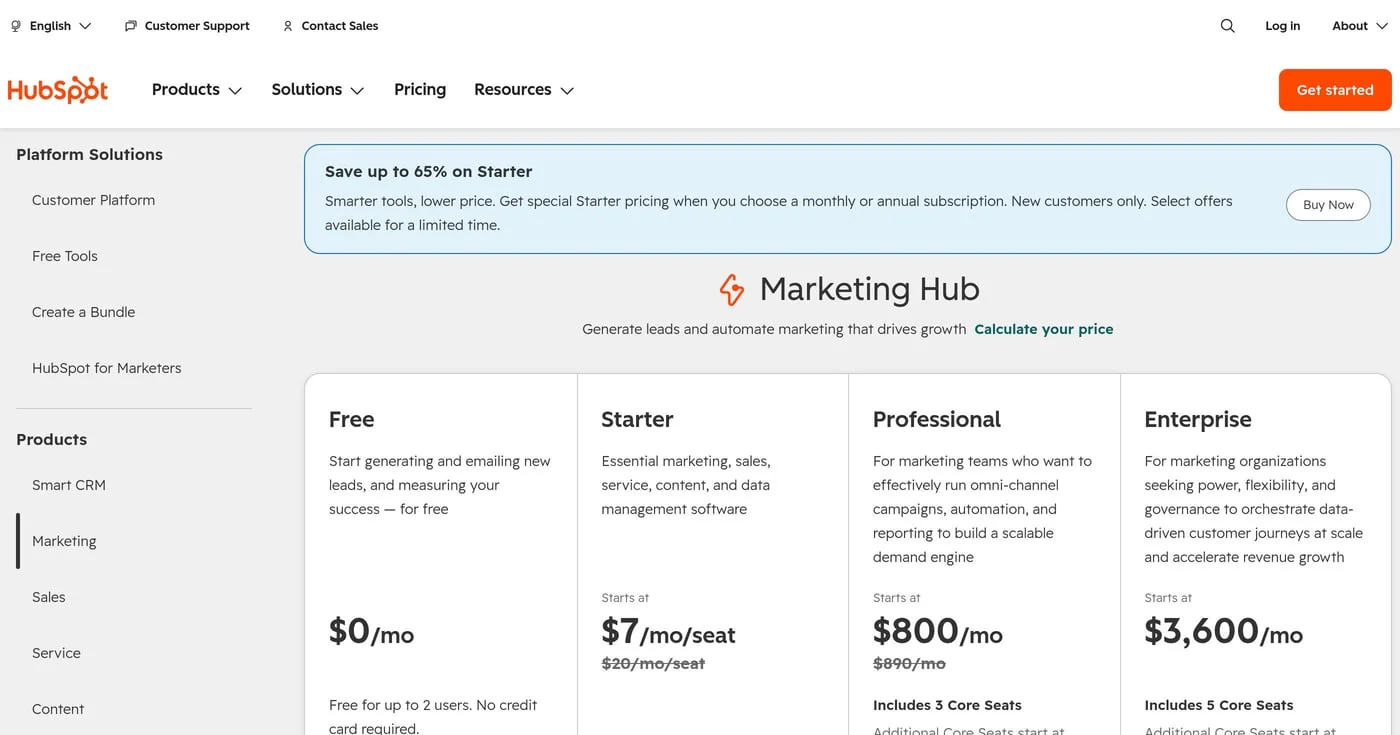
HubSpot Marketing Hub Professional costs $800 a month on annual billing with 3 seats, 2,000 marketing contacts and a required $3,000 onboarding. Enterprise is $3,600 a month with 5 seats, 10,000 contacts and $7,000 onboarding. Both include the CRM, so the contact database and the email tool are the same system.
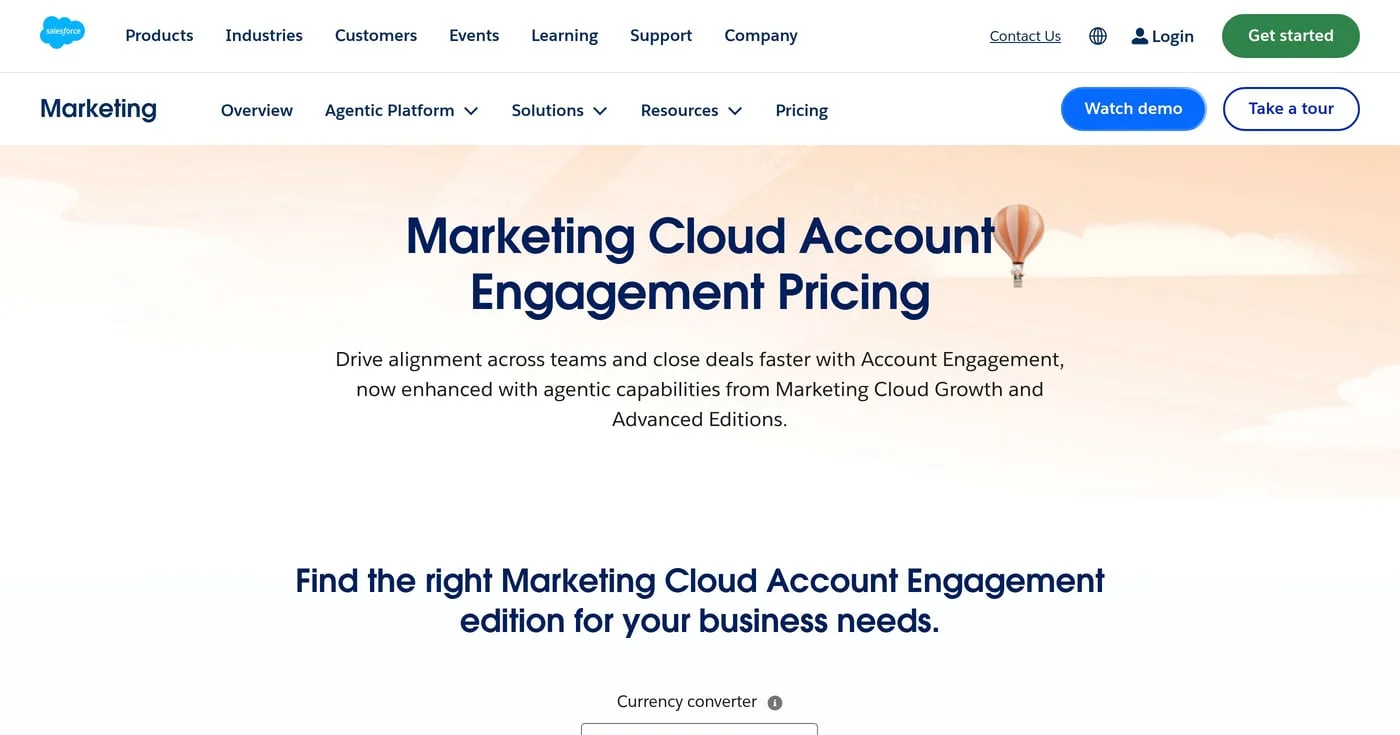
Salesforce Account Engagement runs $1,250 (Growth+), $2,750 (Plus+), $4,400 (Advanced+) and $15,000 (Premium+) per org per month on annual contracts. Growth+ includes Marketing Cloud Next Growth, which on its own lists at $1,500 per org a month (Advanced is $3,250).
Contact counts decide the cheaper option. At 2,000 contacts HubSpot Professional is the lower bill; Account Engagement includes 10,000 contacts and charges $100 per 10,000 more, so the gap narrows as your list grows. Salesforce also agreed on October 20, 2026 to acquire Braze for about $5.66 billion to strengthen cross-channel personalization in Marketing Cloud, so expect its marketing lineup to change before the deal closes in fiscal 2028.
Winner: HubSpot. One system, a lower entry price and campaigns your team launches without a RevOps ticket. Salesforce closes the gap once your list outgrows HubSpot's contact allowance and an admin already runs the org.
Take a 10-seat sales team at list price. HubSpot Sales Hub Professional is $90 x 10 x 12 = $10,800, plus the $1,500 onboarding fee: $12,300 in year one, or $13,500 at the $100 monthly-billing rate. Salesforce Pro Suite is $100 x 10 x 12 = $12,000 in licenses, about the same.
10-seat team, year one | HubSpot | Salesforce |
|---|---|---|
Sales licenses | $10,800 (Professional) | $12,000 (Pro Suite) |
Onboarding or implementation | $1,500 (required, fixed) | $10,000 to $30,000 (partner estimate) |
Marketing automation | $12,600 (Marketing Hub Pro, incl. $3,000 onboarding) | $15,000 (Account Engagement Growth+) |
Salesforce publishes no onboarding fee. Partners quote $10,000 to $30,000 over 6 to 10 weeks for a small business, and another puts year one for a 5-user Starter Suite team, licenses included, at $15,000 to $30,000. Treat both as estimates; HubSpot's onboarding fees are fixed list prices.
Above the mid tier the license gap opens again. Sales Cloud Core is $195 per user, Advanced $395 and Max $550 a month, while HubSpot's top Sales Hub tier is $150 per seat plus $3,500 onboarding.
Winner: HubSpot. Licenses tie at the mid tier, but HubSpot's fixed onboarding beats an open-ended Salesforce implementation for any team without an admin already on payroll.
G2 reviewers rate both at 4.4 out of 5, with HubSpot praised most for its interface. The difference is who runs the tool after launch.
On LinkedIn, David Vicente put it in one line: "HubSpot's CRM ceiling is a pricing tier. Salesforce's is your maintenance capacity" (David Vicente on LinkedIn, October 2026).
Reporting follows the same split. Olasubomi Soyebo on LinkedIn (October 2026) puts it this way: "Salesforce often leans toward governed reporting. HubSpot leans further toward self-service."
If your CFO needs locked, audited pipeline reports, that favors Salesforce; if marketers build their own dashboards, it favors HubSpot.
Ryan Gunn describes the marketing side from an Uber Freight consolidation. RevOps had to do work for every campaign, and "after the migration, the marketing team could launch campaigns themselves" (Ryan Gunn, 23:56). Gunn, like most voices on this question, works on the HubSpot side; weigh that.
Winner: HubSpot. A marketing team can configure it without an admin; Salesforce assumes one.
Salesforce separates Leads, Contacts and Accounts, and lets you build almost any object, rule or flow on top. Even Gunn names where he would pick Salesforce: using it "as your ERP as well as your CRM," and strict data validation and routing for very large sales teams (#chadtpodcast, 22:07). He also argues data volume alone no longer forces Salesforce (21:41).
HubSpot keeps the model simpler and charges for depth. Custom objects need Enterprise, and u/MrShineyPants in r/salesforce warns that "With Hubspot you will create the tech debt to customize the tool. With Salesforce, you will start up with the existing model."
Testing changes is the other gap. Salesforce includes a Full Sandbox from Advanced ($395), so admins can rebuild a flow without touching live data. HubSpot includes a standard sandbox account only on Sales Hub Enterprise, the same tier that unlocks custom objects.
For a marketing team, HubSpot Professional covers lifecycle stages, lists and workflows. The trouble starts when sales wants objects HubSpot only offers at $150 a seat.
Winner: Salesforce. If your process needs territories, quote-to-contract or ERP-style records, Salesforce models it out of the box.
AppExchange lists 5,600 apps against more than 2,300 in HubSpot's marketplace. For ERP, CPQ and data warehouse connectors, the Salesforce catalog is deeper.
On AI, HubSpot's Breeze agents draw on included HubSpot Credits, and Salesforce sells Agentforce on Flex Credits; Agentforce reached $800 million ARR in Q4 fiscal 2026. Jason Lemkin observed in September 2026 that HubSpot's price increases target its own agents while Salesforce's target third-party agents, so check which agents you plan to run before you price either.
Credits behave differently on each side. HubSpot includes 500, 3,000 or 5,000 credits a month by tier and charges $0.010 per credit beyond that, with no rollover. Salesforce bundles 500,000 to 2.75 million Flex Credits per org per year on Core, Advanced and Max.
Agentforce has also drawn security scrutiny: researchers reported zero-click flaws they named SalesBleed.
Winner: Salesforce, on catalog size and enterprise connectors. Standard marketing integrations exist in both marketplaces.
The common split stack puts marketing in HubSpot and sales in Salesforce. HubSpot's native connector needs a Salesforce edition with API access (Group Edition is not supported), and a single contact sync can use up to four Salesforce API calls, capped by your org's limit.
HubSpot checks for changes about every 15 minutes, so the two systems are never quite live. On r/salesforce, duplicates are the recurring complaint: u/wickedpixel1221, who has run both for 8 years, notes "Hubspot uses email as primary key but SF allows multiple records with the same email."
The fixes admins on Reddit report are procedural:
Integrate, migrate or stay. If you run Salesforce today and want to move, budget for overlapping subscriptions and staff time, and plan backwards from your Salesforce renewal date. A HubSpot solutions architect on SmartBug's show advises planning the move over about a quarter (SmartBug, 23:16) and running both systems on a sync while people train on the new one, then cutting the sync.
"If you can stay with marketing and sales within HubSpot you are much much better off doing so," u/weoter in r/hubspot tells teams already split. Migrations break on reporting, which Radisa Radisic on LinkedIn (October 2026) describes as go-live day when "the Head of Sales can't find half of his reports."
If you are still choosing, see the HubSpot alternatives and customizable CRMs that sit between the two, or the AI CRM picks if agents drive your shortlist.
Both free plans stop at 2 users, so they work for evaluation, not for a team. Check HubSpot's pricing and Salesforce's pricing before you sign: HubSpot runs rotating promos, and Salesforce lists "transaction fees apply" on its Suites without detail.
Choose HubSpot if you are a marketing-led team of up to a few dozen users, you want email, automation and CRM in one place, and you do not have (or want) a full-time CRM admin. Year-one cost is a fixed onboarding fee plus seats, and your marketers ship campaigns themselves.
Choose Salesforce if your sales process needs territories, quotas, quote-to-contract or ERP-style data, you have admin capacity, or your marketing list is large enough that Account Engagement's 10,000-contact base is the better deal. If you already run Salesforce, integrate HubSpot for marketing before you consider migrating.

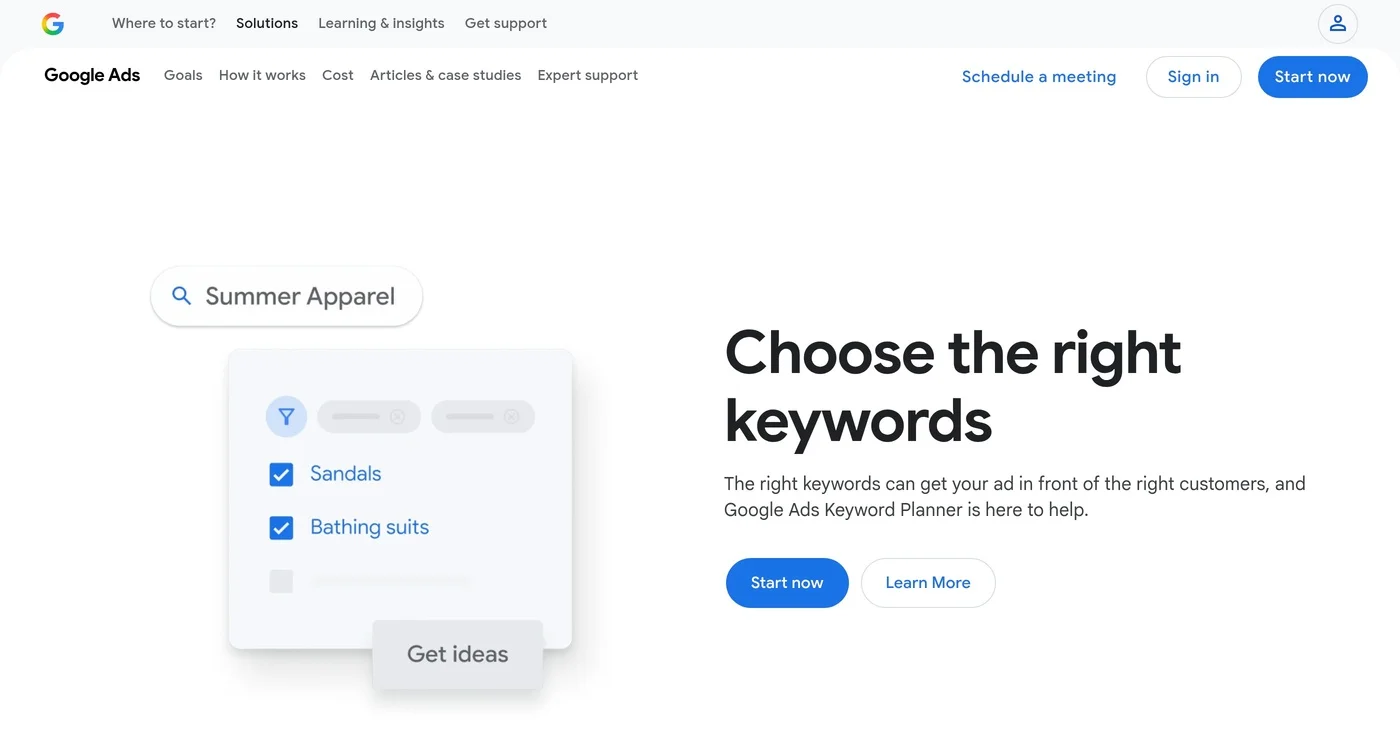
Open Google Keyword Planner without treating setup as running ads, then read volume, competition, and the two bid columns for what those numbers are not.
ZoomInfo alternatives have no public platform list price. Apollo publishes a seat price, Cognism covers EU phones, and Lusha starts at $49.90 a month.
