


10 HubSpot Alternatives, Ranked by What You Actually Need
HubSpot's pricing jumps from $0 to $890/month with no mid-tier. These 10 HubSpot alternatives are segmented by sales CRM, email automation, and agency use case
Updated 20 min read


HubSpot's pricing jumps from $0 to $890/month with no mid-tier. These 10 HubSpot alternatives are segmented by sales CRM, email automation, and agency use case
Pipedrive is the closest replacement for sales-driven teams; ActiveCampaign covers marketing automation without the $890 paywall; EngageBay matches HubSpot's breadth for free. Most teams leave HubSpot when a single feature need (a second pipeline, an automated sequence, a custom report) triggers the Professional upgrade and adds $870 to the monthly bill overnight.
The right alternative depends on which HubSpot identity you were relying on: sales CRM, marketing automation platform, or agency all-in-one. Every pick below names that use case directly.
HubSpot is built to be outgrown. The free CRM handles unlimited users and up to 1,000 contacts with Gmail and Outlook sync, a feature set generous enough to run a small sales operation for 6 to 12 months. That generosity is the business model.
You can get your contacts in and your pipeline set up on the free plan. What you cannot do without upgrading: create a second pipeline, send deal-triggered email sequences, build custom reports, set up multi-step workflows, or exceed 1,000 marketing contacts. Every feature that makes a CRM operationally useful, as opposed to just a contacts database, sits behind a single upgrade threshold.
That threshold is $890 per month (Marketing Hub Professional, 3 seats, 2,000 contacts), with no middle tier. On Reddit's r/CRM, users describe this as a deliberate bait and switch, and they're not wrong about the architecture. As u/No_Boysenberry_6827 in r/smallbusiness (May 2025) put it: "HubSpot free is only free until you need literally any real feature."
A typical 5-person team that wants forecasting, deal automation, and basic email marketing pays Sales Hub Pro at $100/seat ($500/month) plus Marketing Hub Pro at $890/month. That's $1,390 per month before a mandatory $1,500–$3,000 onboarding fee. Enterprise implementation adds $12,000–$60,000 via partners.
Four other consistent departure triggers across all research phases:
Where HubSpot still wins: multi-channel marketing automation with complex attribution, organizations running separate marketing, sales, and service teams that need clean handoffs on a single platform, and teams invested in HubSpot Academy certifications. The AI Breeze suite (predictive lead scoring, content writer, call summaries) is a genuine differentiator at depth.
HubSpot serves approximately 300,000 paying customers with $3.3B in trailing twelve-month revenue. For the right team, it's the right tool.
Ordered by use-case fit: closest overall match first, narrowing toward specialized alternatives for agencies, email, and enterprise.
Alternative | Differentiator Tag | Best For | Entry Pricing | Free Plan | G2 Rating |
|---|---|---|---|---|---|
Closest match | Sales-only teams | No (14-day trial) | 4.2/5 | ||
Best for marketing automation | Email-led B2B/B2C | No | 4.5/5 | ||
Best free option | Early-stage startups, SMBs | Yes (250 contacts) | 4.6/5 | ||
Best for AI included | Mid-market sales (10-100) | Yes (3 users) | 4.5/5 | ||
Budget pick | Budget-conscious teams, Zoho ecosystem | Yes (3 users) | 4.1/5 | ||
Best for agencies | Digital agencies, SMBs | No | 4.4/5 | ||
Best for email + large lists | Email-heavy businesses, EU/GDPR | Yes (unlimited contacts) | 4.5/5 | ||
Most popular community pick | SMBs wanting full CRM + email bundle | No | 4.3/5 | ||
Best for project-led teams | Teams managing client projects + sales | Yes (2 seats) | 4.7/5 | ||
Upgrade pick | Enterprises (50+ users) | No | 4.4/5 |
All 10 HubSpot alternatives compared by pricing, free plan, and G2 rating
Best HubSpot alternative for sales-focused teams
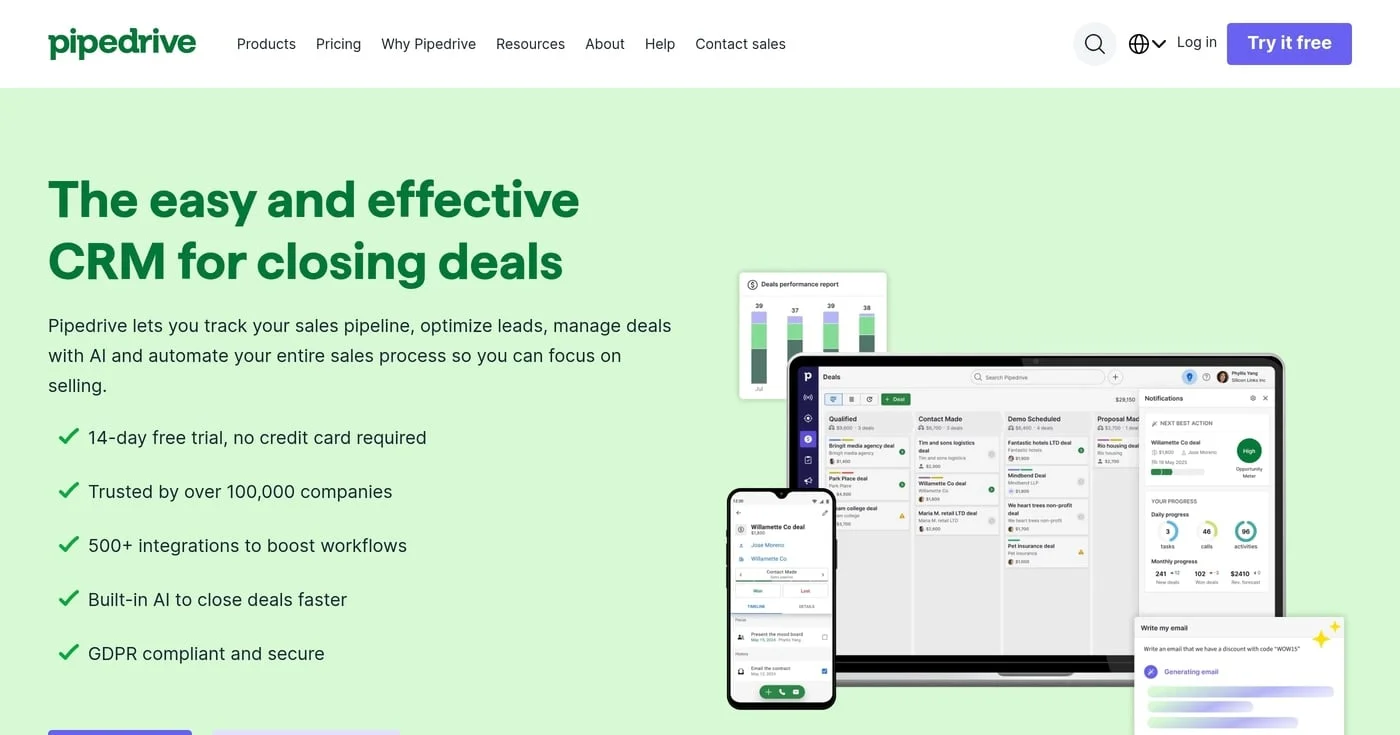
Pipedrive is a visual sales CRM built around how pipeline reps work: drag deals across stages, log calls in one click, and automate the next follow-up based on deal movement. 100,000+ customers and an entry price of $14/seat/month make it the most SERP-consistent HubSpot alternative for teams that want CRM without the marketing overhead.
Pipedrive was named Best Sales CRM in the 2026 CRMmys Awards by CRM.org.
Pipedrive and HubSpot are different categories. HubSpot was designed as an inbound marketing platform; Pipedrive was designed as a deal-progression tool. What Pipedrive lacks: native email marketing, a marketing automation builder, landing pages, and a service desk.
What it delivers: a cleaner sales-only experience at roughly half the Professional-tier cost. A 4-person team running deal-stage automation with email sequencing pays around $196/month on Growth, compared to HubSpot's $1,390/month equivalent.
u/TinyPlotTwist in r/CRM (May 2025) documented exactly this migration: "I've watched 20+ teams make this exact move. The migration takes about 3 days to fully map contacts and deals, and you keep most functionality that actually matters for operations."
Lite: $14/seat/month | Growth: $39/seat/month | Advanced: $49/seat/month | Professional: $64/seat/month
No free tier; 14-day trial on all plans.
Best HubSpot alternative for marketing automation
ActiveCampaign is a marketing automation platform with a built-in CRM. Where HubSpot charges $890/month for multi-step workflow automation, ActiveCampaign starts at approximately $15/month for 1,000 contacts, with a Starter plan that includes a visual drag-and-drop automation builder, advanced email segmentation, and 900+ integrations. Its G2 score of 4.5/5 reflects 180,000+ customers across 170+ countries.
ActiveCampaign's AI story differs structurally from HubSpot's Breeze suite. As ActiveCampaign noted on LinkedIn (June 2026), the differentiator is context: not what you tell it once, but what it learns from every decision you make over time.
HubSpot's Breeze features are powerful but require manual configuration at setup; ActiveCampaign's automation engine refines itself with campaign data over time. This is the AI-native vs. AI-bolted-on distinction that's reshaping AI CRM evaluation in 2026.
ActiveCampaign covers HubSpot's Marketing Hub (email automation, segmentation, lifecycle campaigns, and A/B testing), but at contact-based pricing instead of HubSpot's seat-based structure. For a list of 10,000 contacts, ActiveCampaign runs $156/month; HubSpot Marketing Hub Professional requires $890/month plus $470 more for 8,000 additional contacts. Where ActiveCampaign falls short: its CRM is lighter than HubSpot's, with no deal pipeline on the base plan, and the automation builder carries a steeper learning curve.
ActiveCampaign's customer Donald Purdy grew enrollment 27% by replacing manual networking and advertising with automation sequences, a common framing for teams switching from HubSpot to more automation-forward tools.
Starter: approximately $15/month (1,000 contacts) | Plus: ~$49/month | Professional: ~$79/month
Pricing scales with contact count, not seats. No free tier; 14-day trial available.
Best HubSpot alternative for teams that want the free all-in-one
EngageBay bundles HubSpot's full stack: marketing, sales, service, and live chat in one subscription starting at zero. The free tier includes CRM, helpdesk, live chat, email marketing, and landing pages for up to 250 contacts. That's the same breadth HubSpot delivers, at a fraction of the cost, and EngageBay offers free migration from any platform.
Rated #1 on Capterra and 4.6/5 on G2, EngageBay is bootstrapped and built specifically as a HubSpot alternative for early-stage companies, founded in 2017 in the Bay Area.
EngageBay's feature set deliberately mirrors HubSpot's: deal pipelines, email sequences, automation workflows, helpdesk ticketing, live chat, and appointment scheduling all in one plan. The differences are ecosystem depth (HubSpot's 1,000+ integrations versus EngageBay's smaller app library), interface polish (HubSpot is more refined), and documentation quality (EngageBay's is thinner). For teams in their first 12 months that have already been surprised by HubSpot's upgrade cliff, EngageBay resolves the immediate problem.
Free: 250 contacts, unlimited users, all departments included | Basic: $13/user/month | Growth: $46/user/month | Pro: $67/user/month
Best HubSpot alternative for AI without a paywall
Freshsales (Freshworks CRM) ships Freddy AI (contact scoring, deal predictions, and activity suggestions) on every paid plan starting at $9/user/month. HubSpot's comparable AI features sit behind the Professional tier ($100/seat/month Sales Hub). The result: a 5-person team gets AI-assisted selling on Freshsales for $45/month versus $500/month on HubSpot Sales Hub Pro.
Freshworks (NASDAQ: FRSH) serves 74,000+ businesses across 120+ countries and is rated 4.5/5 on G2. The built-in VoIP phone system sets it apart from most mid-market CRMs: call, log, and follow up without a separate Aircall or JustCall integration.
Freshsales matches HubSpot's sales CRM layer: pipelines, contacts, email tracking, sequences, and AI features at the base tier. What it doesn't match: marketing automation, landing pages, and content tooling.
Those require Freshmarketer (separate product, separate cost). For teams that use HubSpot primarily as a sales CRM and have been paying the $100/seat Professional tax, Freshsales reduces per-seat costs by 75% while keeping the AI features.
Free: 3 users | Growth: $9/user/month | Pro: $39/user/month | Enterprise: $59/user/month
Best HubSpot alternative for budget-conscious teams
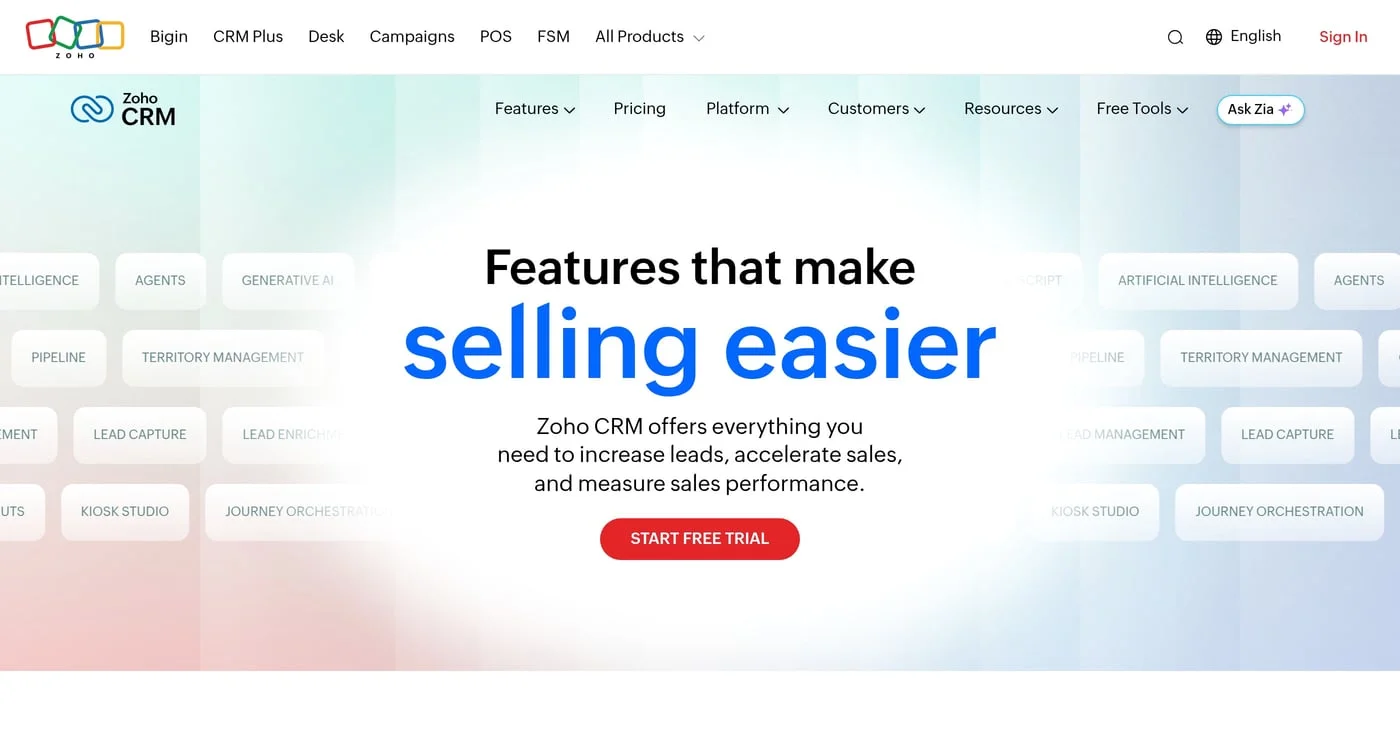
Zoho CRM serves 250,000+ businesses across 180 countries at a Standard plan starting at $14/user/month; Enterprise with Zia AI runs $40/user/month. As a bootstrapped company with 15,000+ employees, Zoho owns its own server infrastructure, which gives it pricing stability that VC-backed competitors can't credibly promise long-term. Zoho's own LinkedIn post (June 2026) frames this directly: "predictable pricing, long-term resilience, and the assurance that our customers aren't paying the price for uncertainty they didn't create."
Zoho spans the full stack: sales pipeline, marketing automation, customer service, and 55+ native Zoho apps (Zoho Books, Zoho Desk, Zoho Campaigns) in an integrated ecosystem. The feature parity with HubSpot Professional is real; the implementation burden is also real.
The honest assessment: Zoho's pricing looks attractive until you reach advanced automation. u/waityoucandothat in r/CRM (June 2025) put it bluntly: "Nothing about the software is intuitive. Running a one-off report can take an IT team (that you pay extra for) a couple days."
Independent r/CRM users consistently recommend Nutshell or Pipedrive over Zoho for teams without technical resources to configure it. If your team has a dedicated admin or a Zoho partner, the value is substantial. If not, budget the setup cost.
Free: 3 users, 5,000 records | Standard: $14/user/month | Professional: $23/user/month | Enterprise: $40/user/month
Best HubSpot alternative for marketing agencies
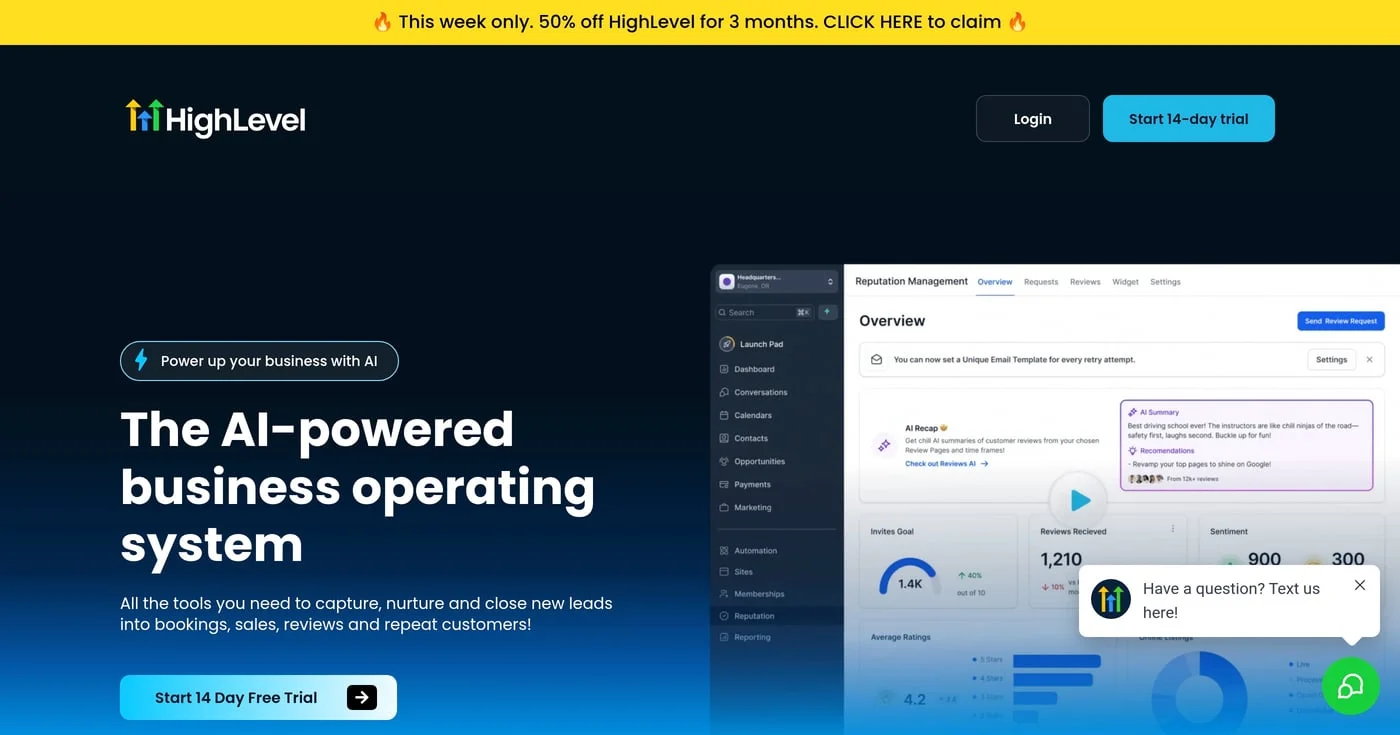
GoHighLevel charges $97/month flat for unlimited contacts and unlimited users. That covers CRM, email campaigns, SMS marketing, booking calendars, a funnel builder, reputation management, and white-label capability.
For a digital marketing agency managing 10+ client accounts, the comparison to HubSpot's per-seat, per-contact model is stark. 1M+ businesses use the platform; its G2 score of 4.4/5 reflects its default status as the all-in-one for agencies that found HubSpot's per-seat model unworkable.
Where HubSpot bills per seat and per contact with separate pricing for each Hub, GoHighLevel bills per account with a flat monthly fee. For an agency running 20 client CRM accounts, that difference can be $3,000+/month versus $97–$297/month.
The white-label feature lets agencies resell GoHighLevel under their own brand, which HubSpot does not support. What GoHighLevel lacks: HubSpot's enterprise-grade reporting, the marketing attribution depth HubSpot provides at the Professional tier, and the CRM sophistication for complex in-house sales operations.
On Reddit's r/CRM and YouTube review channels, GoHighLevel is consistently framed as the solution for agencies and SMBs that have hit HubSpot's per-seat trap. Migrations consistently yield "1/10th of the HubSpot cost for equivalent email marketing automation."
Starter: $97/month (unlimited contacts, 3 sub-accounts) | Unlimited: $297/month (unlimited sub-accounts) | Agency Pro: $497/month (with SaaS reseller features)
Best HubSpot alternative for email marketing with large contact lists
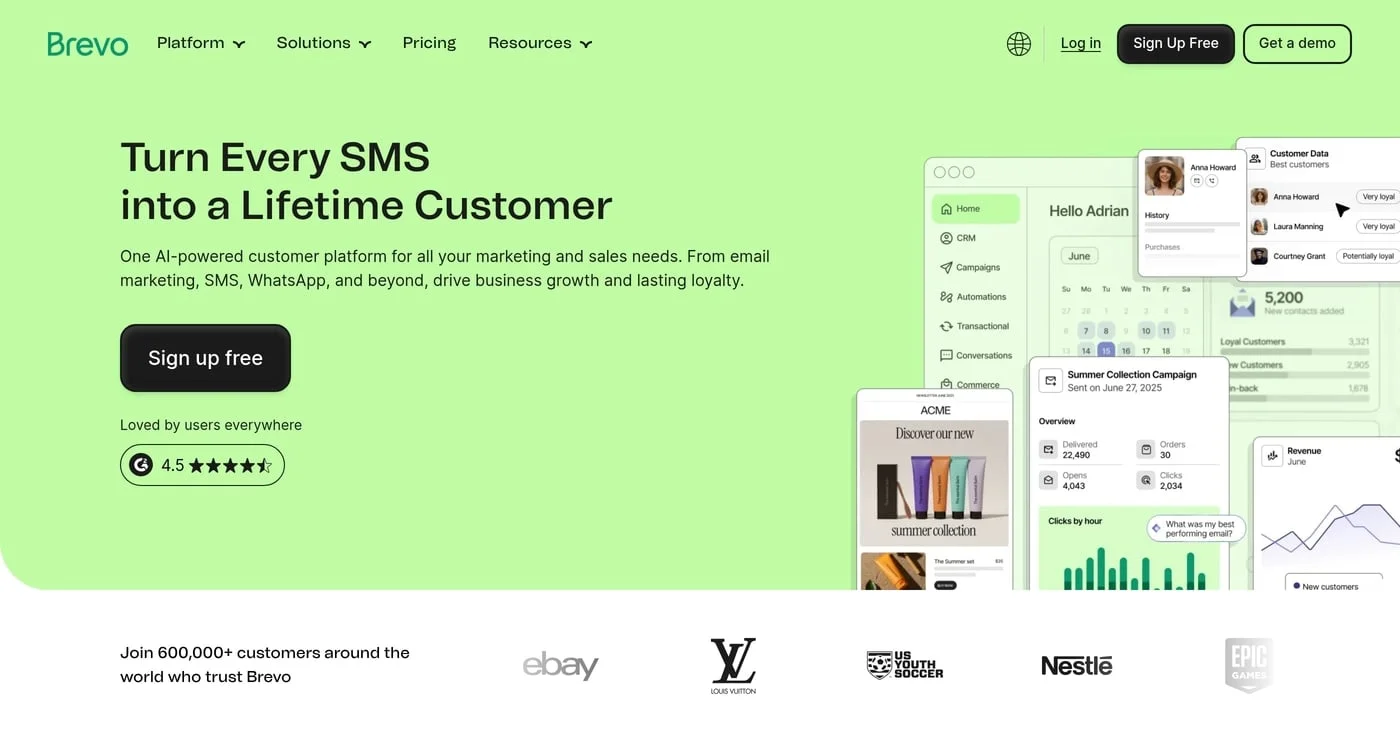
Brevo (formerly Sendinblue) prices on email volume, not contact count. The free tier includes unlimited contacts and 300 emails/day; the Starter plan begins at $9/month (5,000 emails/month, scaling to $19/month at 20,000 emails/month). For a team with 50,000 contacts and a monthly newsletter, HubSpot Marketing Hub Professional starts at $2,400/month (contact scaling above 2,000); Brevo handles comparable email volume for a fraction of the cost.
With 600,000+ users and a G2 score of 4.5/5, Brevo is the contact-volume leader in email pricing. EU-based (Paris), GDPR-native, it bundles email marketing, SMS, transactional emails, and a basic CRM in one subscription. The Aura AI suite adds predictive sending and subject-line optimization across all paid plans.
Brevo handles HubSpot's Marketing Hub email functionality at a fraction of the cost for businesses where contact list size drives the bill. What it does not replace: HubSpot's CRM depth, the deal pipeline, sales automation, or the service desk.
Teams switching from HubSpot to Brevo often pair it with Pipedrive for the pipeline side, a pattern noted across r/CRM threads. This matches the broader trend toward B2B email marketing software combining best-of-breed email with a separate sales CRM.
Free: unlimited contacts, 300 emails/day | Starter: $9/month (5,000 emails/month, volume-scaled) | Standard: from $18/month (marketing automation + A/B testing)
Best HubSpot alternative recommended by the CRM community
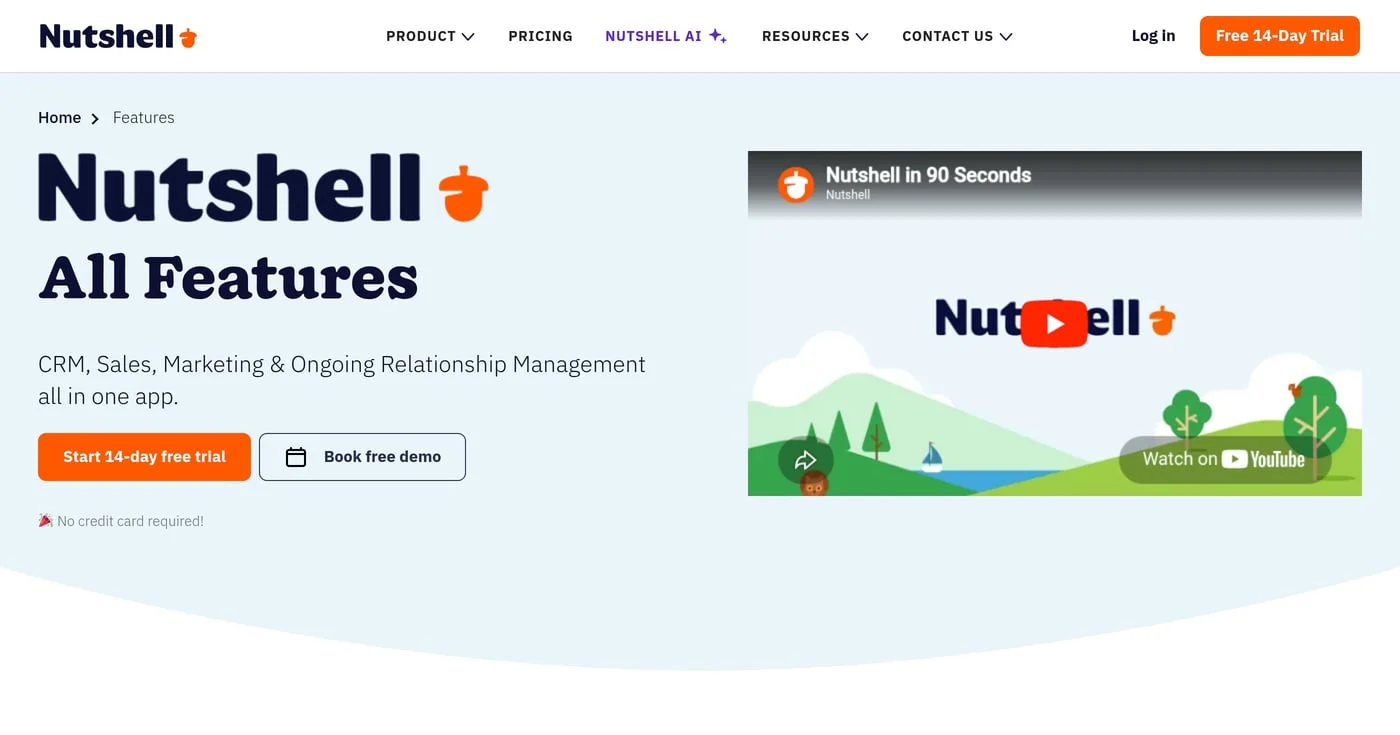
Nutshell appears in only 1 out of 9 major SERP articles on HubSpot alternatives. Across r/CRM, it is the most organically recommended tool, named by multiple independent users with no promotional signals as their preferred switch from HubSpot. The consistent framing from users who migrated: Nutshell delivers roughly 80%+ of HubSpot's functionality at under 50% of the cost, with CRM, email marketing, SMS, and chatbot capabilities bundled in the base plan.
u/Ok-Prompt3555 in r/CRM (June 2025) described their team's experience directly: "We feel it gives you about 80%+ of what HubSpot can give you for not even 50% of the price. I'd honestly say that the ease of use is the #1 thing."
A second r/CRM user in the same thread cited "probably the best CRM support I've experienced": a stark contrast to HubSpot's support, which degrades below Enterprise tier.
Nutshell bundles sales CRM plus email marketing plus SMS plus live chat in its base plan: a feature stack that would require at minimum two HubSpot Hubs at the Professional tier to match.
The SERP underrepresentation isn't a signal of product weakness; it reflects that Nutshell doesn't invest in the affiliate-driven content that powers most "alternatives" rankings. One r/CRM user described trialing Nutshell, Pipedrive, and Zoho with their sales team and selecting Nutshell because "ease of use is the #1 thing," a finding consistent across multiple independent threads.
Foundation: $13/user/month | Growth: $25/user/month | Pro: $42/user/month | Business: $59/user/month
Nutshell consistently prices below 50% of comparable HubSpot tier costs.
Best HubSpot alternative for project-led organizations
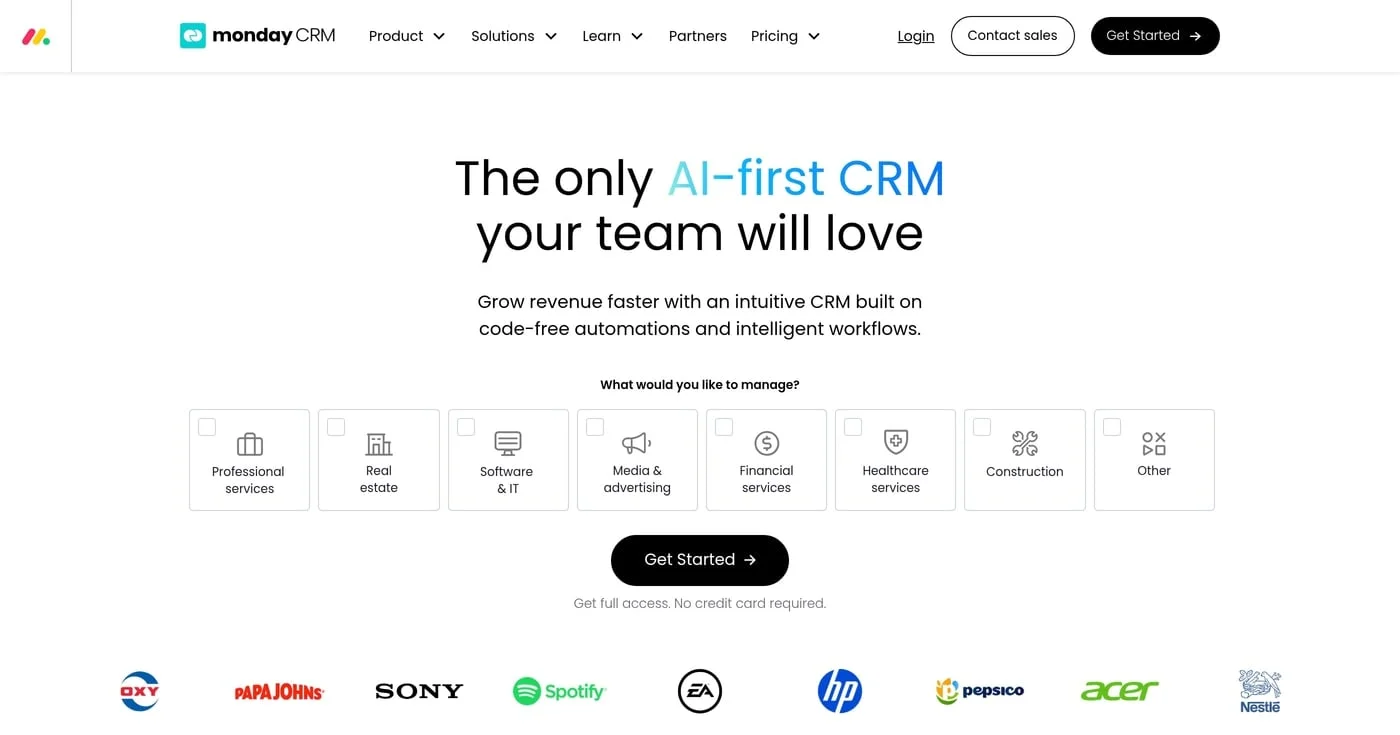
Monday.com CRM sits at the intersection of sales pipeline and project management: you can link a closed deal directly to the post-sale delivery project in the same workspace. NASDAQ-listed (MNDY) with $1B+ revenue in FY2025, monday.com CRM holds a G2 score of 4.7/5, the highest of any tool in this alternatives pool. Basic plan starts at $9/seat/month.
The AI differentiation is Sidekick, an agent workforce that handles task creation, email drafting, and deal summary generation. Unlike HubSpot's Breeze, Sidekick is embedded in monday.com's flexible data model, which lets teams track any entity (not just contacts and deals) in the same system.
HubSpot's data model is fixed around marketing contacts, sales deals, and service tickets. Monday.com CRM uses a flexible row-column model that adapts to any workflow, useful for agencies and consultancies that manage client relationships alongside production timelines.
What monday.com doesn't replace: HubSpot's email marketing automation, multi-step campaign sequences, and landing page tooling. Teams that live in project management alongside sales will find monday.com more natural; teams that primarily run email campaigns should look at ActiveCampaign or Brevo instead.
Free: 2 seats | Basic: $9/seat/month | Standard: $12/seat/month | Pro: $19/seat/month | Enterprise: custom
Best HubSpot alternative for enterprise teams
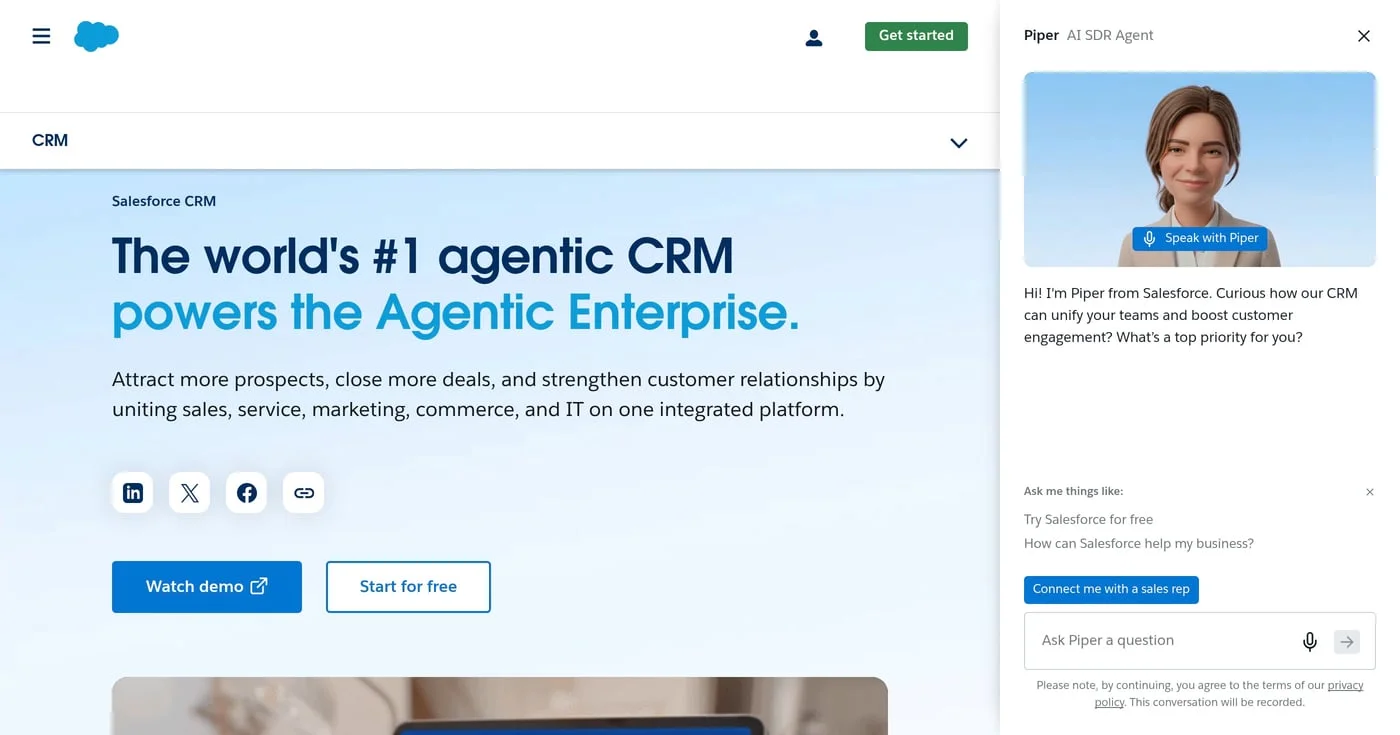
Salesforce is the CRM category the rest of the market benchmarks against. 90% of Fortune 500 companies use it; 93,571 reviews on G2 give it a 4.4/5 at the largest review volume of any CRM.
Revenue hit $37.9B in FY2025. Entry pricing starts at $25/user/month (Sales Cloud Starter); meaningful enterprise deployments start closer to $150–$550/user/month.
The case for switching to Salesforce from HubSpot isn't price: it's customization ceiling and compliance requirements. HubSpot's Professional tier is opinionated about data structure; Salesforce's data model is infinitely extensible via custom objects, flows, and the AppExchange (6,000+ integrations). AI runs via Agentforce and Einstein, with predictive scoring, agent conversations, and multi-modal analytics available at Enterprise tier.
HubSpot and Salesforce serve the same buyer persona (B2B SaaS, mid-market to enterprise) at different scales. HubSpot is faster to onboard, has better default UX, and integrates marketing and sales in a coherent package.
Salesforce is more powerful, more customizable, and more expensive to own: it requires a dedicated Salesforce admin on any team above 20 users. Marketing automation workflows that HubSpot handles natively need the separate Marketing Cloud add-on. For enterprise teams that have outgrown HubSpot's Professional data model or need Salesforce's compliance certifications, the switch makes financial sense on a 3-year horizon.
Starter Suite: $25/user/month | Pro Suite: $100/user/month | Enterprise: $165/user/month | Unlimited: $330/user/month
For sales-only teams that hit HubSpot's automation paywall, Pipedrive solves the immediate problem in a 3-day migration. For marketing-led teams spending $890/month on the Marketing Hub, ActiveCampaign covers the same automation surface for $15–$79/month based on contact volume.
For early-stage teams that want the full HubSpot experience without the cost, EngageBay is the most structurally honest replacement. And for teams who want the CRM the Reddit community actually recommends (not the one the affiliate content industry promotes): Nutshell is the pick that nine out of ten "best HubSpot alternatives" articles miss.
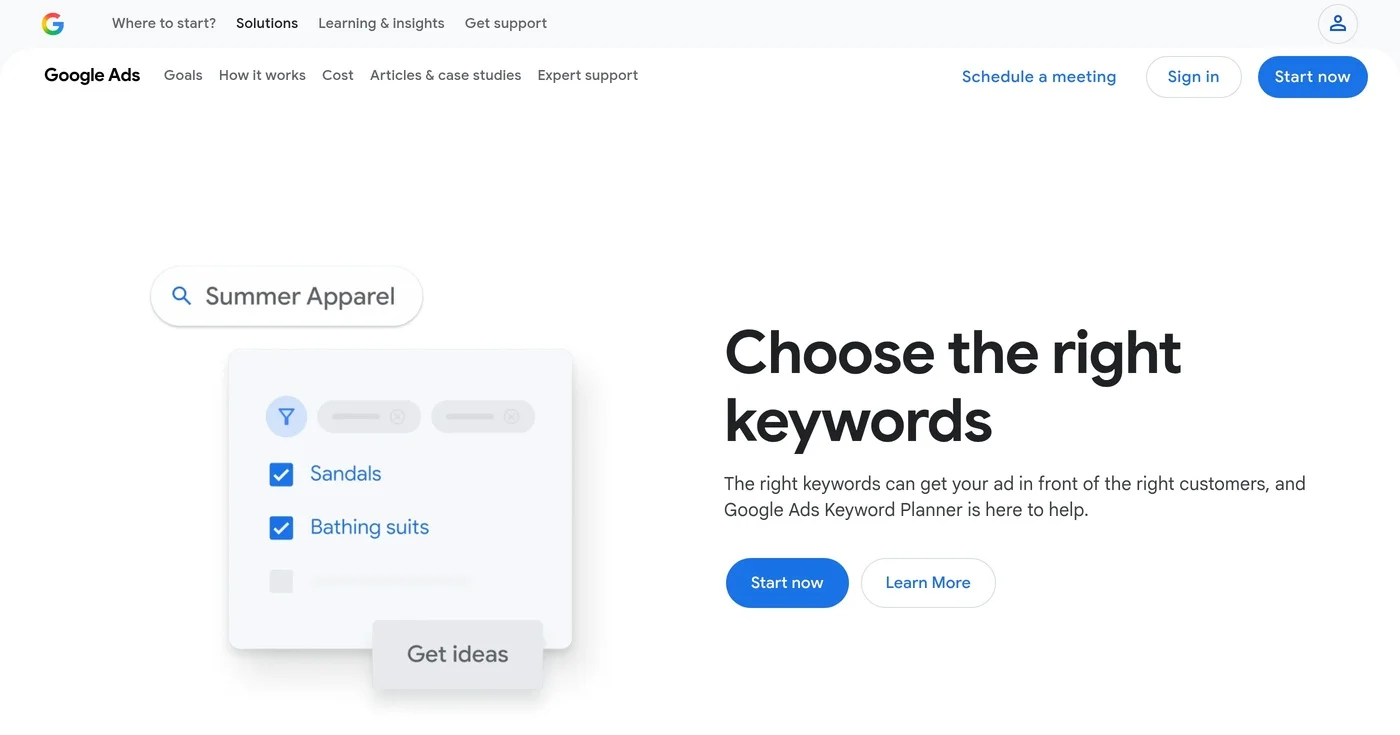
Open Google Keyword Planner without treating setup as running ads, then read volume, competition, and the two bid columns for what those numbers are not.
ZoomInfo alternatives have no public platform list price. Apollo publishes a seat price, Cognism covers EU phones, and Lusha starts at $49.90 a month.
Rank Zapier alternatives by billing unit: n8n executions, Make credits, Pabbly lifetime. Live September 2026 prices.
