


Positioning Statement: Internal Memo, Not Homepage Copy
A positioning statement is the internal memo that names your buyer, category, benefit, and proof versus the alternative.
Updated 11 min read


A positioning statement is the internal memo that names your buyer, category, benefit, and proof versus the alternative.
A positioning statement is a one- or two-sentence internal brief that names who you serve, which category you compete in, what unique value you deliver, and why that claim is believable against the alternative. April Dunford defines positioning as how your product is a leader at delivering something a well-defined set of customers cares a lot about. Ries and Trout put the fight in the prospect's mind, not on the product.
The sentence is a constraint for your team. It is not a tagline, a mission, or homepage copy.
Marketers search this term when sales, product, and the site tell three different stories. A naming strategy decides what you are called. The statement decides the slot you occupy.
If you need a paragraph, the work is unfinished. Practitioners converge on one or two sentences that constrain how the product or brand occupies a place in the target customer's mind.
Al Ries and Jack Trout formalized positioning in a 1972 Advertising Age series and in Positioning: The Battle for Your Mind (1981). They did not invent the fill-in-the-blank sentence. The prize they named is a word in the prospect's mind.
The written template arrived later, from Geoffrey Moore in Crossing the Chasm (Harper Business, 1991). Moore still runs workshops that treat the sentence as a life-cycle alignment tool for press, analysts, partners, and customers.
April Dunford is the living practitioner voice. Her method is refined with more than 200 companies. Obviously Awesome self-states over 100,000 copies sold.
On Lenny's Podcast she tightens the definition: your product is the best in the world at delivering some value that a well-defined set of companies care a lot about.
The term here means brand, product, and market statements in marketing, not a legal or HR "position statement," and not a personal-brand bio.
Teams mix the memo with every other short sentence the company owns. Keep the jobs separate.
Concept | Job | Faces the customer? | Named example |
|---|---|---|---|
Positioning statement | Internal constraint on who, where, why you win | No | Moore's six blanks |
Value proposition | Promise of value; why a buyer should choose you | Yes | The benefit clause inside the memo |
Mission | Why the organization exists | Yes | |
Tagline | Public mnemonic | Yes | Nike "Just Do It" |
Messaging | The words you say once the slot is chosen | Yes | Homepage, pitch, ads |
Dunford is blunt: positioning is an input to messaging, not the copy. Founders still send her a homepage and ask if the "position" is good.
"A lot of times people will send me a link to their home page and they'll say what do you think, is this position good or not? And the problem with B2B tech companies is, unless I'm your buyer, I'm not the right person to ask." (April Dunford, Lenny's Podcast, 19:52)
On r/marketing, the same mix-up shows up as people treating Nike's "Just Do It" as the strategy document. A tagline is a punchline. The memo is the strategy behind it.
Shreyas Doshi keeps a one-line map that product marketers still circulate: Mission is Why, Vision is What, Strategy is How, Segmentation is Who, Positioning is Where, Roadmap is When.
The industry-named format is Moore's six blanks. Each blank is a decision. The sentence is documentation.
For [target customer]
who [statement of need or opportunity],
the [product name] is a [product category]
that [key benefit / compelling reason to buy].
Unlike [primary competitive alternative],
our product [statement of primary differentiation].
A shorter four-blank variant drops the "Unlike" clause and asks for proof instead:
For [target audience], [brand name] is the [market category]
that [unique benefit] because [proof / reason to believe].Name a segment a salesperson could put on a list. "Marketing leaders at B2B SaaS companies with 50-500 employees" works. "Businesses" does not.
Pair this blank with your marketing segmentation work, or the rest of the sentence will sound specific while pointing at everyone.
The category is the mental bucket that sets the comparison set and the price. Call the product "email" and buyers compare you to inboxes. Call it "chat" and they compare you to Slack.
Dunford picks category last, after value is clear. Choosing it first leaves you no way to judge whether the bucket is any good.
Write the outcome the named customer buys, not the feature you shipped. "Visibility into pipeline health without manual reporting" is a promise. "Real-time dashboards" is a spec.
Harvard DCE pushes this further: put the customer's problem in the benefit blank. You often do not need to describe the product at all.
ZestFinance (first-party on that Harvard page): "helps lenders in all credit segments better assess the credit risk of potential borrowers."
Gazelle (same page): "we pay you for the cell phones, iPads, Macs, and other Apple devices you no longer need." The author notes you can need Gazelle without knowing how the service works.
One checkable fact is enough: a capability the alternative lacks, a process, an ingredient, a named constraint. If the proof is a vibe word ("innovative," "trusted," "leading"), the blank is empty.
Write what the customer would use if you did not exist. That includes a spreadsheet, an intern, and "do nothing."
Hearing "alternatives" as "companies that look like us" is the failure Dunford keeps naming.
Moore gives you the skeleton. Dunford's objection is about the ritual of filling it first. In "A Product Positioning Exercise" she argues the Mad-Libs exercise is harmful for three reasons:
Her five-component canvas, worked backwards from alternatives:
The canvas is the work. The sentence is optional documentation. Date it.
On r/ProductMarketing, filling any famous framework with "For busy professionals, we are the reliable software that saves time" is the named failure mode: the sentence looks finished while the decisions are still generic.
"There's absolutely nothing wrong with having a very simple positioning statement. Simple stuff gets used. Complex stuff sits in a Google Doc last edited 23 months ago." (Tim Cameron-Kitchen in "How To Find Your Positioning Statement", Exposure Ninja, 2:22)
Use the shortest sentence your team will actually repeat. Do not confuse brevity with skipping the five decisions.
This is a walkthrough, not a real company's internal memo:
For marketing leaders at B2B SaaS companies with 50-500 employees
who need forecast risk before the Monday standup,
Northstar Forecast is a revenue-intelligence platform
that flags slipped deals from activity the CRM already has.
Unlike a spreadsheet plus CRM exports,
Northstar Forecast names the at-risk deals without a weekly data pull.
Read it aloud. If a colleague outside the team cannot repeat it, rewrite the blanks. Do not paste it on the homepage.
Brand, product, and market statements are different objects. Harvard brand courses and product-marketing practice split them. Ranking what-is pages usually collapse the three into one object.
Type | Best For | Key Characteristics |
|---|---|---|
Product | A single offer vs alternatives | Category, benefit, proof, "unlike" |
Brand | The company or portfolio | Mental real estate across products |
Market | How the firm is sized in the category | Leader, challenger, or specialist |
A product statement drives adoption. It names the category, the outcome, and the alternative a buyer would otherwise pick.
Slack's public tagline is "Where work happens". That is a mnemonic, not proof that Slack published a Moore sentence internally.
When you have one product, the product name and the brand name match. The jobs still differ: the product line argues for this offer, and the brand line has to survive the next product.
David Aaker called brand position the part of brand identity you actively communicate. The job is a North Star for marketing, not a public asset. A brand statement owns that identity space across the portfolio.
Official language is safer than reconstructed Mad Libs. Nike's mission is: "Bring inspiration and innovation to every athlete in the world. If you have a body, you are an athlete."
That is a mission. "Just Do It" is a tagline.
Teaching blogs reconstruct a "For athletes in need of high-quality athletic wear…" sentence and label it Nike's. Nike did not publish that sentence.
Mark Ritson is more useful on Apple than any "For individuals who want the best personal computer…" reconstruction. After 1997, Apple's brand position sat on three tenets (simplicity, creativity, humanity) and showed up in Chiat/Day work (Think Different, Silhouette). Prefer campaign analysis over a fake Moore fill-in.
Market positioning is how buyers sort you by size and credibility: leader, challenger, specialist.
A specialist can win a product statement ("the only X for Y") while remaining a challenger in market position.
Geoffrey Moore still talks about this as a chasm problem. Product virtues excite early adopters. Pragmatists want alignment across press, analysts, partners, and customers.
Product virtues excite early adopters but leave pragmatists unconvinced. To win them over, you need alignment across press, analysts, partners, and customers. Skip a step, and momentum stalls. https://t.co/zLiCJreO7x #ProductMarketing #TechAdoption #GoToMarket
Ask one person from each team what the product is, who it is for, what it replaces, and why it is better. Mismatched answers are the failure. Site, pitch, and roadmap should not invent three versions of the same story.
Emily Kramer tells teams to write half a page of building blocks before any public sentence: problem, product, who it is for, why it beats the current way.
1. Start w/ messaging building blocks—don't write exact copy yet. This should be 1/2 page max. Include: ⚡️What problem do you solve? 💡What is your product? 👩🔬 Who is it for? 1️⃣ Why is your product better (than current way of solving problem)? https://t.co/mFL39pnmtX
Tim Cameron-Kitchen runs new services, videos, and posts through a three-part filter: what you do, who you do it for, why people choose you. If a blog idea fails the filter, it does not ship.
A startup marketing strategy that skips this filter spends the first year explaining the product a different way on every page.
Existing category: you borrow understanding and inherit a crowded comparison set. New category: you pay an education cost and get to set the terms.
The memo forces you to pick. Category Pirates argue that if outsiders can understand a one-page strategy, you can design a category.
A usable reason-to-believe blank kills "leading provider of innovative solutions." On r/SaaS, the practical hunt for that proof is mid-star reviews, not 1-star bug reports.
"The most reliable signal I've found is looking at where competitors create friction for a specific subset of users. Go through the 2 and 3 star reviews on G2 and Capterra… That gap is usually where a defensible angle lives." (u/wesdacar in r/SaaS, Jun 2026)
Filling Moore's blanks in a short offsite produces a sentence. It does not produce positioning. Dunford calls that the false "done."
Mitigation: write the five-component canvas first, date it, and treat the sentence as a rewrite pass.
On r/marketing, u/anandp29 argued the written sentence is optional. What matters is who the audience is, why the product matters to them, and why they would pick you over others, whether you keep that as a sentence, bullets, or a one-page memo (Jul 2018).
Readers search "Apple's statement" and "Nike's statement" and land on teaching Mad Libs. Ranked example pages have labeled Nike's sustainability-purpose line as the strategy sentence.
Other teaching pages are explicit that their Nike / Apple / Amazon sentences are reconstructions. Mitigation: label the source class every time. Official mission, About copy, reconstruction, or classroom example.
"Anyone who wants to grow" is not a customer. A broad blank makes every other blank generic.
Mitigation: start from your best-customer list and support-ticket language, then write the ICP as a person a salesperson could find.
On r/marketing, comms teams get asked to launch a "repositioning" that is a visual refresh plus internally workshopped pillars.
"There is no comms move that fixes a positioning with no customer truth in it. You have no news angle for the same reason the pillars are generic, both came out of internal stakeholder rooms with no customer in them." (u/kamilc86 in r/marketing, May 2026)
Mitigation: agree the validation plan (who you will interview, which mid-star reviews you will mine, which landing-page test you will run) before anyone wordsmiths a launch blog.
Dunford argues the opposite of the laminated-sentence habit for very early products. Keep positioning loose until a pattern of who loves it and why is visible.
Tightening on one customer type (Dunford's "tuna-only" example) before that pattern exists kills discovery.

Paid search wins when you need a visit this week and you do not already rank. SEO wins when you can wait months for a click you stop paying for.
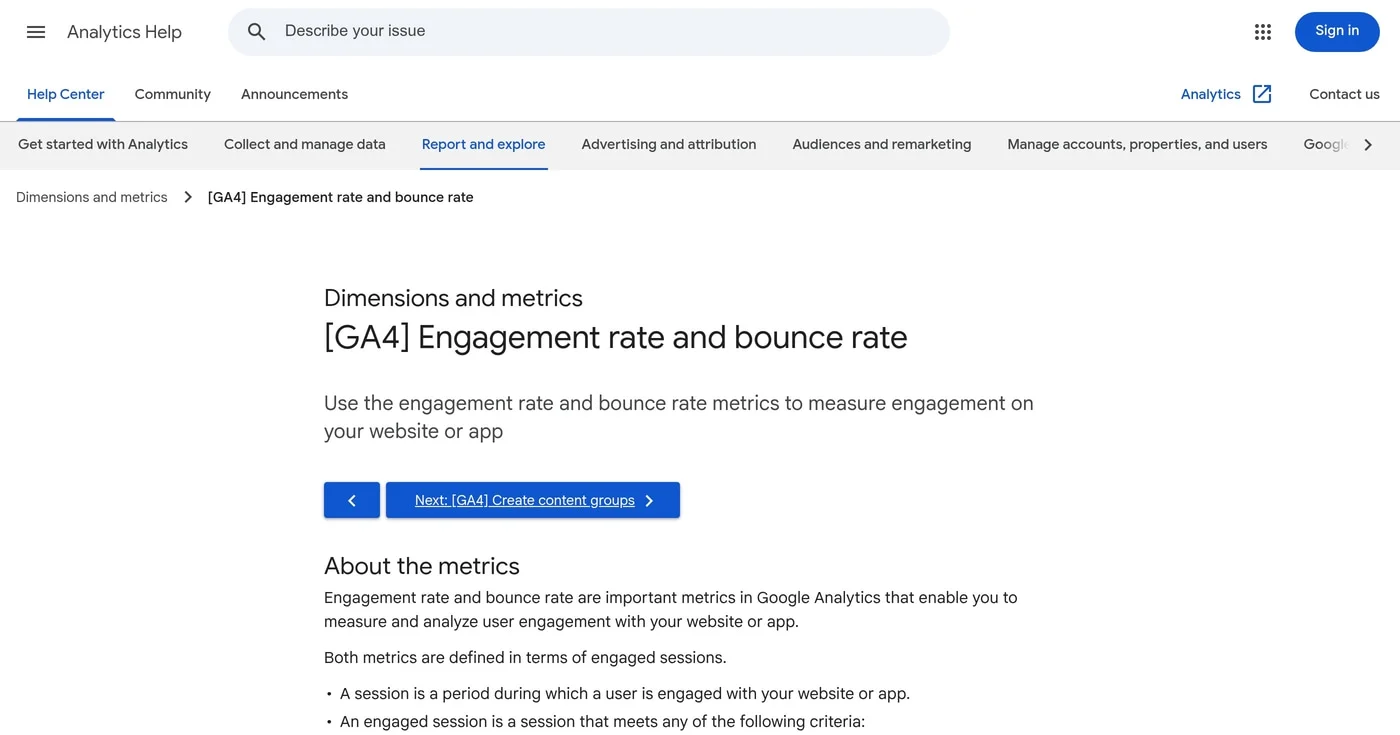
Bounce rate in GA4 is the share of sessions that were not engaged. See how that differs from Universal Analytics, why samples disagree, and what to check first.
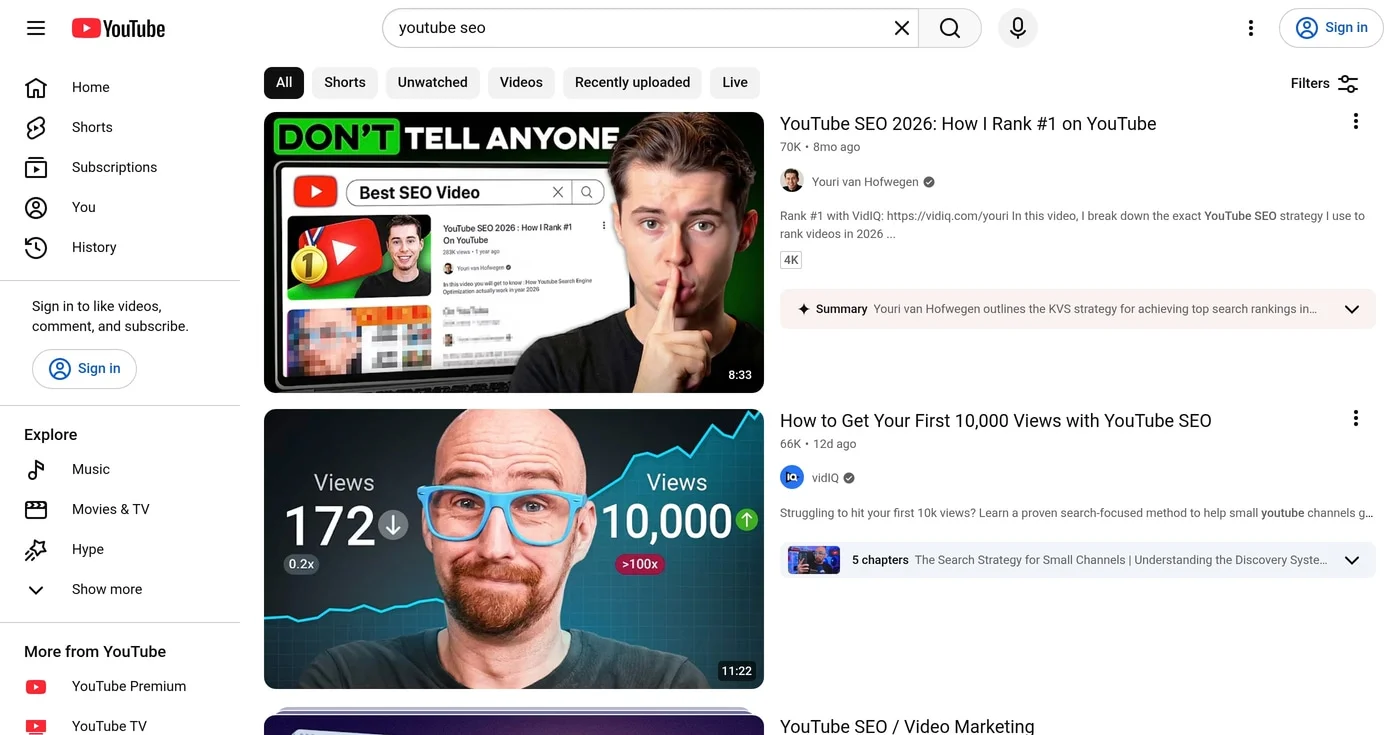
YouTube SEO matches a video to a query. See the ranking factors YouTube names, the official metadata limits, and why retention has no published cutoff.
