


16 Market Research Tools That Answer the Right Research Question
The 16 best market research tools for 2026, matched to your research goal. Compare SurveyMonkey, GWI, Listen Labs, and quantilope with pricing and free tiers.
Updated 30 min read


The 16 best market research tools for 2026, matched to your research goal. Compare SurveyMonkey, GWI, Listen Labs, and quantilope with pricing and free tiers.
SurveyMonkey, GWI, and Listen Labs each answer a different research question: what your audience says in a structured survey, who they are across 52 global markets, and what they reveal in an AI-moderated interview. The global market research industry reached $153 billion in 2025, and most research programs use tools from 2-3 categories simultaneously. The biggest mistake is picking a tool before deciding which type of research the question actually requires.
Ordered by research goal category, not brand popularity.
Software | Best For | Key Features | Pricing | Free Plan | Platforms |
|---|---|---|---|---|---|
Quantitative surveys | 335M+ panel, AI survey builder, LaunchPad | Yes (10Q/40R) | Web, iOS, Android | ||
Peer-reviewed synthetic user research and message testing | Simulated personas matched to your ICP, 86% theme recall (peer-reviewed) | Yes | Web | ||
Enterprise XM | AI synthetic panels, 1B+ surveys/yr, 50+ countries | Custom | No | Web, iOS, Android | |
Conversational surveys | AI Clarify, Research Flow, one-question UX | Yes | Web, iOS, Android | ||
Demand validation | Search interest, geographic data, rising queries | Free | Yes (fully free) | Web | |
Search intel and competitive data | Market Explorer, Traffic Analytics, keyword research | Limited (10/day) | Web | ||
Consumer question mapping | Search autocomplete data, 100+ questions per topic | Yes (3/day) | Web | ||
Consumer audience intelligence | 250K+ data points, 3B+ people, Agent Spark AI | Custom | No | Web | |
Secondary market data | 1M+ statistics, 170 industries, 150 countries | Partial | Web | ||
Social listening | 1.2T+ historical documents, 500M+ posts/day | Custom (~$800+/mo) | No | Web | |
Behavioral UX research | Heatmaps, session recordings, on-site surveys | Contact | Yes | Web | |
AI qualitative interviews | 30M+ participants, 5x faster, AI moderation | Custom | No | Web | |
Consumer research and concept testing | Quantitative surveys, AI-moderated interviews | Custom | No | Web | |
AI-moderated qual with visuals | Visual Intelligence, SOC 2 + HIPAA + GDPR | Custom | No | Web | |
AI secondary research | Deep Research, real-time web search, synthesis | Yes | Web, iOS, Android | ||
Automated quant methods | MaxDiff, conjoint, TURF, AI co-pilot "quinn" | No | Web |
Best market research tools compared at a glance
Best for teams that need structured quantitative data fast, at any budget
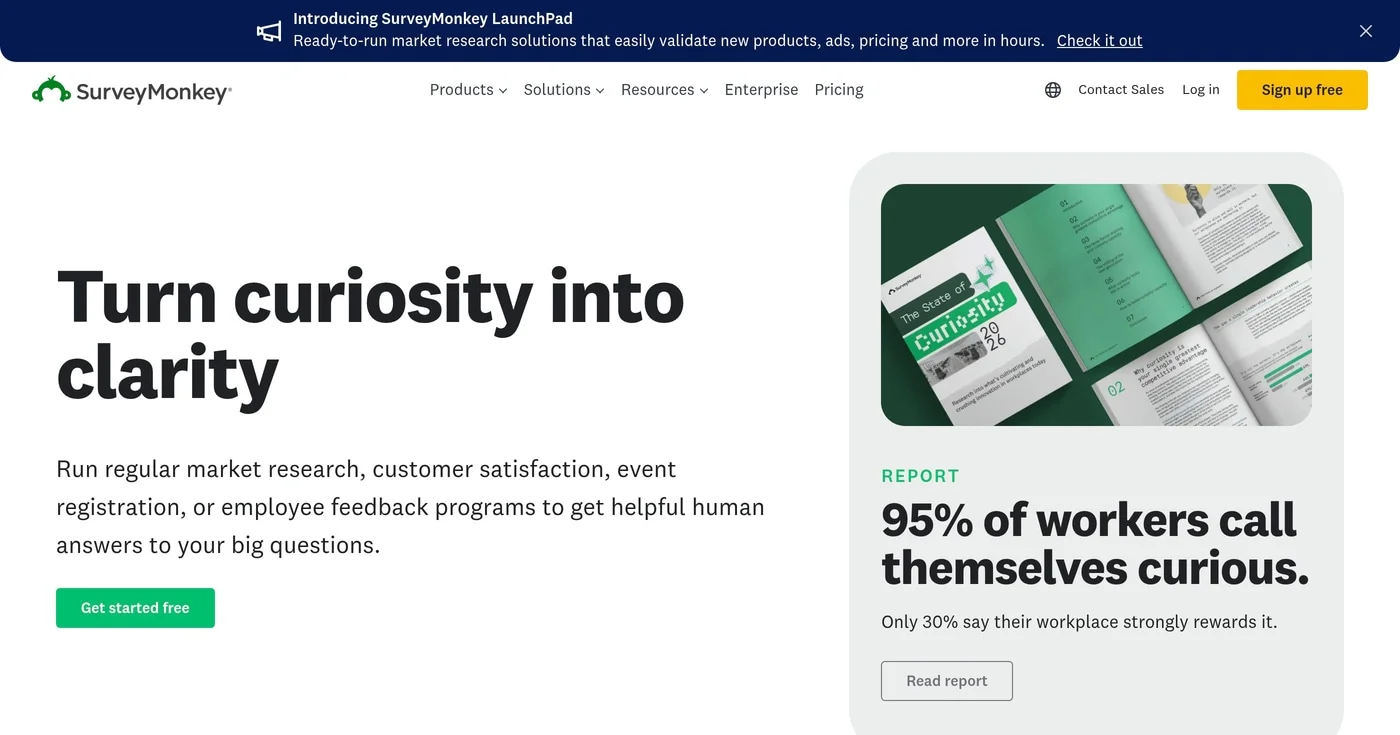
SurveyMonkey is the most widely deployed survey platform, built on 26 years of iteration. Its free plan lets you run a 10-question survey and collect up to 40 responses per survey with no credit card required, the standard starting point for teams running their first primary research. The 335M+ global respondent panel across 130+ countries provides demographic-targeted quantitative samples for teams that need responses they can't collect organically.
Two notable additions shipped in 2026 change what SurveyMonkey is for. LaunchPad, launched in June 2026, handles product concept validation as a structured workflow rather than a blank survey canvas. Claude Connector, launched in May 2026, lets teams build surveys inside Claude AI and pipe responses back into SurveyMonkey's dashboards, integrating the platform into AI-native research workflows without replacing it.
SurveyMonkey documented on LinkedIn (June 2026) that their own team collected 4,500+ responses in a single afternoon to resolve a product naming decision through data rather than internal debate.
On r/Marketresearch, SurveyMonkey gets consistent credit as the accessible entry point, "anyone can work it out quickly," alongside an honest ceiling: it doesn't handle complex branching logic, enterprise panel management, or research-grade statistical analysis. Teams that outgrow it typically move to Alchemer (flat per-seat licensing, cost-predictable) or QuestionPro (strong branching logic, competitively priced for migrating customers).
SurveyMonkey's paid plans come with a 30-day money-back guarantee on annual subscriptions. Panel access is priced separately per study, not included in the base subscription.
Best for marketing teams needing peer-reviewed synthetic user research at speed
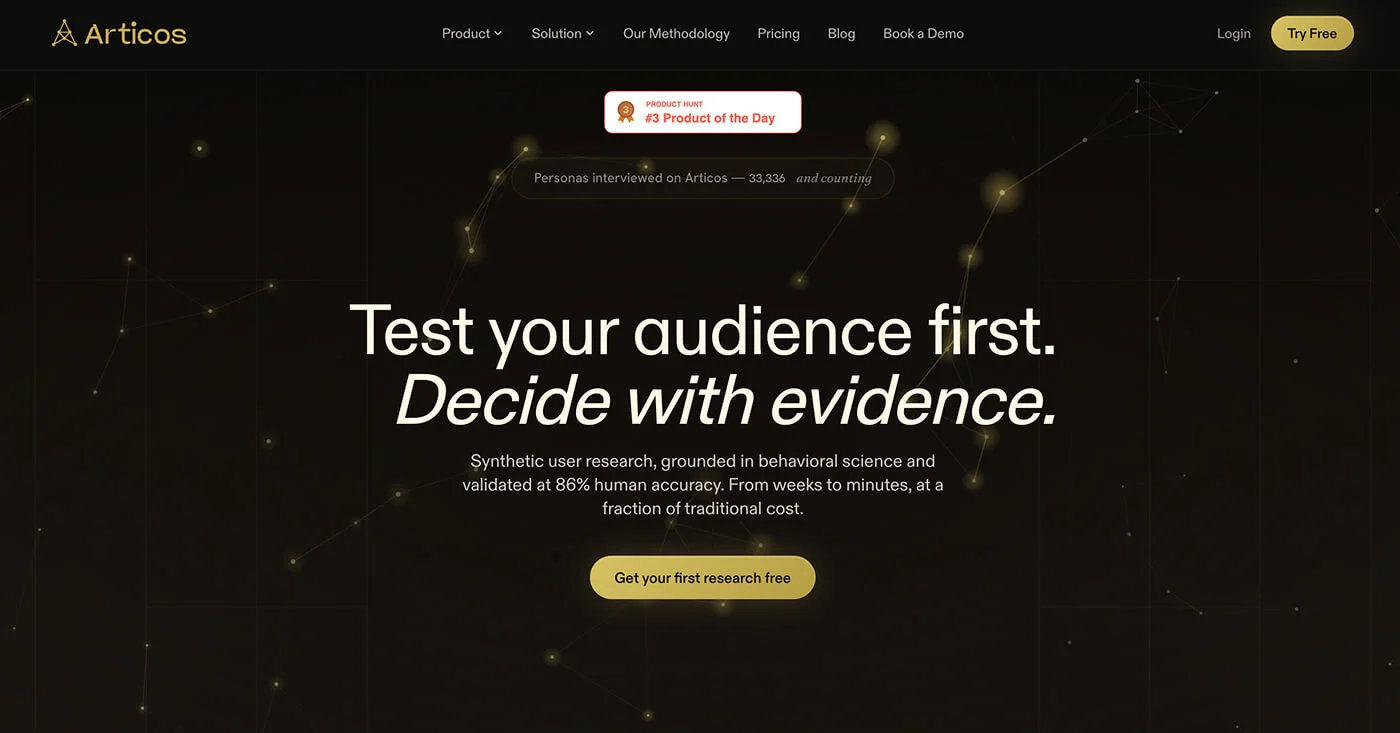
Articos is a peer-reviewed synthetic user research platform for marketing teams and agencies. The platform's methodology has been validated across 46 studies in 9 domains, delivering 86% theme recall against benchmarks from Baymard Institute and Nielsen Norman Group. For research tasks specifically, Articos is 7.5 times more accurate than general-purpose LLMs like ChatGPT and Claude when used directly for the same work.
The peer-reviewed foundation is what separates Articos from other synthetic research tools in the category. Teams evaluating platforms want validation they can defend when leadership, clients, or investors ask how the numbers were produced. Publishing the underlying methodology openly is unusual for this category.
Individual studies run in under 30 minutes at $8-$20 per study. Traditional user research costs $5,000-$30,000 and takes 4-8 weeks, putting it out of reach for most teams shipping messaging decisions weekly. Articos closes that gap, making continuous message testing viable for teams that previously relied on gut calls or ChatGPT prompts.
The platform supports message testing, positioning validation, headline testing, email copy evaluation, landing page testing, and user interviews. A "Talk to Research" capability lets researchers ask follow-up questions to any persona after a study completes, useful when reports surface patterns worth exploring before final decisions.
The honest limitation: synthetic research is a supplement to live customer conversations, not a full replacement. Foundational discovery, exploratory qualitative research for entirely new segments, and high-stakes strategic decisions still benefit from real customer interviews alongside synthetic testing. Teams using Articos most effectively pair it with periodic live research rather than replace live research entirely.
Articos publishes its peer-reviewed methodology and accuracy benchmarks openly, which is unusual for the synthetic research category.
Best for enterprise teams running continuous experience research at statistical scale
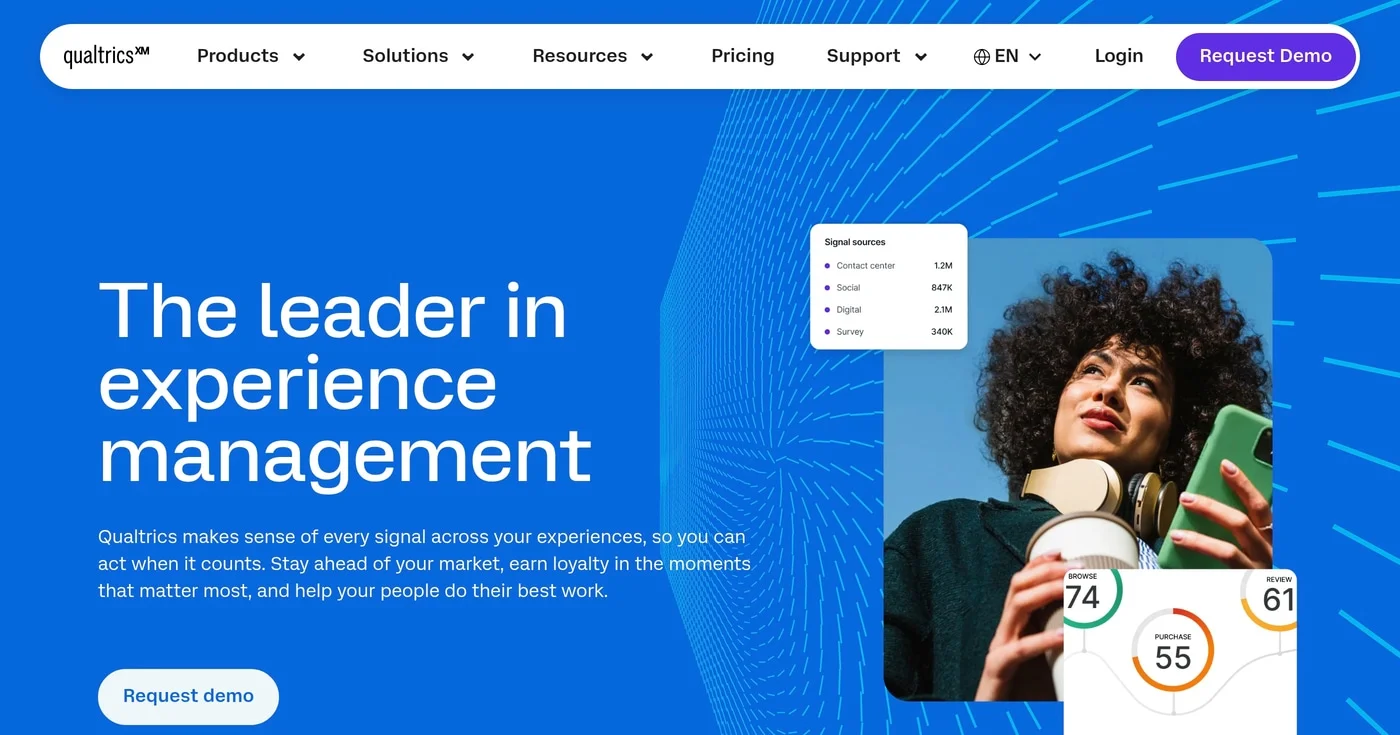
Qualtrics runs more than 1 billion surveys a year across 50+ countries. Qualtrics stands out through methodology depth: complex branching, quota management, conjoint analysis, longitudinal panel tracking, and real-time dashboards that route findings to regional managers, all inside a single system.
The acquisition of Press Ganey Forsta for $6.75 billion (closed May 2026) reshaped the competitive landscape. The combined platform now covers employee experience, customer experience, healthcare CX, and market research under a single license. AI synthetic panels, launched at Qualtrics X4 in March 2026, allow simulation of market responses before fielding live surveys; Dollar Shave Club used them to validate entirely new consumer markets in days.
Practitioners on r/Marketresearch are direct about the trade-offs: the thread reactions to the Forsta acquisition show real concern. Forsta was praised for technical research support; Qualtrics is known for revolving account managers and aggressive auto-renewal clauses with 90-day notice windows. Teams evaluating Qualtrics should confirm support SLAs and notice period terms in writing before signing.
Verify all contract terms carefully before committing. The 90-day notice window for cancellation is a recurring practitioner complaint.
Best for startups and UX researchers who need high survey completion rates
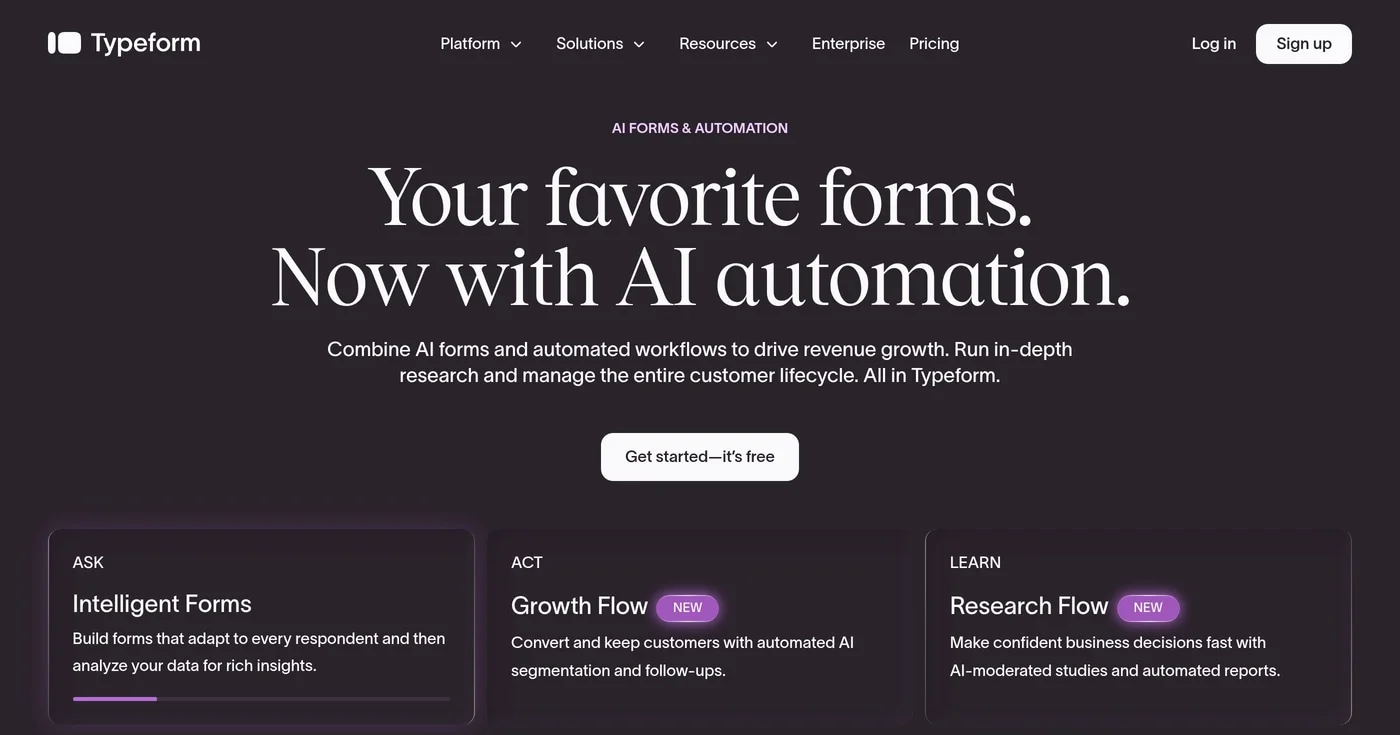
Typeform takes a different approach to survey design: one question at a time, conversational pacing, and a UI built for the respondent rather than the researcher. That design choice produces higher completion rates than traditional multi-question survey formats, which matters when you're collecting responses without a panel budget.
Two 2026 additions expand Typeform's research capability beyond structured surveys. AI Clarify probes respondents with follow-up questions in real time when an answer needs depth. Research Flow adds moderated qualitative research capabilities inside the same interface, meaning Typeform can now handle both structured quantitative surveys and semi-structured qualitative conversations in a single platform.
The Barcelona-based company (founded 2012) still positions below Qualtrics on raw statistical capability, but above SurveyMonkey on qualitative research depth for teams that don't have a dedicated research ops team.
Best-fit scenario: an early-stage product team running concept tests, a UX researcher conducting moderated interviews on a tight budget, or a startup validating messaging before launch. Typeform's per-response pricing at scale and the absence of a native respondent panel make it less cost-effective than SurveyMonkey for large quantitative samples where volume is the priority.
AI Clarify and conditional logic are included on all paid plans. Research Flow is available on Business and above.
Best for free demand validation and tracking topic interest over time
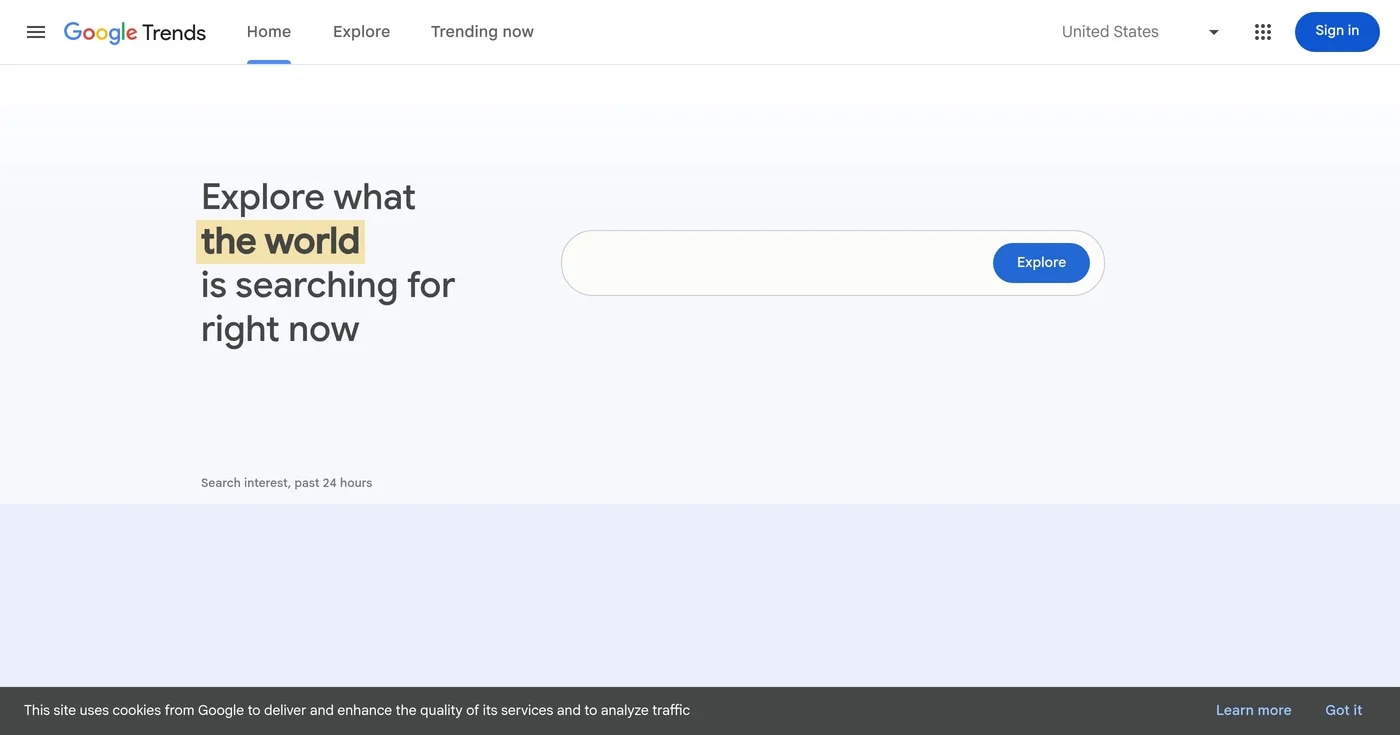
No account required, no response limits, no sales call: Google Trends gives you direct access to Google's search index for any topic, any geography, back to 2004. You can compare up to five topics simultaneously, track seasonality patterns, and identify geographic pockets of demand, all for free.
The AI modifier signal is useful in 2026: "AI tools for market research" shows +90% rising trend growth with about 170 monthly searches, confirming AI-native platforms are entering the early majority. Google Trends caught this signal months before it appeared in industry reports. That's the core value: real-time direction before paid data catches up.
Two structural limitations define where Google Trends stops being useful. It shows relative search interest, not absolute search volume: you see that Topic A is twice as popular as Topic B in March, not that both generate 10,000 searches. It also carries no demographic breakdowns.
For absolute volume, Semrush or DataForSEO fills the gap; for demographic overlays, GWI or Statista.
Best for digital teams treating search data as a proxy for customer intent
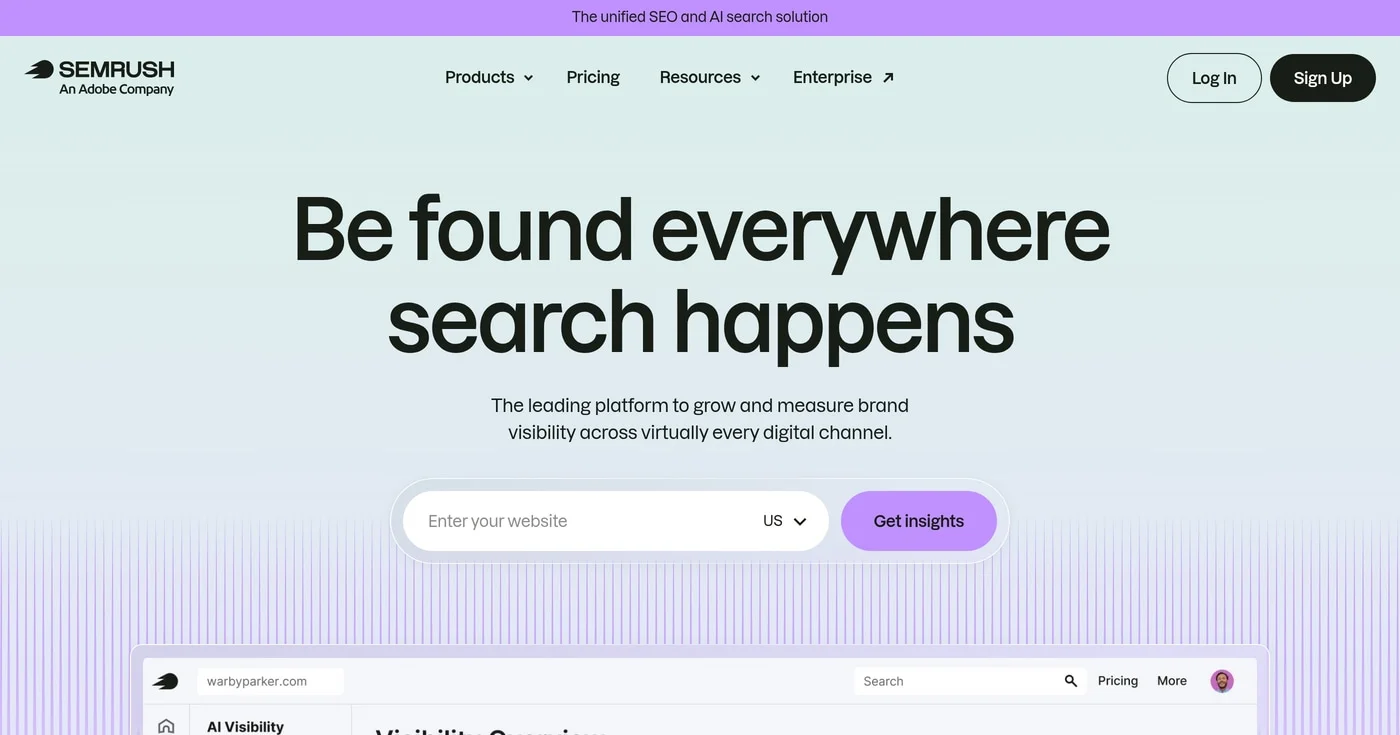
Semrush functions as a market research tool for teams where consumer intent data from search queries is more actionable than survey responses. The Market Explorer module estimates total addressable market size from web traffic, maps competitor audience overlap, and profiles the demographics of any market segment by search behavior, without fielding a single survey.
Kevin Indig (@Kevin_Indig), a growth strategist who has covered search intelligence for years, frames the use case directly: Ahrefs and Semrush provide keyword data as a proxy for customer intent and market size. A search volume trend for a problem statement (not just a branded keyword) reveals real demand before you invest in primary research. Traffic Analytics benchmarks competitor digital presence; .Trends shows market share shifts over time.
Semrush's keyword research tools also surface adjacent markets and emerging sub-categories that consumer surveys would miss entirely, because consumers don't always know the vocabulary for problems they're experiencing.
The limitations are real. Search data reflects people who are already aware of a product category and searching for solutions. Semrush cannot measure unmet needs, brand sentiment, or the motivations behind behavior: it shows what people search, not why.
Free plan: 10 searches per day across most tools, sufficient for occasional competitive lookups.
Best for content strategists and product teams mapping consumer questions
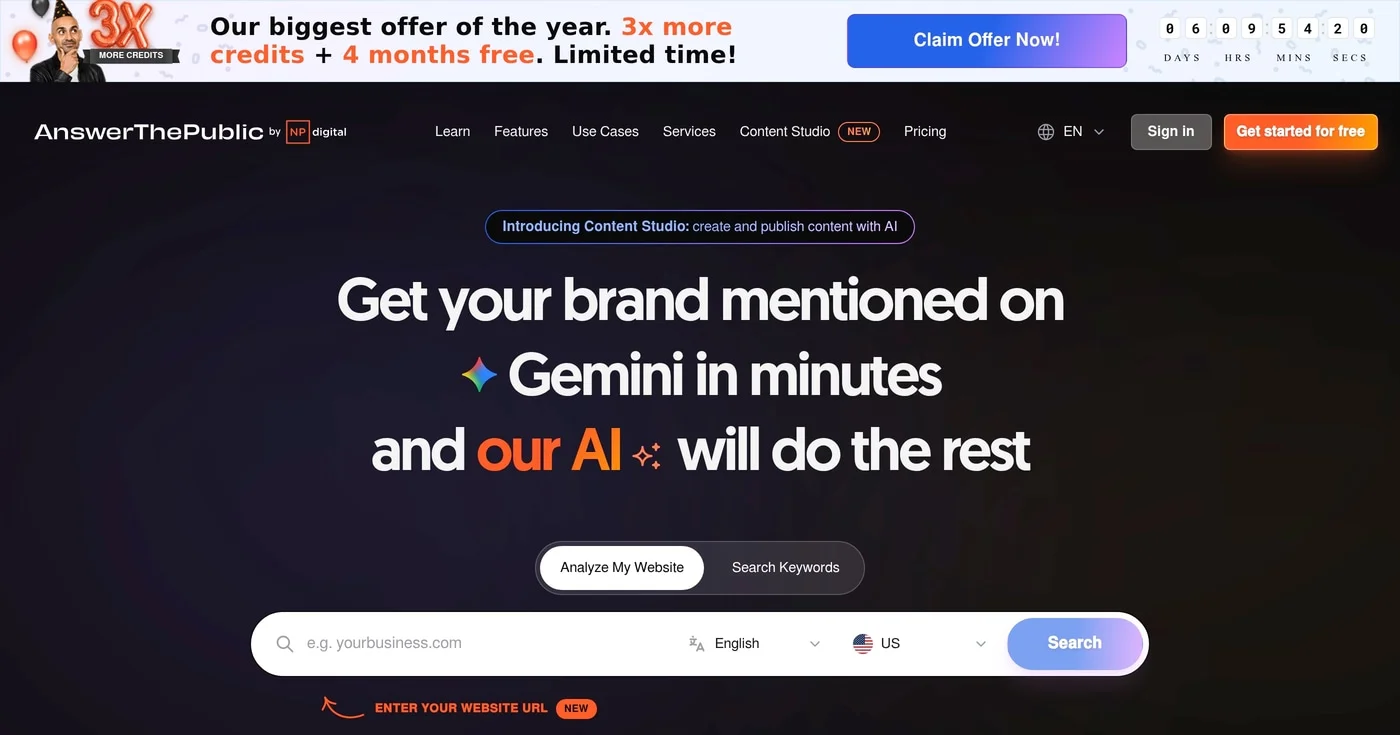
AnswerThePublic (now part of Neil Patel's NP Digital) pulls autocomplete data from Google and Bing and organizes it into a visual map of every question people ask around a topic. Type "market research" and you'll see 120+ question variations organized by type: What is, How to, Why, When, Which, Where, Who, Can, Are. That taxonomy reveals exactly what your target audience doesn't know yet and what language they use when they search.
The tool's primary value in market research is informational gap analysis: understanding the questions customers ask before making decisions, the comparisons they're already running, and the vocabulary they use to describe their own problems. Product and content teams get more value per dollar from AnswerThePublic than from most enterprise platforms for this task: auditing question space, identifying FAQ gaps, and surfacing how customers frame their problems.
Three free searches per day is limiting for high-volume research workflows, but for one-off question audits it's genuinely sufficient. The paid plan at $20/month removes limits and adds comparison mode across two keywords simultaneously.
Best for consumer audience intelligence and brand tracking across global markets
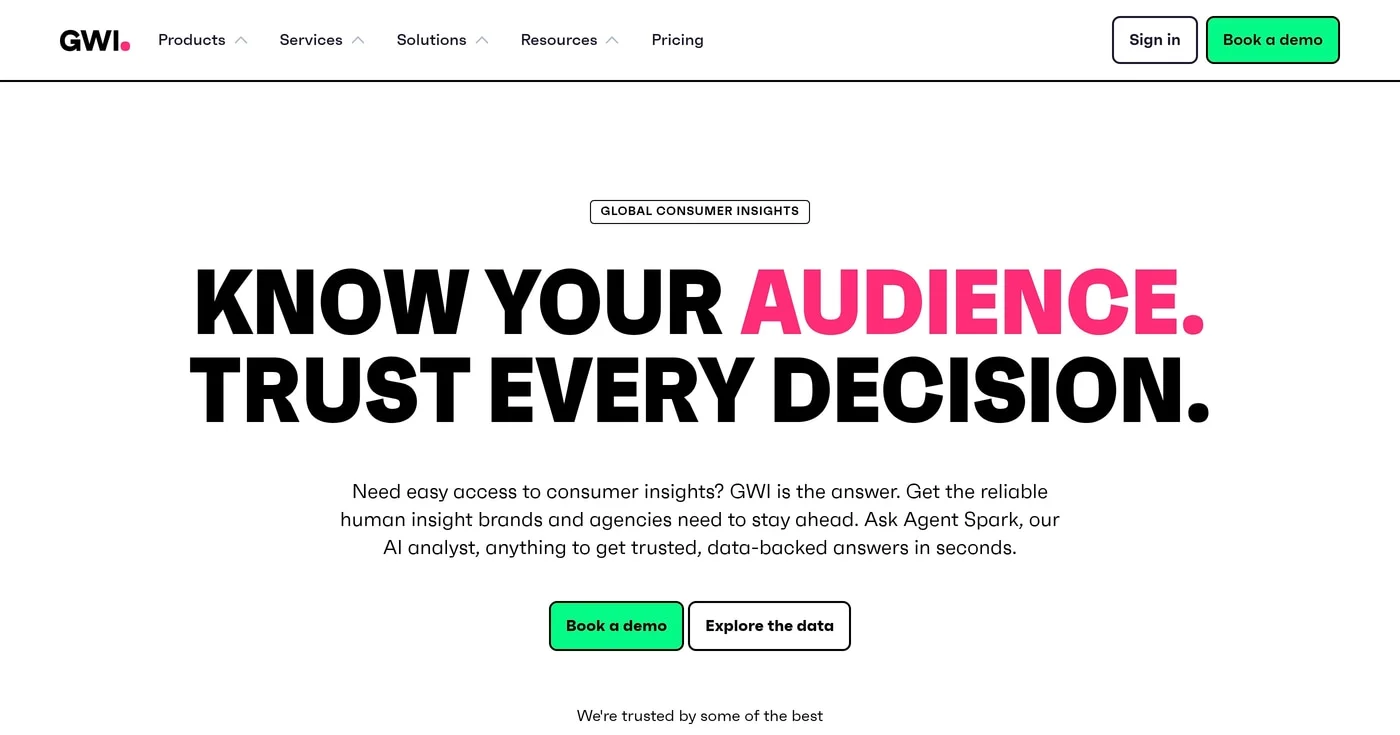
With 250,000+ data points tracked across 1.4 million annual surveys spanning 52 markets and representing 3 billion people, GWI (Global Web Index) is the deepest consumer intelligence platform on this list.
The core GWI product answers a question that surveys and search tools structurally cannot: who is your audience, and what do they care about? You can profile any segment by demographics, media consumption, brand affinity, social platform usage, and purchasing behavior, longitudinally, which means you can trend sentiment back years rather than weeks. The AI analyst layer "Agent Spark," available via MCP and API, lets you query the data conversationally without a data analyst.
Rand Fishkin in "How To Do Market Research" (Brand Master Academy): surveys "cannot tell you where you can reliably do your marketing to reach a group of people that you don't already reach."
GWI solves exactly that. It maps where your audience actually gathers, what media they consume, and how their stated preferences align with observable behavioral patterns across the panel.
Best for secondary market data and fast industry benchmarks
Statista aggregates over 1 million statistics from 22,500+ data sources across 170 industries and 150 countries. The practical use case is narrow and specific: you need a market size figure, an industry benchmark, or a demographic breakdown in under 10 minutes, without conducting primary research. It delivers instant secondary data across global markets, and that is exactly where its value ends.
Statista is a secondary research starting point, not a primary research platform. It cannot tell you about your specific audience, your brand's competitive position, or the why behind any statistic. Research teams use it for the first slide of a research brief (market size, growth rate, industry context) before switching to GWI, Qualtrics, or Listen Labs for the research that actually drives decisions.
A Starter subscription at approximately $199/month (billed annually) makes sense for teams that reference market data regularly. The Professional tier at ~$1,399/month (5 seats, ~$16,788/year) only pays off for research teams with continuous secondary data needs.
Per-report secondary research from Mintel or IBISWorld ($800-$3,695 per report) only works for one-time deep dives into a specific industry.
Note: Statista's exact self-serve pricing changes; verify against the live pricing page before budgeting.
Best for brand health monitoring and competitive sentiment analysis
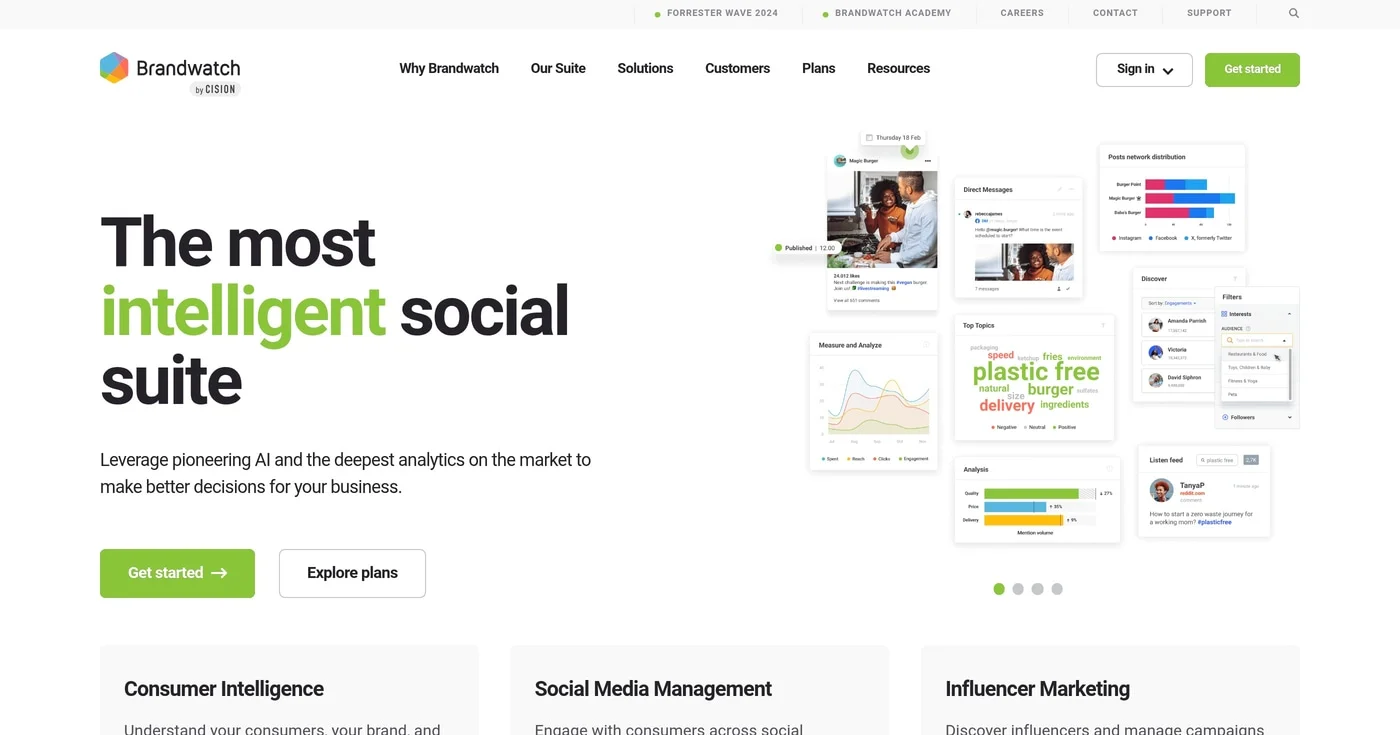
Brandwatch monitors 500 million+ new public posts every day across 100 million+ sources, with a historical archive of 1.2 trillion+ documents going back to 2008. For market research teams that need to understand what a market is saying about a brand, a competitor, or a product category in real time, that corpus is the most comprehensive in the industry.
The core Brandwatch capability is sentiment intelligence at scale: AI tags, classifies, and clusters mentions by topic, sentiment, and business significance. Image recognition identifies brand logos in user-generated visual content. The April 2026 APAC data expansion extended coverage for research teams operating across Southeast Asia and Pacific markets.
Brandwatch Audiences overlays social data against demographic profiles for audience segmentation that complements survey-based research.
Brandwatch answers a different question than GWI. GWI profiles who your audience is and what they care about through continuous surveying. Brandwatch tracks what they're saying about your brand and competitors in unstructured real-time public data.
Both provide attitudinal data: what people say: not behavioral data: what they do. For the behavioral layer, Hotjar and on-site analytics provide the complement.
Best for understanding what users actually do inside your product
Hotjar captures behavioral data: heatmaps that show where users click and scroll, session recordings that replay individual user journeys, and on-site survey widgets that let you ask questions at the exact moment a behavior occurs. Hotjar is now part of Contentsquare, which acquired the platform in 2021, adding Contentsquare's AI-powered digital experience analytics to Hotjar's front-end toolset.
Behavioral data is what surveys structurally cannot capture. SurveyMonkey users will tell you they found your signup flow simple. Hotjar session recordings may show 60% of them rage-clicking a broken form element.
Both are true; only one reveals the actual problem to fix.
Hotjar's free plan is genuinely useful for small product teams: unlimited heatmaps, 35 daily sessions, and basic survey widgets at $0. Post-acquisition, Contentsquare is now the sales relationship for paid plans. Existing Hotjar customers should confirm pricing and support continuity directly, since acquisition-driven pricing changes are common in the first 12-18 months after a deal closes.
Best for qualitative research teams that need interview depth at quantitative speed
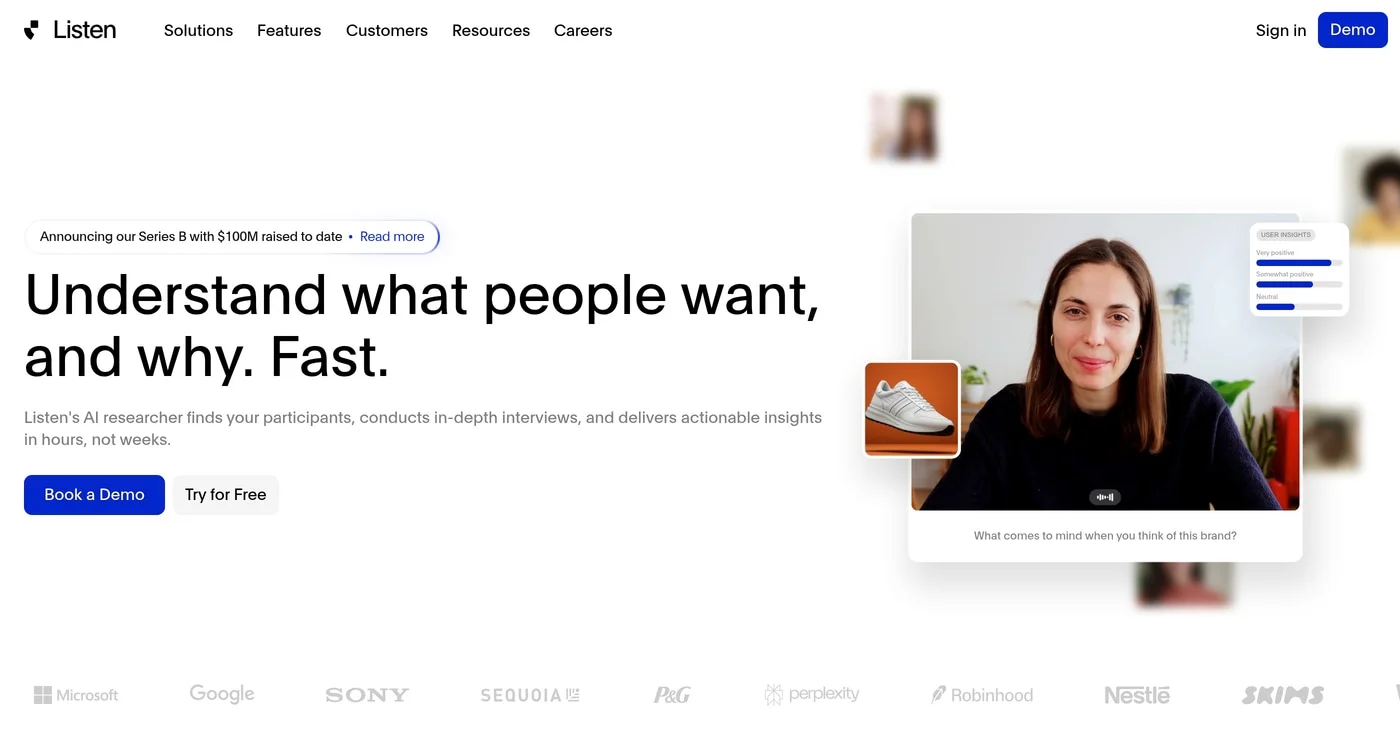
Listen Labs runs AI-moderated qualitative interviews at scale. You design the interview guide; Listen Labs' AI recruits from a 30M+ participant network, conducts the interviews, transcribes, and synthesizes findings. Traditional research firms take 4-8 weeks for the same scope; Listen Labs delivers in under 24 hours.
The business case rests on a specific claim: Listen Labs reports being 5x faster at one-third the cost of traditional qualitative research. The company's $69 million Series B (January 2026, ~$500 million valuation) with $100M+ total raised signals category maturity, and enterprise clients including Microsoft and P&G validate production-scale deployment.
Practitioners on r/Marketresearch flag a legitimate constraint. As u/Main_Flounder160 noted in r/Marketresearch (April 2026): "Works well: large-scale text analysis (NPS verbatims, open ends), transcript synthesis when you have a clear codebook going in, screener writing and pretesting. Does not work: synthetic respondents."
Listen Labs conducts real interviews with real participants; the AI moderation challenge is calibrating to emotional tone in real time the way a skilled human moderator does. For volume and breadth, Listen Labs is the clear choice. For emotionally sensitive or diagnostically complex topics, human-moderated interviews remain superior.
Best for consumer brands that need fast quantitative research with the option to go deeper qualitatively
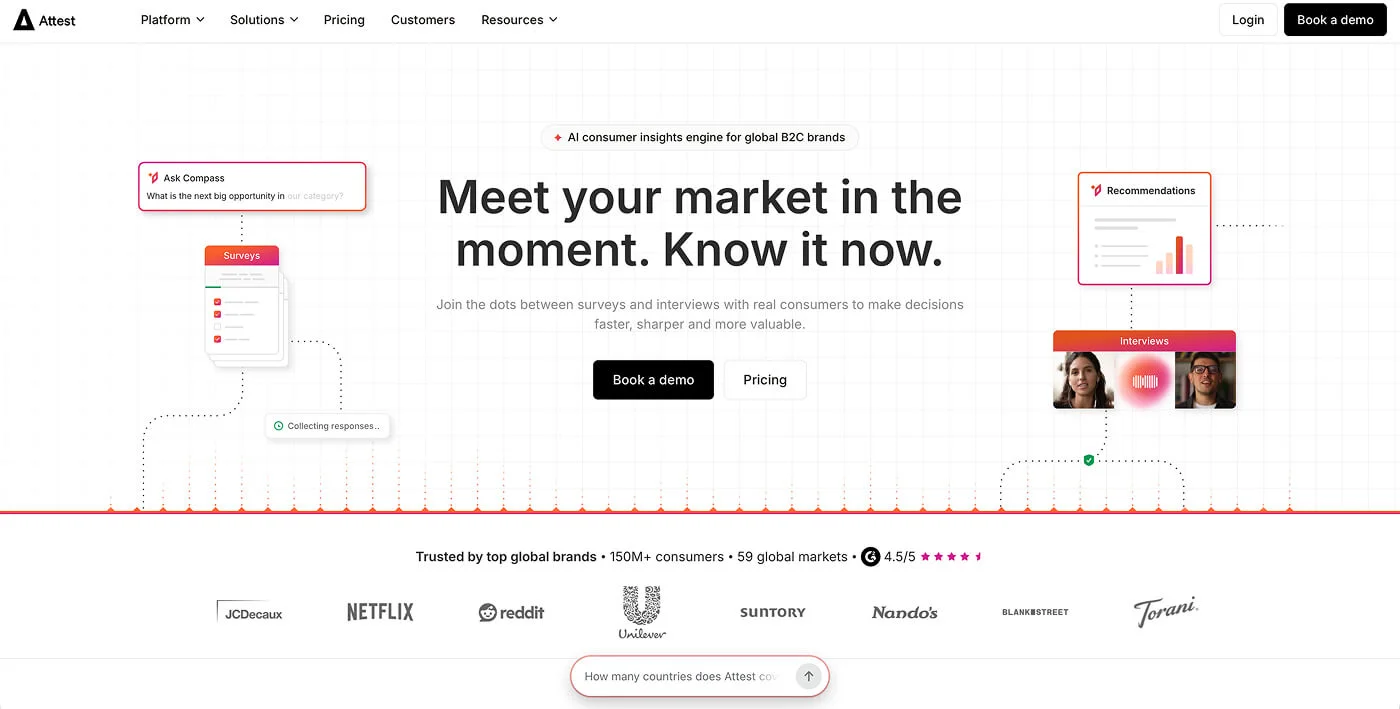
Attest is built around primary consumer research, combining quantitative surveys with newer AI-moderated interviews in the same platform. Its quantitative offering lets teams target respondents by demographics, run multi-market studies, and use their own audience or Attest's panel network.
The main differentiator is the combination of scale and research depth. Compass, Attest's AI co-pilot, can help researchers plan studies, draft and refine survey questions, analyze themes and sentiment, and turn results into findings boards. Attest Explore extends the workflow into 1:1 AI-moderated interviews, allowing teams to investigate the motivations behind quantitative results without moving to a separate qualitative platform.
Attest is particularly useful for B2C teams running concept tests, brand research, product research, or recurring consumer studies across multiple markets. Its focus is primarily consumer research, though, so it isn't designed to replace tools that provide secondary market data, search intelligence, social listening, or deeper behavioral analytics. Teams also need to account for the cost of respondent research alongside the platform itself, as pricing is based on research credits rather than a simple monthly self-serve subscription.
All plans are based on research needs and require a demo rather than displaying a fixed monthly subscription price.
Best for AI-moderated research requiring visual stimuli: concept tests, packaging, prototypes
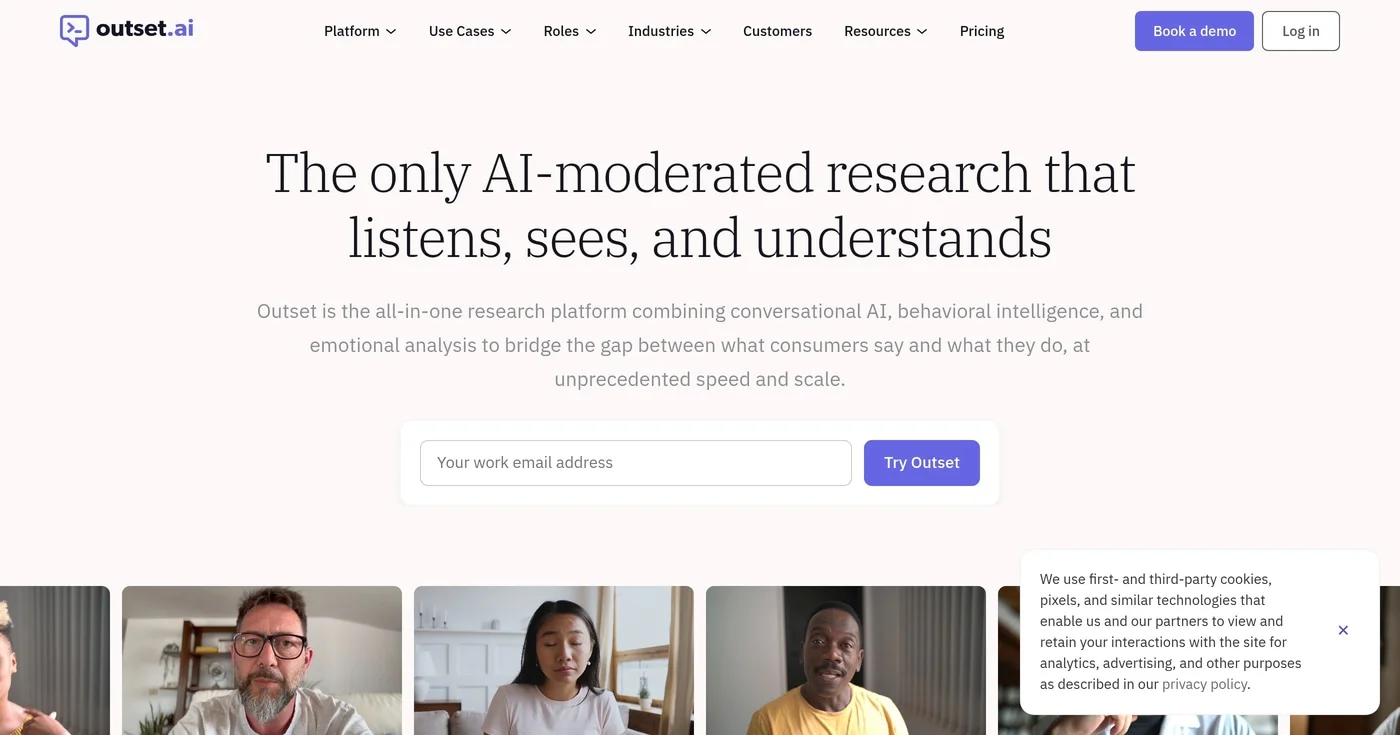
Outset covers the broadest methodology range of any AI-native qualitative research platform currently available. The Visual Intelligence suite: the first to market in its category: lets the AI moderator see screens, prototypes, and packaging in real time during interviews. That makes Outset the default choice for concept testing, packaging research, and usability studies where visual stimuli are part of the research design, not an optional extra.
The Outset Almanac published in June 2026 frames the product positioning directly: "Most tools were built for the demo. Outset was built for the job." The platform is SOC 2 Type II, GDPR, and HIPAA compliant, making it deployable in regulated industries including healthcare and financial services. Enterprise clients include Microsoft, HubSpot, Nestlé, Google, and Uber.
Outset also clarifies where the AI-native platform category fits relative to broader AI tooling. General-purpose LLMs (ChatGPT, Claude, Perplexity) handle ad-hoc synthesis and ideation but lack structured research workflows. Purpose-built research platforms like Outset handle rigor, scale, and complexity for ongoing programs.
Point solutions focus on a single task like competitive tracking or sentiment monitoring. Outset is in the second category: it replaces a traditional qualitative research vendor, not a survey tool or a search platform.
Best for fast, free AI-powered secondary research before committing to primary research
Free for basic use and $20/month for Pro with Deep Research mode, Perplexity AI is the lowest-friction AI research tool on this list. Use it to scope a market, understand a competitive landscape, or draft a research brief: then move to GWI, Listen Labs, or Qualtrics for the research that requires a real consumer signal.
Perplexity Pro's Deep Research mode chains multiple search queries and synthesizes a structured report with source citations. Deep Research mode is the fastest path to competitive intelligence mapping, market sizing, and literature reviews that would otherwise take hours of manual search across multiple sources.
One structural limitation matters before using Perplexity for research. As u/cf858 observed in r/Marketresearch (April 2026): "90% of all business research that has ever been done hasn't made its way to the open web. So the LLM training set for this is based on academic papers and published data on vendor websites: the latter being largely biased towards tools/products those vendors are trying to push."
Verify all statistics from Perplexity outputs against primary sources before including them in any client deliverable.
Best for in-house research teams running recurring automated quantitative studies
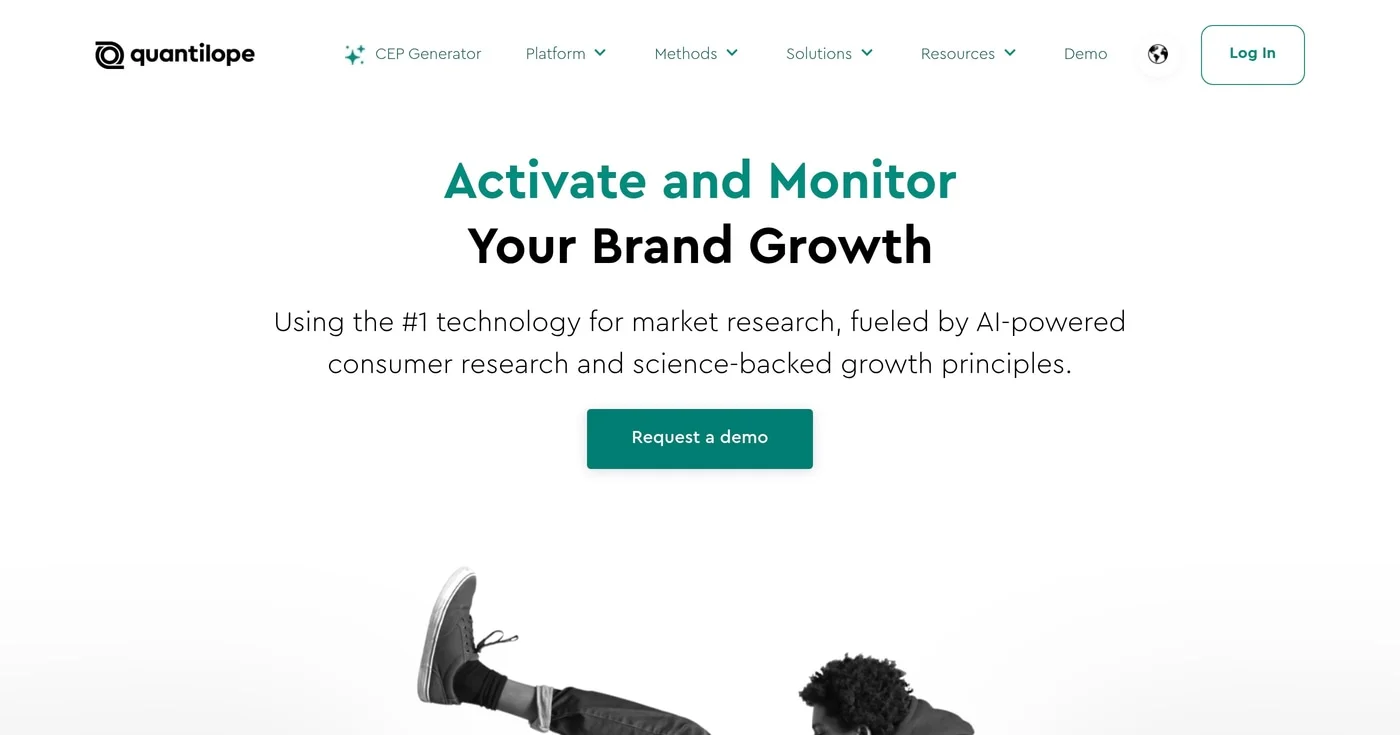
Sixteen built-in research methods and no months-long enterprise procurement process: quantilope brings agency-grade quantitative methodology to in-house teams without a custom contract. Those methods include conjoint analysis, MaxDiff (maximum difference scaling), TURF analysis, Van Westendorp pricing model, concept testing, and shopper research: the toolkit that research agencies charge significant fees to deploy.
The AI co-pilot "quinn" auto-summarizes open-ended responses, recommends research methodologies based on your stated objective, and flags statistical anomalies in real time during fieldwork. Purpose-built for in-house teams that run recurring quantitative consumer studies, quantilope is designed by and for research professionals.
At $2,000/month for three users, quantilope makes sense for in-house research teams at consumer brands, retailers, and agencies running 10+ quantitative studies per year. Teams that need a one-time study or lack internal methodology knowledge are better served by a managed-service research agency or a simpler survey tool.
All plans require purchasing respondent panel access separately. A demo is required before accessing the platform.
The research question determines the tool. SurveySensum put it clearly: "Most teams start with 'Which is the best market research tool?' But that's usually the wrong place to start. You're not choosing between 12 tools: you're choosing between different types of research workflows."
I do not know of any product that failed because the team used a sub-optimal sprint process, issue tracking tool, or North Star metric. I know of plenty of products that failed because they did not understand their customers, picked the wrong problem, or could not differentiate.
Shreyas Doshi (@shreyas, ex-Stripe and Twitter PM) made the same point: product failures come from not understanding customers, picking the wrong problem, or an inability to differentiate, not from choosing between SurveyMonkey and Typeform.
Four questions that determine the right tool category:
Budget reality: the free stack (Google Trends, AnswerThePublic, SurveyMonkey free plan, Hotjar free plan, Perplexity AI) covers desk research and initial validation without any spend. Enterprise tools (GWI, Qualtrics, Brandwatch, Listen Labs) require custom contracts and are appropriate for teams running ongoing, decision-grade research programs.
AI-native platforms (Listen Labs, Outset, quantilope) deliver 24-72 hour research cycles that traditional methods extend to 4-8 weeks. The gap between teams using these tools and teams still relying on manual surveys is no longer a marginal efficiency difference. AI-enhanced platforms (SurveyMonkey Claude Connector, Qualtrics AI panels, Brandwatch AI clustering) improve yield without changing that timeline.
Despite enterprise platforms promoting AI synthetic panels for market simulation, the practitioner consensus is cautious. u/0nin_ in r/Marketresearch (August 2025) documented consistent findings:
"I regularly conduct tests with quant data, half human and half synthetic: the synthetic falls apart when the audience is anything too far removed from gen pop... Targeting bikers in LA? Need orthopedic surgeons? Humans are SOOO nuanced."
Synthetic panels work for broad consumer markets; niche audiences require human respondents to avoid aggregate results that mask large segment-level errors.
Qualtrics' $6.75B acquisition of Forsta (closed May 2026) and Contentsquare's acquisition of Hotjar (2021) signal ongoing consolidation among experience analytics platforms. Practitioners on r/Marketresearch are watching whether Forsta's technical research capabilities survive Qualtrics integration: a meaningful evaluation factor for enterprise buyers signing multi-year contracts over the next 12-18 months.
Open Google Keyword Planner without treating setup as running ads, then read volume, competition, and the two bid columns for what those numbers are not.
ZoomInfo alternatives have no public platform list price. Apollo publishes a seat price, Cognism covers EU phones, and Lusha starts at $49.90 a month.

HubSpot's pricing jumps from $0 to $890/month with no mid-tier. These 10 HubSpot alternatives are segmented by sales CRM, email automation, and agency use case
